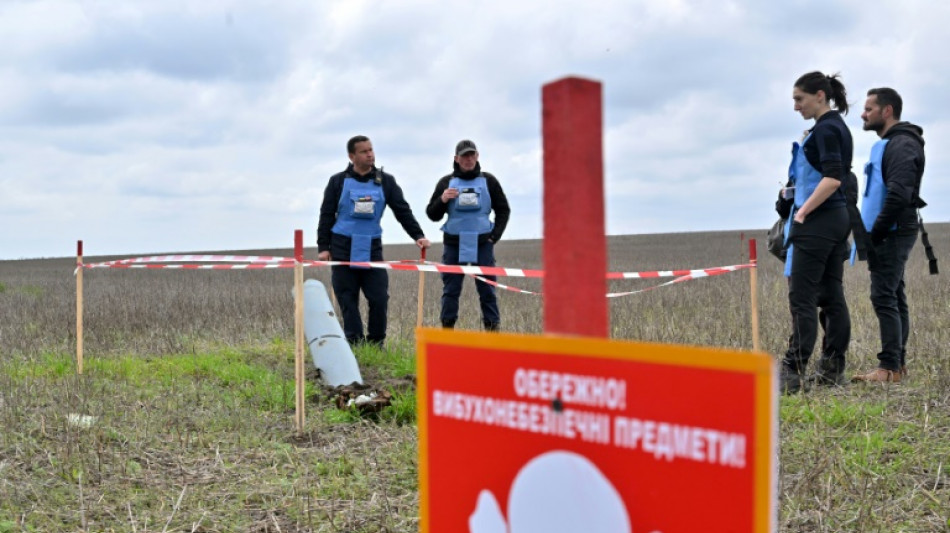
Ukraine farmer risks life clearing shells from fields / Photo: Sergei SUPINSKY - AFP

 Toogood Gold's Table Mountain Sits in the Shadow of a Nevada Gold Rush

 MEXC July–August Security Report: 38.66M USDT in Risk Funds Intercepted, Futures Insurance Fund Hits 792M USDT

 'Breathing toxin every day': Indonesians choked by haze feel helpless

 Stocks edge higher ahead of US Fed rate call

 Philippines ex-leader Duterte makes first in-person ICC appearance

 2027 Formula One calendar includes Monaco sprint race

 Palestinians are the real victims, Thunberg tells Ed Sheeran

 Hashim Thaci: From 'George Washington of Kosovo' to Hague convict

 Amnesty says Iran committed 'crimes against humanity' in crackdown on 2022 protests

 EU to ban social media for under 13s, curb access until 15

 Philippines ex-leader Duterte makes first appearance at ICC

 EU chief pitches 'associate member' status for Canada

 English village votes to 'secede' from UK over asylum centre plan

 Wildfires push endangered Sumatran elephants to brink: Indonesian NGO

 Stocks head higher as traders prepare for Fed decision

 English village votes to 'secede' from UK over asylum centre
 Hong Kong unveils plan to align economy with China's goals

 Brazilian voters the latest to eye Bukele security model with envy

 EU chief hosts Canada's Carney in push to 'deepen' alliance

 EU chief to unveil social media, gaming curbs for under-15s

 Saudi says Houthis target Mecca, warn of 'red line'

 Asian stocks stutter as traders prepare for Fed decision
 US touts its power, avoids Iran war at G20 Energy meeting

 Dead animals, barren fields, and hunger - El Nino chokes Central America

 In hydropowered Bhutan, solar starts to rise

His fields peppered with Russian shells, Ukrainian farmer Vitaliy Sydor has resorted to desperate measures to clear explosives from the land himself so he can plant crops.
"I bought metal detectors and had a bit of a look on the Internet," said Sydor, 28. He had no protective equipment, he admitted, and relies on a friend with army experience.
His village, Novogrygorivka, in Ukraine's southern Mykolaiv region, was within sight of the Russian front line and heavily bombarded from March to November last year until the Russians retreated.
The landscape is littered with splintered trees, shattered houses and burnt-out vehicles.
"Wherever you look there are holes," said Sydor, indicating the shattered outbuildings and machinery.
The house built by his father and grandfather is just a heap of rubble.
With some of Ukraine's best agricultural land, this region is crucial to the harvest, and farmers need to earn money after losing last year's crops.
International demining organisations and military and police sappers are out in force, but the area is vast and some farmers, needing to recoup huge losses, are taking clearance into their own hands.
"You can wait a long time. No one knows when they will come and demine everything," said Sydor, adding that he exchanges information online with other farmers on finding munitions.
An estimated half of Mykolaiv region's agricultural land will go unused this year "due to contamination or fear of contamination", said Jasmine Dann, regional operations manager for The HALO Trust, which is working in the region.
But Sydor's do-it-yourself approach carries "very big risks", she said.
"There is not only the risk that something will be missed but also that the mines might be booby trapped," she warned.
"Other explosives can be very unstable and explode if tampered with."
- 'It was scary' -
Anti-vehicle and -personnel landmines were planted in some areas in the Mykolaiv region, but there is also a huge amount of unexploded ordnance on the surface.
"The fields are all covered in shells, detonated and not yet detonated," Sydor said, digging up shrapnel with his boot.
He and his workers used ropes to test if a shell had exploded, he said.
"Just in case, we take a long rope, lie down and pull the projectile -- if it fires, it fires. If not, then you're lucky."
Most dangerous are the anti-personnel mines, with their plastic casings and fuses, he added.
"Everyone is afraid of the plastic ones, because the metal detector just doesn't pick them up."
On the small farm he runs with his parents, they have already sown around 100 hectares with spring barley.
"Of course it was scary. This was the first field we went over ourselves, demined ourselves," Sydor said, pointing to the green blades.
"There are mines on small parachutes, mines on cables -- we found these in two places, exploded," he added.
"There are huge amounts of pieces of rockets. Sometimes even a tractor cannot pull out a rocket, it's gone so deep into the earth."
Inside the field, there is a very deep hole surrounded with red-and-white flags, where Sydor thinks there may be an unexploded shell.
- 'Slow and methodical' -
The HALO Trust -- which famously had Princess Diana walk through a minefield -- is clearing a large field with a rusty hulk in the centre, near the village of Yevgenivka, an area occupied by the Russians.
A Ukrainian helicopter in March 2022 fired on a truck in the field carrying Russian ammunition.
Explosives including rocket-propelled grenades and hand grenades, flew out over 100 metres in every direction, some exploding, some not.
Two teams slowly walked across the field in formation, swinging detectors and going over every section twice.
This is termed a "battle area clearance task", Dann said.
The land is rented by a large agrifirm, which hopes to plant coriander, flax, millet and sunflowers this year.
"We're like ants. They destroy us and we build everything back," said the firm's director, Vadym Belyk.
The HALO Trust gives a guarantee that after its work, people can use the area freely.
This way is "slow, methodical", said Dann.
"We'll find everything possible."
Ukraine currently does not permit NGOs to use explosives to destroy munitions in situ. That slows down the process, since HALO must call in army help.
Dann acknowledged that the farmers were impatient to sow.
"For us now agricultural land is the number one priority," she said.
"You spoke to the farmer here: he's going to use this land right now."
Sydor said he was happy with his spring barley and hoped to sow sunflowers soon.
"In 10 days or so you won't be able to see the earth, it will be covered in green."
W.Nelson--AT