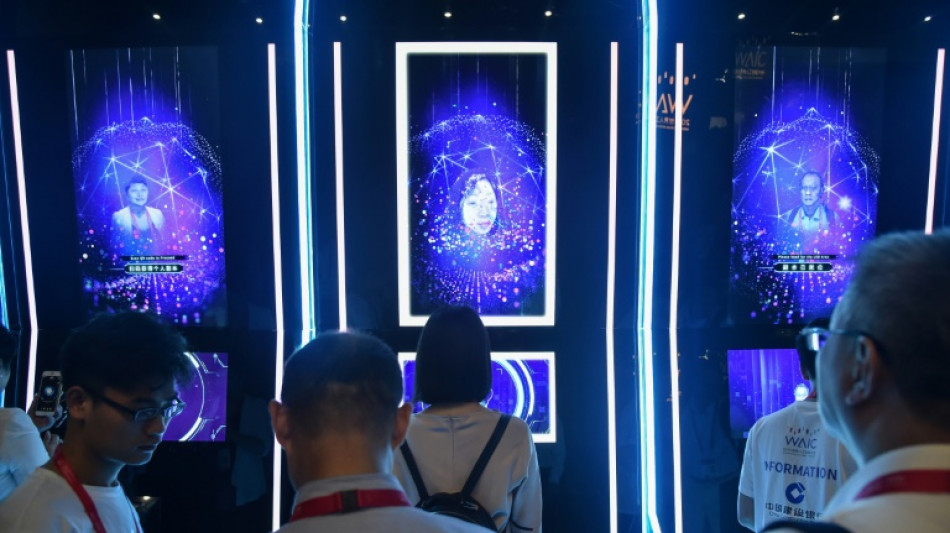
China to require 'security assessment' for new AI products / Photo: HECTOR RETAMAL - AFP/File

 Toogood Gold's Table Mountain Sits in the Shadow of a Nevada Gold Rush

 MEXC July–August Security Report: 38.66M USDT in Risk Funds Intercepted, Futures Insurance Fund Hits 792M USDT

 'Breathing toxin every day': Indonesians choked by haze feel helpless
 Stocks edge higher ahead of US Fed rate call

 Philippines ex-leader Duterte makes first in-person ICC appearance

 2027 Formula One calendar includes Monaco sprint race

 Palestinians are the real victims, Thunberg tells Ed Sheeran

 Hashim Thaci: From 'George Washington of Kosovo' to Hague convict

 Amnesty says Iran committed 'crimes against humanity' in crackdown on 2022 protests

 EU to ban social media for under 13s, curb access until 15

 Philippines ex-leader Duterte makes first appearance at ICC
 EU chief pitches 'associate member' status for Canada

 English village votes to 'secede' from UK over asylum centre plan

 Wildfires push endangered Sumatran elephants to brink: Indonesian NGO

 Stocks head higher as traders prepare for Fed decision

 English village votes to 'secede' from UK over asylum centre

 Hong Kong unveils plan to align economy with China's goals

 Brazilian voters the latest to eye Bukele security model with envy

 EU chief hosts Canada's Carney in push to 'deepen' alliance
 EU chief to unveil social media, gaming curbs for under-15s
 Saudi says Houthis target Mecca, warn of 'red line'

 Asian stocks stutter as traders prepare for Fed decision
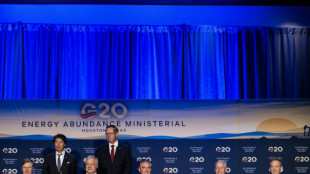 US touts its power, avoids Iran war at G20 Energy meeting

 Dead animals, barren fields, and hunger - El Nino chokes Central America
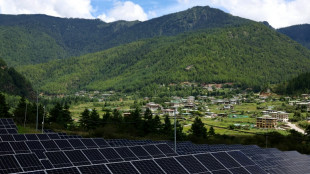 In hydropowered Bhutan, solar starts to rise

New AI products developed in China will have to undergo a security assessment before being released and must reflect "core socialist values", a sweeping new draft law by the country's internet regulator showed Tuesday.
The fresh regulations come as a flurry of Chinese companies rush to develop artificial intelligence services that can mimic human speech since San Francisco-based OpenAI launched ChatGPT in November, sparking a gold rush in the market.
Rapid advancements in AI have stoked global alarm over the technology's potential for disinformation and misuse, with deepfake images and people shown mouthing things they never said.
"Before providing services to the public that use generative AI products, a security assessment shall be applied for through national internet regulatory departments," the draft law, released by the Cyberspace Administration of China, reads.
The draft law -- dubbed "Administrative Measures for Generative Artificial Intelligence Services" -- aims to ensure "the healthy development and standardised application of generative AI technology", it read.
AI-generated content, it continued, needs to "reflect core socialist values, and must not contain content on subversion of state power".
It must also not contain, among other things, "terrorist or extremist propaganda", "ethnic hatred" or "other content that may disrupt economic and social order."
The Cyberspace Administration of China said it was seeking public input on the contents of the new regulations, which under Beijing's highly centralised political system are almost certain to become law.
- 'Strictest so far' -
"The new CAC draft document is one of the strictest measures for generative AI so far," Andy Chun, adjunct professor at City University of Hong Kong, told AFP.
Companies submitting security assessments will need to "be very careful to ensure each data source used for AI learning must be within guidelines, accurate, unbiased, and not infringe on IP rights of others," he said.
"Ensuring accuracy is hard. No generative AI system to date can do that," said Chun.
The regulatory crackdown comes as China's tech giants ramp up their efforts in the closely-watched sector.
Alibaba's cloud computing unit on Tuesday unveiled its own product called Tongyi Qianwen, which is expected to be rolled out across the tech giant's office workplace communications software and household appliances.
CEO Daniel Zhang said in a statement that the software came in a "technological watershed moment driven by generative AI and cloud computing".
And Baidu -- which operates the country's leading search engine -- released its own "Ernie Bot" AI chat product last month.
But investors were unimpressed by the bot's display of linguistic and maths skills at an unveiling, sending shares falling by as much as 10 percent.
ChatGPT is unavailable in China, but the American software is also gaining a base of Chinese users who use virtual private networks to get around the ban, deploying it to write essays and cram for exams.
And a 24-year-old Shanghai blogger caused a stir this month when he used AI technology to "resurrect" his dead grandmother, producing lifelike imagery of his interactions with the deceased relative.
Beijing has announced ambitious plans to become a global leader in the field of AI by 2030, and consultancy group McKinsey estimates the sector could add about $600 billion every year to China's gross domestic product by then.
But it has also warned that deepfakes present a "danger to national security and social stability".
Beijing in January enforced new rules that would require businesses offering deepfake services to obtain the real identities of their users. They also require deepfake content to be appropriately tagged to avoid "any confusion".
R.Garcia--AT