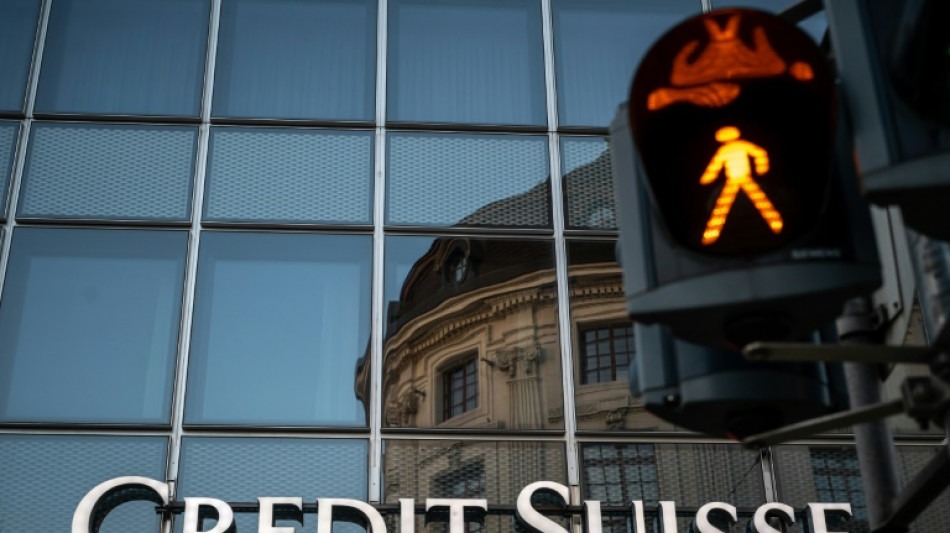
Bank takeover prevented Swiss economy collapse: minister / Photo: Fabrice COFFRINI - AFP/File

 British PM says to make 'difficult decisions' as inflation rises

 TotalEnergies pumps up controversy in France with cut-price gas

 Global fuel price demos: a round-up

 Leverate Launches MCP for Traders to Connect AI Assistants With Trading Platforms

 MEXC Launches $1M "Discover Your Wall Street DNA" Campaign to Help Traders Find Their Market Fit

 Emporio Armani names Dario Vitale new creative director
 Maresca defends VAR officials after Man City benefit from error

 Courts jails LGBTQ activists as Turkey crackdown widens

 French court to hear Depardieu's appeal against rape trial order: sources

 The German state premier hoping to halt far-right surge

 Lebanon wants Israel security deal as prelude to peace: president to AFP

 England's Brook keen to learn from 'hero' Pietersen after stunning ton

 Saudi says Houthis target Mecca, warns of 'red line'

 Phillippines ex-leader Duterte makes first appearance at ICC

 Lebanon wants Israel security deal, Hezbollah disarmament without confrontation: president to AFP

 BASIS.pro Expands On-Chain Infrastructure with XDC Network Partnership and Zypher DAO as Auto Earn Goes Live

 Samson relishing battle with teen star Sooryavanshi for India spot
 Pickle-flavoured tart? AI inspires Japan's convenience stores

 Macau holds first closed-door national security trial

 Bank of Japan set to raise rates under pressure from inflation, US

 Zverev, Shelton back on court for Davis Cup qualifiers

 Peace is a 'dangerous' word in Russian city heading to polls

 Meta chief pushes back on AI slowdown calls

 'Resident Evil' film brings video game's ethos to the big screen
 Court orders N. Korea pay Seoul $32.5 mn for blowing up office

Swiss Finance Minister Karin Keller-Sutter said Switzerland's economy would probably have collapsed had Credit Suisse gone bankrupt, in an interview published Sunday.
Keller-Sutter told Le Temps newspaper that the government had acted in the country's best interests in swiftly arranging the takeover of Switzerland's second-biggest bank by its larger domestic rival UBS.
Amid fears of a global banking crisis last month, investor confidence in Credit Suisse collapsed on March 15, with the government then orchestrating a takeover during the weekend before the markets reopened on March 20.
Some 109 billion Swiss francs ($120 billion) have been put on the table between government guarantees and the liquidity made available by the Swiss central bank.
"Given the circumstances, we acted as best we could to minimise the burden for the state and the taxpayers," Keller-Sutter said.
"Without determined intervention by the authorities, the alternative would have been a bankruptcy of Credit Suisse on Monday morning, accompanied by a probable collapse of the Swiss economy."
Like UBS, Credit Suisse was among the 30 banks worldwide deemed of global importance to the international banking system and therefore too big to fail.
But it suffered a string of scandals in recent years, and after three US regional banks collapsed in March, it was left looking like the weakest link in the chain.
- Double-quick deal -
The takeover talks were hastily conducted at Keller-Sutter's finance ministry in Bern and the $3.25 billion deal was announced on the evening of March 19.
"The bank would have gone bankrupt on Monday, March 20. For what? Because over the years there has been a culture that seems to have created the wrong incentives. Because there have been many scandals," said Keller-Sutter.
As for whether any executives would be brought to justice, she said: "It's difficult and complex."
She said the government's priority was to complete the merger. UBS said Wednesday it should close the takeover within the coming months.
The finance minister said it was too soon to talk about the future structure of UBS, which will become a mega-bank with some $5 trillion in invested assets.
Keller-Sutter said the government would have to analyse what happened in full, and then adapt the regulations on banks considered too big to fail.
"But there are limits. Let's not forget that... confidence cannot be regulated."
T.Sanchez--AT