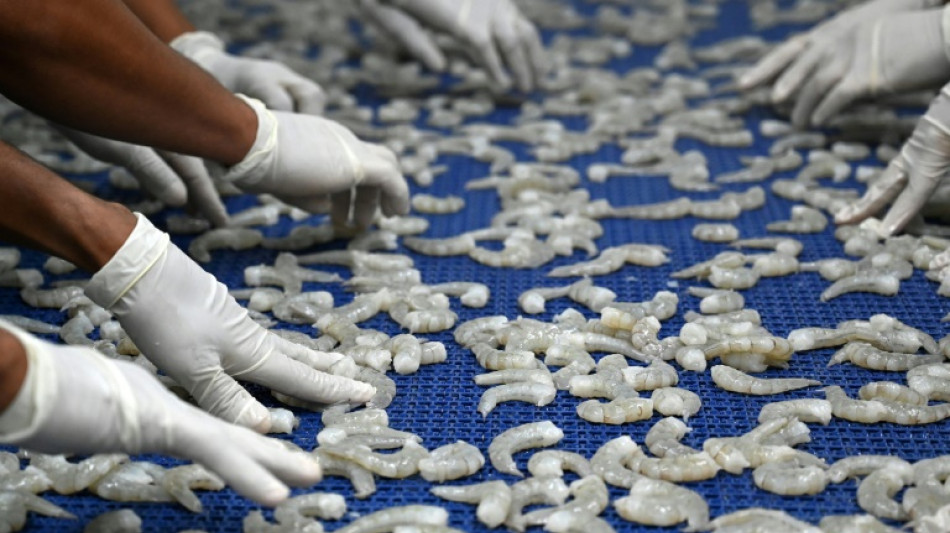
Honduras shrimp industry worried by diplomatic break with Taiwan / Photo: Orlando SIERRA - AFP

 British PM says to make 'difficult decisions' as inflation rises

 TotalEnergies pumps up controversy in France with cut-price gas

 Global fuel price demos: a round-up

 Leverate Launches MCP for Traders to Connect AI Assistants With Trading Platforms

 MEXC Launches $1M "Discover Your Wall Street DNA" Campaign to Help Traders Find Their Market Fit
 Emporio Armani names Dario Vitale new creative director
 Maresca defends VAR officials after Man City benefit from error

 Courts jails LGBTQ activists as Turkey crackdown widens

 French court to hear Depardieu's appeal against rape trial order: sources

 The German state premier hoping to halt far-right surge
 Lebanon wants Israel security deal as prelude to peace: president to AFP

 England's Brook keen to learn from 'hero' Pietersen after stunning ton

 Saudi says Houthis target Mecca, warns of 'red line'

 Phillippines ex-leader Duterte makes first appearance at ICC
 Lebanon wants Israel security deal, Hezbollah disarmament without confrontation: president to AFP

 BASIS.pro Expands On-Chain Infrastructure with XDC Network Partnership and Zypher DAO as Auto Earn Goes Live
 Samson relishing battle with teen star Sooryavanshi for India spot
 Pickle-flavoured tart? AI inspires Japan's convenience stores

 Macau holds first closed-door national security trial
 Bank of Japan set to raise rates under pressure from inflation, US
 Zverev, Shelton back on court for Davis Cup qualifiers
 Peace is a 'dangerous' word in Russian city heading to polls

 Meta chief pushes back on AI slowdown calls

 'Resident Evil' film brings video game's ethos to the big screen
 Court orders N. Korea pay Seoul $32.5 mn for blowing up office

On the Pacific coast of Honduras, thousands of people working in the shrimp farming industry are worried about their futures following the government's decision to break diplomatic ties with their largest export market: Taiwan.
"We don't want them to stop business with Taiwan," Lorena de Jesus Zelaya, 51, who works in a shrimp packing plant, said to AFP.
Along with another 800 women, she works in a warehouse in Choluteca, around 85 kilometers (50 miles) south of the capital Tegucigalpa, where frozen shrimp is packaged and sent in refrigerated containers to Taiwan, Mexico and Europe.
Wearing a hat, apron and rubber shoes, Zelaya told AFP she has worked in the shrimp industry for 31 years.
Leftist President Xiomara Castro announced last month that she was breaking off diplomatic relations with Taiwan and signing on with China instead.
Shrimp workers fear that move could jeopardize the free-trade agreement between Honduras and Taiwan, signed in 2008, on which their livelihoods largely depend.
"For Honduras, as a shrimp producer, losing the Taiwanese market is a very difficult situation in terms of price levels," businessman Yader Rodriguez, 46, told AFP.
"Taiwan is a high-value market where our shrimp can sell at almost twice the price of the Chinese market."
Although the Chinese economy is 12 times larger than Taiwan's, "we're very worried about what this political decision will bring," he added.
Rodriguez said shrimp exports are worth about $100 million a year.
Although Taiwan is a self-ruled democratic island, China claims it as part of its territory to be integrated into the nation one day, by force if necessary.
Beijing refuses to have diplomatic relations with countries that recognize Taipei.
Castro's move followed in the footsteps of several other Latin American countries in recent years, including Nicaragua, El Salvador, Panama, Costa Rica and the Dominican Republic.
It leaves Taiwan with only 13 diplomatic allies, including Guatemala and Belize, which President Tsai Ing-wan visited last week.
- Government 'open to listening' -
The shrimp are farmed in huge artificial ponds using seawater from the nearby Gulf of Fonseca.
Since it launched in the 1970s, shrimp farming exploded in Honduras, with 324 farms covering an area of 24,500 hectares (60,000 acres).
Around 23,000 people are directly employed in the industry, but that figure rises to 150,000 when including those indirectly dependent on shrimp farming.
The National Aquaculturists Association of Honduras (ANDAH) has expressed its concerns in several meetings with authorities.
They fear Taiwan could simply refuse to buy shrimp from the Central American nation and have asked the government to write to Taiwan requesting the continuation of trade relations despite the diplomatic rupture.
"The government is open to listening and looking for solutions," said ANDAH president Juan Carlos Javier, adding that more than a third of shrimp export revenue last year came from Taiwan.
While the government has said nothing about its trade agreement with Taiwan, many people are deeply concerned about the ramifications of ending diplomatic cooperation.
"All the families are worried ... about this (trade) agreement they want to break," Carlos Abrego, 28, who works for a shrimp company, told AFP.
"We are really are very worried because here where we live, it's very serious to lose your job or to take a pay cut," added laborer Pedro Antonio Martinez, 34.
Shrimp is the fifth largest export for Honduras after coffee, bananas, sugar and palm oil.
Last year, the country's exports were worth $6.1 billion, with $130 million of that coming from Taiwan.
O.Brown--AT