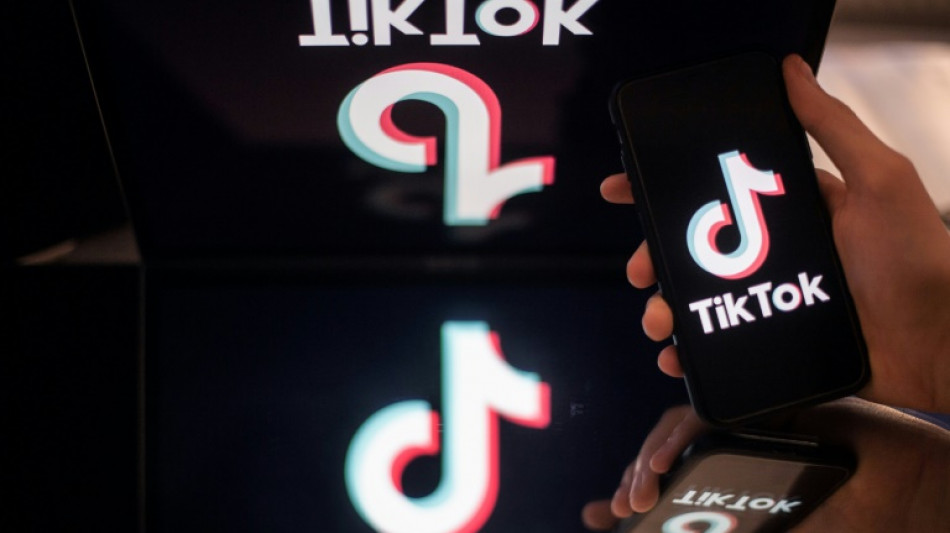
Australia bans TikTok on government devices / Photo: LOIC VENANCE - AFP/File

 British PM says to make 'difficult decisions' as inflation rises

 TotalEnergies pumps up controversy in France with cut-price gas

 Global fuel price demos: a round-up

 Leverate Launches MCP for Traders to Connect AI Assistants With Trading Platforms

 MEXC Launches $1M "Discover Your Wall Street DNA" Campaign to Help Traders Find Their Market Fit

 Emporio Armani names Dario Vitale new creative director
 Maresca defends VAR officials after Man City benefit from error

 Courts jails LGBTQ activists as Turkey crackdown widens

 French court to hear Depardieu's appeal against rape trial order: sources

 The German state premier hoping to halt far-right surge

 Lebanon wants Israel security deal as prelude to peace: president to AFP

 England's Brook keen to learn from 'hero' Pietersen after stunning ton
 Saudi says Houthis target Mecca, warns of 'red line'

 Phillippines ex-leader Duterte makes first appearance at ICC
 Lebanon wants Israel security deal, Hezbollah disarmament without confrontation: president to AFP

 BASIS.pro Expands On-Chain Infrastructure with XDC Network Partnership and Zypher DAO as Auto Earn Goes Live

 Samson relishing battle with teen star Sooryavanshi for India spot
 Pickle-flavoured tart? AI inspires Japan's convenience stores

 Macau holds first closed-door national security trial
 Bank of Japan set to raise rates under pressure from inflation, US

 Zverev, Shelton back on court for Davis Cup qualifiers
 Peace is a 'dangerous' word in Russian city heading to polls

 Meta chief pushes back on AI slowdown calls

 'Resident Evil' film brings video game's ethos to the big screen
 Court orders N. Korea pay Seoul $32.5 mn for blowing up office

Australia said Tuesday it will ban TikTok on government devices, joining a growing list of Western nations cracking down on the Chinese-owned app due to national security fears.
Attorney-General Mark Dreyfus said the decision followed advice from the country's intelligence agencies and would begin "as soon as practicable".
Australia is the last member of the secretive Five Eyes security alliance to pursue a government TikTok ban, joining its allies the United States, Britain, Canada and New Zealand.
France, the Netherlands and the European Commission have made similar moves.
Dreyfus said the government would approve some exemptions on a "case-by-case basis" with "appropriate security mitigations in place".
Cyber security experts have warned that the app -- which boasts more than one billion users -- could be used to hoover up data that is then shared with the Chinese government.
Fergus Ryan, an analyst with the Australian Strategic Policy Institute, said stripping TikTok from government devices was a "no-brainer".
"It's been clear for years that TikTok user data is accessible in China," Ryan told AFP.
"Banning the use of the app on government phones is a prudent decision given this fact."
Ryan said Beijing would likely "perceive it as unfair treatment of and discrimination against a Chinese company".
The security concerns are underpinned by a 2017 Chinese law that requires local firms to hand over personal data to the state if it is relevant to national security.
Beijing has denied these reforms pose a threat to ordinary users.
China "has never and will not require companies or individuals to collect or provide data located in a foreign country, in a way that violates local law", foreign ministry spokesperson Mao Ning said in March.
- 'Rooted in xenophobia' -
TikTok has said such bans were "rooted in xenophobia", while insisting that it is not owned or operated by the Chinese government.
The company's Australian spokesman Lee Hunter said it "would never" give data to the Chinese government.
"No one is working harder to make sure this would never be a possibility," he told Australia's Channel Seven.
But the firm acknowledged in November that some employees in China could access European user data, and in December it said employees had used the data to spy on journalists.
The app is used to share short, lighthearted videos and has exploded in popularity in recent years.
Many government departments were initially eager to use TikTok as a way to connect with a younger demographic that is harder to reach through traditional media channels.
New Zealand banned TikTok from government devices in March, saying the risks were "not acceptable in the current New Zealand Parliamentary environment".
Earlier this year, the Australian government announced it would be stripping Chinese-made CCTV cameras from politicians' offices due to security concerns.
R.Chavez--AT