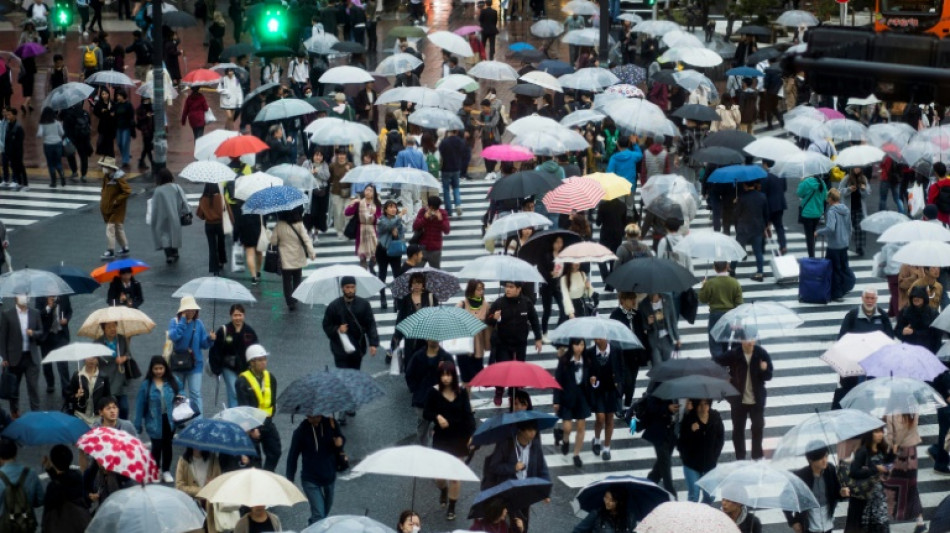
'Don't blame women': Japan birth drive sparks online debate / Photo: Odd ANDERSEN - AFP/File

 Fitzpatrick 'not comfortable' over Dubai golf finale

 Gaza apartment block collapse kills 21, including 12 children

 Gaza apartment block collapse leaves 21 dead

 US House targets data centers as midterm backlash grows

 French ex-minister Dati goes on trial in Renault-Nissan corruption case

 'Being Heumann' captures joy in fight for disability rights

 Retired great Nadal to play in exhibition matches

 IR-MED and Dice Technologies Announce collaboration to Evaluate and Advance Pressure-Injury Prevention Platform in Japan

 Watts, Pitt, Cruz to light up Spain's top film festival

 Sweden expels Iran embassy employee over anti-Jewish threats

 Toogood Gold's Table Mountain Sits in the Shadow of a Nevada Gold Rush

 MEXC July–August Security Report: 38.66M USDT in Risk Funds Intercepted, Futures Insurance Fund Hits 792M USDT

 'Breathing toxin every day': Indonesians choked by haze feel helpless

 Stocks edge higher ahead of US Fed rate call

 Philippines ex-leader Duterte makes first in-person ICC appearance

 2027 Formula One calendar includes Monaco sprint race

 Palestinians are the real victims, Thunberg tells Ed Sheeran

 Hashim Thaci: From 'George Washington of Kosovo' to Hague convict

 Amnesty says Iran committed 'crimes against humanity' in crackdown on 2022 protests

 EU to ban social media for under 13s, curb access until 15

 Philippines ex-leader Duterte makes first appearance at ICC

 EU chief pitches 'associate member' status for Canada

 English village votes to 'secede' from UK over asylum centre plan

 Wildfires push endangered Sumatran elephants to brink: Indonesian NGO

 Stocks head higher as traders prepare for Fed decision

Japan's government has made tackling its falling birth rate a top priority, but with few women involved in official debate on the issue, some are making themselves heard on social media.
Japan recorded fewer than 800,000 births last year, the lowest in the country of 125 million since records began.
The prime minister has warned the trend threatens "whether we can continue to function as a society", and fresh focus on the issue has sparked countless articles.
But one in particular, noting Japan has the highest ratio in the OECD of women aged 50 who have never had children, triggered an outpouring of responses using the hashtag "life-long childlessness".
Tomoko Okada had long felt "ashamed" about not having children and hesitated to click on the trending topic on Twitter initially, fearing the usual barrage of criticism.
Instead, she found mostly sympathetic and nuanced discussions, with women explaining why they had been unable to start a family or, in some cases, why they had chosen not to.
"I used to strongly believe that giving birth was the 'normal' thing to do," the 47-year-old freelance writer told AFP.
She tried matchmaking services hoping to find a partner, with no luck, and was left feeling guilty when her dad asked for a grandchild for Father's Day.
But posting her experiences and reading those of others helped her feel "my way of life is also OK".
- 'So much criticism' -
While many developed countries are struggling with low birth rates, the problem is particularly acute in Japan.
It has the world's second-oldest population after Monaco, and its relatively strict immigration rules mean it faces growing labour shortages.
Prime Minister Fumio Kishida has vowed policies including financial aid for families, easier childcare access and more parental leave.
But with female lawmakers accounting for fewer than 10 percent of Japan's powerful lower house, and Kishida's 19-minister cabinet including just two women, most of those involved in the debate are men.
That has left some women feeling sidelined, or even under attack.
"Don't blame women for the low birth rate," tweeted Ayako, a 38-year-old Tokyo resident without children, who used the hashtag to call for recognition of "various choices" in life.
She told AFP that Japan's traditional gender roles are central to the problem.
A 2021 government survey found that Japanese women spend around four times as long on chores and childcare as men, even with more husbands working from home.
Ayako is outspoken online, but said she finds herself "shunned" when she speaks about gender-related issues in real life, and preferred not to give her surname.
"It's hard to raise your voice in the real world. I feel like women receive so much criticism just for expressing their opinions," she said.
On social media, however, "I'm often surprised to find other people with the same views."
- 'Echo chambers' -
Yuiko Fujita, a media and gender studies professor at Meiji University, said social media has become a way for women in particular to discuss political and societal issues with less fear, often anonymously.
Other birthrate-related hashtags, railing against mothers being "single-operator childcare services" or lamenting rejected nursery applications, have also gone viral.
But the outpouring has limited impact outside the "echo chambers" online, warned Fujita.
"Unfortunately... not many of these voices make it beyond the community of women to reach the political arena."
Experts believe the declining birth rate is a complex problem with numerous roots.
Just 2.4 percent of births in Japan are outside of marriage, the lowest among the OECD group of 38 countries -- a figure often attributed to conservative norms and financial structures that favour families.
Some point to economics, arguing the country's long-stagnant growth discourages couples from having babies.
Policy changes such as expanding daycare provision can help boost birth rates, but the increase is often "temporary", said Takumi Fujinami of the Japan Research Institute.
As well as equality when it comes to household chores, he said, "long-term economic stability and rising incomes are key."
T.Sanchez--AT