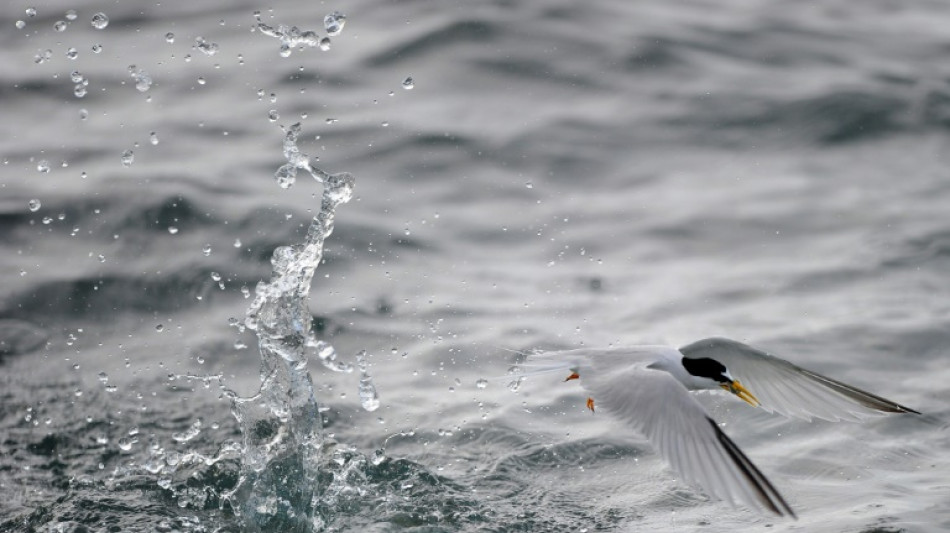
Microplastic pollution impairs seabird gut health / Photo: JEWEL SAMAD - AFP/File

 Fitzpatrick 'not comfortable' over Dubai golf finale

 Gaza apartment block collapse kills 21, including 12 children

 Gaza apartment block collapse leaves 21 dead

 US House targets data centers as midterm backlash grows

 French ex-minister Dati goes on trial in Renault-Nissan corruption case

 'Being Heumann' captures joy in fight for disability rights

 Retired great Nadal to play in exhibition matches

 IR-MED and Dice Technologies Announce collaboration to Evaluate and Advance Pressure-Injury Prevention Platform in Japan

 Watts, Pitt, Cruz to light up Spain's top film festival

 Sweden expels Iran embassy employee over anti-Jewish threats

 Toogood Gold's Table Mountain Sits in the Shadow of a Nevada Gold Rush

 MEXC July–August Security Report: 38.66M USDT in Risk Funds Intercepted, Futures Insurance Fund Hits 792M USDT

 'Breathing toxin every day': Indonesians choked by haze feel helpless

 Stocks edge higher ahead of US Fed rate call

 Philippines ex-leader Duterte makes first in-person ICC appearance

 2027 Formula One calendar includes Monaco sprint race

 Palestinians are the real victims, Thunberg tells Ed Sheeran

 Hashim Thaci: From 'George Washington of Kosovo' to Hague convict

 Amnesty says Iran committed 'crimes against humanity' in crackdown on 2022 protests

 EU to ban social media for under 13s, curb access until 15

 Philippines ex-leader Duterte makes first appearance at ICC

 EU chief pitches 'associate member' status for Canada

 English village votes to 'secede' from UK over asylum centre plan

 Wildfires push endangered Sumatran elephants to brink: Indonesian NGO

 Stocks head higher as traders prepare for Fed decision

Scientists have long known that wild seabirds ingest bits of plastic pollution as they feed, but a study Monday shows the tiny particles don't just clog or transit the stomach but can subvert its complex mix of good and bad bacteria too.
Plastic-infested digestive tracks from two species of Atlantic seabirds, northern fulmars and Cory's shearwaters, showed a decrease of mostly beneficial "indigenous" bacteria and more potentially harmful pathogens.
There was also an increase in antibiotic-resistant and plastic-degrading microbes, researchers reported in the journal Nature Ecology & Evolution.
Certain types of microplastic, the findings suggested, may be leeching chemicals that disrupt the birds' so-called gut microbiome.
Microplastics -- produced when plastic products break down in the environment -- are directly and indirectly ingested across most animal food chains.
They can be found in every corner of the world, from the deepest oceans trenches to top of Mount Everest.
In humans, they have been detected in the blood, breast milk and placentas.
The new study supports previous findings that prolonged ingestion of microplastics causes an imbalance of healthy and unhealthy bacteria in the stomach, a condition known as gut dysbiosis.
The implications are far-reaching.
Like humans, birds have evolved with a vast network of microbes, including bacteria, that live in our bodies in communities called microbiomes.
Some microbes cause diseases, but most exist as "friendly" bacteria with a critical role in digestion, immune response and other critical functions.
"There's a symbiosis that goes on -- and that's the case in the seabirds as well as in humans," lead author Gloria Fackelmann of Ulm University in Germany told AFP.
Little is known about the effects of individual microbes on the body.
But overall, a growing body of research points to the harmful impacts of microplastics on animal health.
The tiny particles -- less than five millimetres in diameter -- can cause cell death and allergic reactions in humans.
Chemicals in microplastics have also been linked to increased risks of cancer, reproductive problems, and DNA mutations.
The authors hope the findings in seabirds will spur related studies for humans.
"If this manmade substance could alter our microbiome, I think that should make people think," said Fackelmann.
A.O.Scott--AT