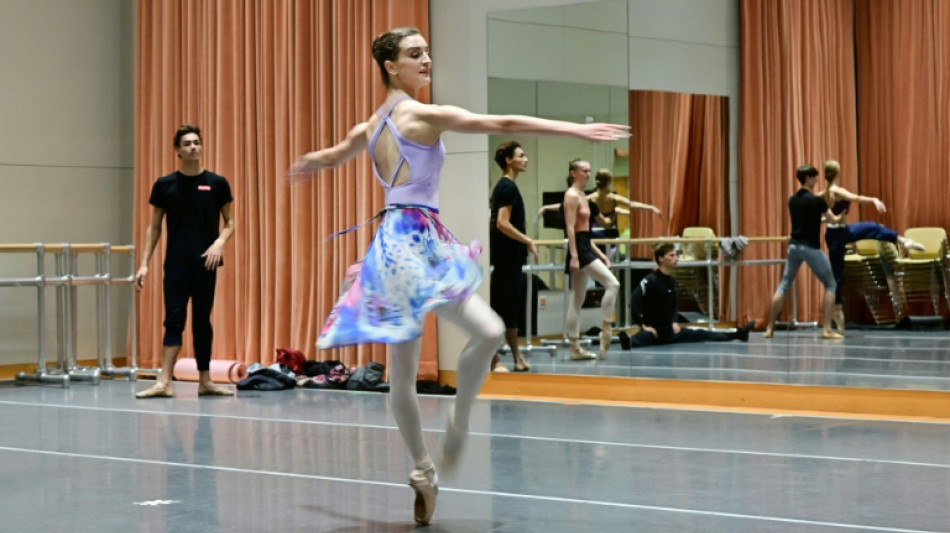
Ballet stars who fled Russia's Ukraine war reunite in US / Photo: Frederic J. BROWN - AFP

 Springboks recall 'outstanding' Papier for Nations Championship

 Bezzecchi out of Czech MotoGP after slapping steward

 FIFA draws criticism as Infantino clocks up air miles at World Cup
 Japan stroll to victory over Tunisia in World Cup's 1,000th game

 Trump blames 'terrible vandals' for Washington pool renovation woes

 Man charged over suspected anti-Muslim attacks in Edinburgh
 Britain's King Charles to reveal personal tax bill: reports

 Fly-half Love ready for All Blacks start after Super Rugby heroics
 Saudis seek to repeat Argentina World Cup 'miracle' against Spain

 Nagelsmann says Germany has higher ambitions than advancing to knockout stage
 US and Iran set for new talks after delay and deadly strikes

 Germany into World Cup last 32 after late comeback, Dutch thrash Sweden

 Albanian protests against Trump-linked resort swell

 Burn dons cowboy boots as England unwind at World Cup

 France's Saliba says playing through the pain at World Cup
 Counter-terror cops probe suspected anti-Muslim 'attacks' in Edinburgh

 Clark begins with bogey as McIlroy charges at US Open
 Specter of military escalation hangs over Colombia vote

 Jamieson strikes as New Zealand eye series-levelling win despite Root heroics
 Netherlands thump Sweden in Houston to get World Cup liftoff

 Jamieson strikes as New Zealand eye series-levelling win against England

 Ronaldinho coming out of retirement to join Italian 3rd division side

 Real Madrid say no contact with Bayern's Olise

 Heartbreak for Japanese ace Satono Reve as Almeraq wins Royal Ascot thriller

 Injured Doris out of Ireland's Nations Championship squad

Joy Womack built herself a fairytale life in Russia's notoriously tough world of classical dance after becoming the first American to graduate from the Bolshoi Ballet Academy.
But a career that inspired a Hollywood film exploded as Moscow's first bombs rained down on Ukraine, and she became one of dozens of dancers who fled Vladimir Putin's war.
"I mourned because it was the end of knowing what was next. And for me, it felt almost in some ways like the end of my career," Womack told AFP in California.
As Russian troops rolled into Ukraine in February, the Texan was in Poland choreographing "Joika."
The film, starring Diane Kruger, tells the story of Womack's life: from arrival in Moscow at the age of 15, not speaking a word of Russian, to a lead role in the Kremlin Ballet.
Womack knew at that moment that she could not return to Russia, and must leave behind her belongings, her friends and the years of sacrifice that had helped her to succeed in one of the world's most competitive ballet environments.
"I was building a future in Russia. I was trying to walk both lines being a ballerina from America, but also working in Russia.
"And my career and my education in Russia led to an international career in the West. So for me, it's really hard to say goodbye to that chapter," she says, pulling off her shoes to reveal feet scarred by her trade.
- 'Fear and sadness' -
Dozens of foreign and domestic dancers had already fled Russia for fear of being called to the frontlines, before Putin ordered a mass mobilization of 300,000 people to bolster his flagging war effort.
But even without a call-up, the drumbeat of conflict was crowding out the cultural spaces, says Ilya Jivoy.
A native of St. Petersburg with a 26-year career, Jivoy left Russia with his Ukrainian wife as war broke out.
They did not know what they would do, or where they would go, but he remains convinced it was the best decision.
"We couldn't work normally since it all started," he says.
"I think now to work in the cultural space in Russia... it may be impossible.
"It's not about the art. It's just about fear and about sadness."
Now exiles in the United States, Womack and Jivoy know they are comparatively lucky because they were able to leave.
Others were not.
"I have a beautiful partner that I used to work with last year," Womack said.
"He was served papers. He's a ballet dancer, not in the army, and it's the end of his career."
- Reunited -
Some exiled dancers have now reunited with one-time colleagues from the Russian stage for a single performance near Los Angeles next month.
The Segerstrom Center for the Arts, a state-of-the-art cultural center in the small town of Costa Mesa, will host "Reunited in Dance."
The one-night-only performance will showcase choreography and recreate some of the repertoire that has wowed Moscow audiences.
The performance's artistic director is Xander Parish, a Briton who lived and worked in Moscow for 12 years, including at the Mariinsky Theater.
Parish, who trained at the Royal Ballet in Britain, recounts the emotional weight of the uprooting these dancers have endured.
"The theater becomes your family. You work with these people, you dance with them, you get to know them very intimately, working in such close proximity. Your coaches are like your parents," he said.
During rehearsals that AFP watched, the camaraderie is evident, as the cast slips in and out of Russian and English, discussing how each minute of the performance should work.
The November 12 show could, Parish thinks, be the springboard for something bigger: a more permanent ballet company that would have space for these talents in exile.
"That's going to take a long time to sort out. But I mean, that'd be my dream, if we can build that in the future," he says.
"These are the first small steps, the foundations, that bring us together."
D.Johnson--AT