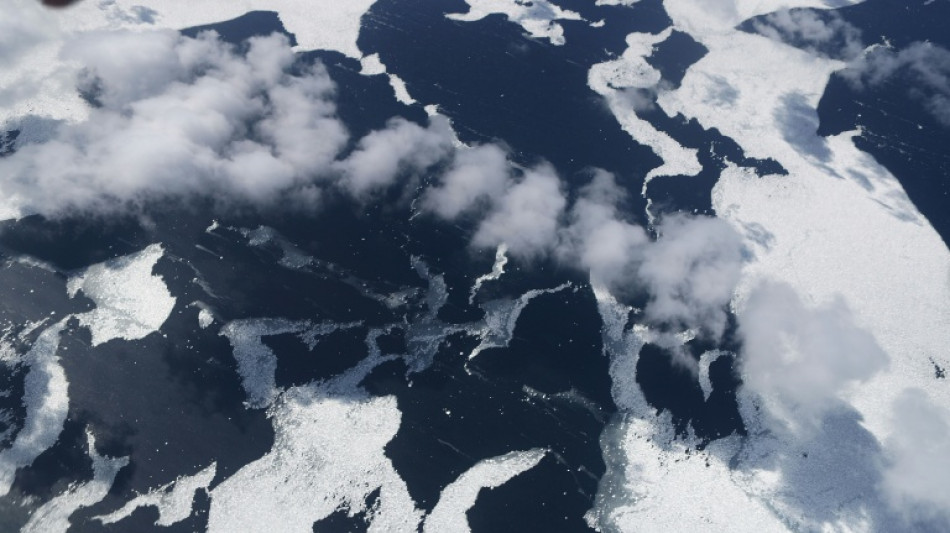
Storms, warm seas drove sudden drop in Antarctic ice: study / Photo: MARIO TAMA - GETTY IMAGES NORTH AMERICA/AFP

 Stocks move lower despite oil prices dropping

 AI driving up innovation investment: UN

 UN Security Council extends Haiti mission by 6 months

 Man Utd do not deserve medals if Man City stripped of titles: Rooney

 Vana Completes Expanded Staking as Part of the Vega Upgrade, Publishes Expanded VANA Token Economics

 Spain to cap gas price hikes, extend fuel discounts

 'We just need rain': Germany's Rhine river hits new low

 Yemen health system at 'breaking point': WHO

 Ireland undecided on second Israel match: coach

 France's Le Pen defiant after top ally hit by antisemitism claims

 Tom Cruise trades stunts for satire as toxic tycoon 'Digger'

 MEXC Unveils "WE SEE YOU" Brand Visual Refresh, Putting People Behind Every Trade in Focus

 Thai capital cleans up after deadly floods

 NATO, EU allies rally to Estonia after 'sabotage' blamed on Russia

 Families demand justice for Cameroon's 'nightmare' wave of murdered women

 Tebas says Man City should face 'most severe' sanctions if guilty of rule breaches

 Pochettino calls Man City success 'a period of deception'

 Settler attack on West Bank village injures Israeli forces, drawing rare rebuke

 Mystery over UK airbase scare after reports no explosives found

 Spanish govt races to adopt housing law under protest pressure

 Estonia slams Russian 'sabotage' after arson attack on defence company

 Slovenia sees surge in '.si' sites after Trump hypes 'super intelligence'

 'Like a dream' for An as Games organisers 'sorry' for latest mix-up

 Tokyo suffers longest streak of rainy days on record

 Indonesia charges train driver over crash that killed 16 women
Unusually strong winds and warm ocean water likely drove a rapid plunge in Antarctic sea ice in recent years, scientists said on Wednesday, shedding new light on a puzzling event.
While the Arctic sea ice area has been steadily declining, the story has been very different in Antarctica, where coverage hit a record high in 2015 before flipping to a record low only two years later.
Climate models struggled to explain this "unexpected and abrupt decline" of the magnitude witnessed in recent decades, wrote a global team of scientists in new research exploring this anomaly.
Understanding why matters because Antarctic sea ice is critical not just to ocean currents and local ecosystems but the climate, as its reflective surface bounces solar energy back into the atmosphere.
In the journal Nature Climate Change, scientists led by Theo Spira from the University of Gothenburg in Sweden said the rapid loss of sea ice was caused by forces working together rather than any single factor.
In particular, they pointed to a gradual weakening of a layer of cold water beneath the surface that normally protects the sea ice from the warmer depths below.
"During the winter of 2015, storms in the Southern Ocean were unusually strong, reducing the cold-water protective layer effect and resulting in the sustained sea ice loss around Antarctica," Spira said in a statement.
Normally, water of vastly different temperatures and salinity -- such as deep ocean water and sea ice melt -- do not mix well and settle in layers in a process known as stratification.
This natural protection helped sea ice grow to record highs until 2015, when strong winds and powerful storms churned the Southern Ocean.
"The storms in 2015 stirred up the sea and warmer water mixed with the cold-water layer, the protection disappeared and the ice melted at record speed," said Spira, the first author of the study.
He said it was crucial scientists understand these complex factors to better predict how Antarctic sea ice may influence the climate and global weather patterns in future.
H.Romero--AT