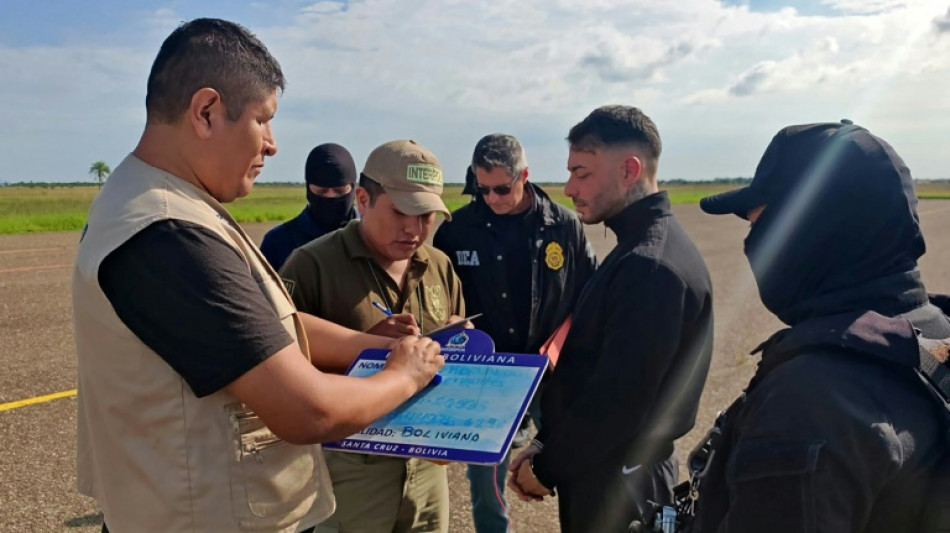
US launches new era of drug war with Latin American allies / Photo: Handout - Secretaria Nacional Antidrogas Paraguay (SENAD)/AFP

 As Canada takes on US tariffs, what's behind the David and Goliath fight?
 UEFA 'likely' to drop threat to boycott FIFA tournaments: source

 US disrupts platforms allegedly used by Chinese hackers
 The foreign tourists missing in Nepal's flash floods

 Hundreds missing after Nepal-Tibet flood kills 98
 CIA director was on 'semi-routine' mission in Moscow: Trump
 Aldeguer switches to Rossi's VR46 for next season
 Rent TRON Energy and Reduce USDT Fees : TronBid Expands Marketplace

 Pakistan captain Babar Azam returns against England '90 percent fit'
 Stocks mixed as oil drops, inflation stays high
 Improving standards transform pole vault as spectacle, says Duplantis
 India close in on win despite Sri Lanka fightback in second Test
 MEXC TradFi Gala Concludes With Over 170,000 Registrations and $4.3 Billion in Daily Trading Volume

 Olympic skating champion Liu to skip new season
 Benfica sign midfielder Palhinha from Bayern
 Flick says Barca may go without striker as Atletico resist Alvarez sale
 Too hot to incubate: Nile crocodiles hatch on their own in French reserve
 Spurs closing in on Man City's Marmoush after signing Savio
 Celtic count the cost of Champions League flop
 Lebanon accuses Israel of burning forest, farmland in south
 Nepal floods at China border kill 8, cause 'major casualties' in Tibet

 France eases cow diets as cheesemakers sweat
 America unites in mourning for Dolly Parton
 Meta and US states discuss settlement in landmark social media trial: report
 Fire haze threatens health of millions in Indonesia, ministry warns
The United States and allies in Latin America and the Caribbean have ushered in a new phase of anti-drug cooperation including extraditions, shared intelligence and security plans despite criticism from international organizations.
The joint initiative dubbed "Shield of the Americas," largely modeled on the Salvadoran approach, was announced on March 8 by President Donald Trump and leaders from 16 nations at a Florida summit.
On Saturday, US authorities took custody of Uruguayan drug trafficker Sebastian Marset following his capture in Bolivia -- barely a year after he was added to Washington's list of most-wanted fugitives.
Marset appeared before a judge on Monday following his swift expulsion by Bolivian authorities.
The collaboration has extended to other nations, with Ecuador recently carrying out an air strike on a FARC rebel training camp in a border area shared with Colombia.
Colombian President Gustavo Petro condemned the attack but his Defense Minister Pedro Sanchez told AFP cooperation exists with Ecuador, Venezuela and the United States to quell such pockets of rebellion.
The FBI has opened a permanent office in Ecuador, whose government recently imposed curfews in the regions hardest hit by violence related to organized crime.
Last week Washington also announced the arrest, pending extradition, of a suspect accused of being one of the leaders of "Los Piratas," the Chilean affiliate of the Tren de Aragua gang.
The suspected drug kingpin, 40-year-old Venezuelan national Rafael Enrique Gamez Salas, could be deported to Chile in the near future.
- Picking up the pace -
The Trump administration is acutely aware of the conservative political shift that has swept through the region and is trying to accelerate its efforts before a new political cycle.
The growing collaboration also means suspects can be sent home from the United States.
In January, the Department of Homeland Security announced the arrest of Chilean national Armando Fernandez Larios, a former military officer and agent of the DINA, the feared political police force of Augusto Pinochet's regime.
Larios, who pleaded guilty to the 1976 assassination of former Chilean minister Orlando Letelier in Washington, had been living in the United States since the late 1980s.
After nearly four decades, he could soon be deported to his home country, a Department of Homeland Security spokesperson confirmed to AFP.
- Three reluctant nations -
Brazil, Mexico and Colombia did not attend the Florida summit, but intelligence cooperation remains ongoing, according to their leaders and diplomatic sources in Washington.
Trump continues to exert pressure on Mexican President Claudia Sheinbaum, as shown by Mexico's operation that led to the death of kingpin Nemesio Oseguera, or "El Mencho," leader of the Jalisco New Generation Cartel (CJNG).
"The economic pressure from President Donald Trump, along with his veiled military threats, has compelled her to take action," observed Amanda Mattingly, a former diplomat and founder of ACM Global Intelligence.
In Brazil, the next chapter in a relationship marked by ups and downs could involve the official designation of two powerful criminal factions -- the "Comando Vermelho" (Red Command) and the "Primeiro Comando da Capital" (PCC) -- as terrorist groups.
Such a designation is a source of tension in the Brazilian government.
When questioned by AFP, a State Department spokesperson said Washington does not "anticipate possible designations" of the groups, but remains "committed to taking appropriate measures against foreign groups that engage in terrorist activities."
The anti-drug campaign, which includes controversial elements such as attacks on suspected drug-smuggling boats in the Caribbean, is sparking alarm in some parts of the region.
"These serial extrajudicial killings constitute a grave violation of the right to life," said Ben Saul, the UN Special Rapporteur on the promotion and protection of human rights, in hearings recently held by the Inter-American Commission on Human Rights (IACHR) in Guatemala.
But the State Department said the IACHR "lacks competence to examine issues regarding the interpretation and application of international humanitarian law" on such issues.
H.Gonzales--AT