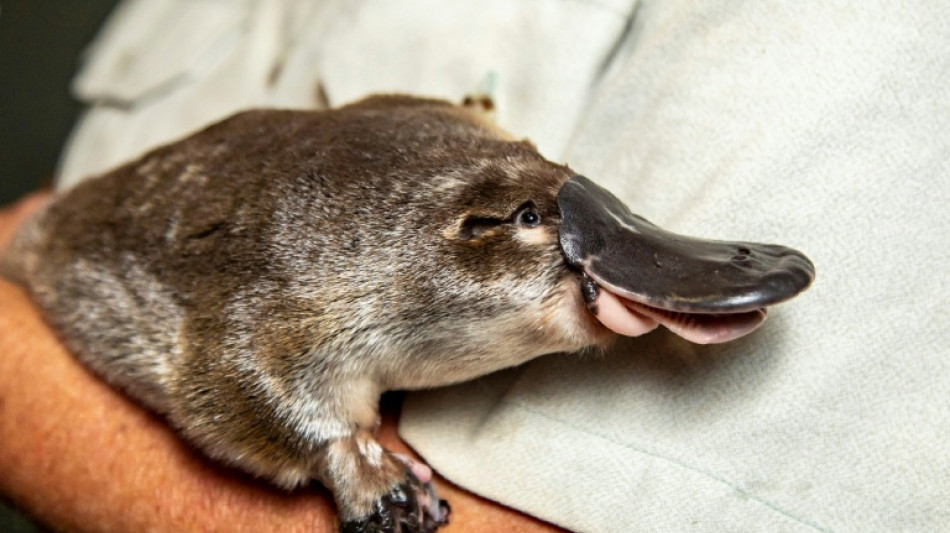
The platypus is even weirder than thought, scientists discover / Photo: RICK STEVENS - TARONGA ZOO/AFP/File

 New Zealanders pick endangered black robin as Bird of the Year

 Asia stocks rise on AI, US-China trade talks optimism

 Malaysia's 'elephant whisperer' fights to save Borneo's endangered giants

 'I live in fear': 1.5 million Pakistani children sexually exploited online

 Cowboys beat Commanders, Vikings down Bears as star QBs injured

 4 Hacks for Yearlong Savings on Your Kids' Wardrobes

 Forest fire threatens tourist town in Colombian Andes

 Torres on target again as PSG beat 10-man Marseille in Ligue 1

 Germany's Merz vows to stay course despite new election defeats

 Carrick demands Man Utd response after 'pathetic' jibes

 Liverpool boss Iraola urges Isak to raise his level

 Evenepoel wins record 4th straight world time-trial title

 France's Macron, Canada's Carney announce closer ties

 Carrick defends troubled Man Utd after Fulham escape

 Horror movie 'Resident Evil' tops N. American box office

 Germany's Merz vows to stay course despite new vote losses

 Man City outgun Sunderland despite Brobbey hat-trick, Man Utd rescue Fulham draw

 Mourinho blames ref committee for Real Madrid derby defeat

 Maresca craves a 1-0 win after eight-goal Man City thriller

 Atletico Madrid beat Real Madrid in tense derby clash

 Reusser retains world time-trial title

 Man City outgun Sunderland despite Brobbey hat-trick, Liverpool win at Bournemouth

 Top US, Chinese economic officials meet ahead of Trump-Xi summit

 Erdogan's LGBTQ crackdown 'first step of election campaign': activist
 Mass drone barrage on Moscow kills two

They already have the bill of a duck, the tail of a beaver, lay eggs like reptiles and have venom like snakes.
Yet the humble platypus, a small creature which quietly swims in the rivers of eastern Australia, has found yet another way to amaze scientists.
It is the only mammal that has hollow structures of the pigment melanin, a trait normally found in birds, biologists said in a new study on Wednesday.
When the first taxidermied specimen of a platypus was brought back from Australia in 1799, European naturalists began looking for the seams -- they assumed it was a hoax.
The animal has been surprising scientists ever since.
The platypus is one of only five mammal species that lay eggs, which are called monotremes. The other four are all types of echidna -- spiny creatures that waddle through the Australian bush.
It is also one of the few poisonous mammals -- males have a spur on their hind legs that releases venom at their enemies.
Now another oddity has been added to the unusual platypus characteristics, according to the study published in the Biology Letters journal of the UK's Royal Society.
In animals with spines, called vertebrates, the pigment called melanin protects against UV radiation, helps regulate body temperature and is responsible for the colour of skin, fur or feathers.
Melanin is contained in tiny, specialised structures inside cells called melanosomes, the shape of which is linked to their colour.
For example, eumelanin -- which produces black, grey and dark brown hues -- is usually found in elongated melanosomes.
Pheomelanin, which produces reds, reddish-browns and some shades of orange and yellow, is found in spherical melanosomes.
And in mammals, these melanosomes are always solid.
However in birds, sometimes the structures are hollow or flat, with only a thin layer of melanin. This helps birds have the dazzling and varied colours seen across the world.
Birds also have melanosomes that are organised into smaller "nanostructures" which create iridescent colours that interact with light, such as the feathers of a peacock.
- 'Surprising and exciting' -
Jessica Leigh Dobson, a biologist at Ghent University in Belgium and the study's lead author, told AFP the team was compiling a database of mammal melanosomes when they made an "extremely surprising and exciting" discovery.
Platypus melanosomes were mostly spherical -- which should give it reddish-orange fur. But the animal is merely dark brown.
Then the scientists discovered that some of its melanosomes are hollow -- like those of birds.
They checked their database for other mammals, including marsupials, rodents and primates.
"To the best of our knowledge, this is the only example of hollow melanosomes in mammals," Dobson said.
The melanosomes were "scattered randomly throughout the hair cortex" and do not create iridescence, she said.
"Further work is definitely needed to find out why they have them," Dobson added.
Why these animals evolved these unusual features in the first place is also unclear.
The ancestors of the platypus and echidna are thought to have been aquatic burrowing animals, so their hollow melanosomes could have helped them adapt to life in the water, giving them warmer insulation.
But this theory raises more questions.
If this was the case, why is this trait "not more widespread among aquatic mammals?" the study asked.
Y.Baker--AT