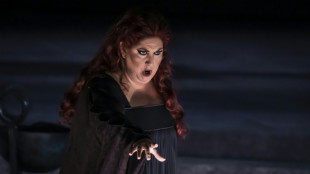
Manhattan arts complex opens new hall by exploring district it once displaced / Photo: ANGELA WEISS - AFP

 Springboks recall 'outstanding' Papier for Nations Championship

 Bezzecchi out of Czech MotoGP after slapping steward

 FIFA draws criticism as Infantino clocks up air miles at World Cup

 Japan stroll to victory over Tunisia in World Cup's 1,000th game

 Trump blames 'terrible vandals' for Washington pool renovation woes

 Man charged over suspected anti-Muslim attacks in Edinburgh
 Britain's King Charles to reveal personal tax bill: reports

 Fly-half Love ready for All Blacks start after Super Rugby heroics

 Saudis seek to repeat Argentina World Cup 'miracle' against Spain

 Nagelsmann says Germany has higher ambitions than advancing to knockout stage
 US and Iran set for new talks after delay and deadly strikes

 Germany into World Cup last 32 after late comeback, Dutch thrash Sweden

 Albanian protests against Trump-linked resort swell

 Burn dons cowboy boots as England unwind at World Cup

 France's Saliba says playing through the pain at World Cup

 Counter-terror cops probe suspected anti-Muslim 'attacks' in Edinburgh

 Clark begins with bogey as McIlroy charges at US Open

 Specter of military escalation hangs over Colombia vote

 Jamieson strikes as New Zealand eye series-levelling win despite Root heroics

 Netherlands thump Sweden in Houston to get World Cup liftoff

 Jamieson strikes as New Zealand eye series-levelling win against England

 Ronaldinho coming out of retirement to join Italian 3rd division side

 Real Madrid say no contact with Bayern's Olise

 Heartbreak for Japanese ace Satono Reve as Almeraq wins Royal Ascot thriller

 Injured Doris out of Ireland's Nations Championship squad

Years before Manhattan's Upper West Side became home to arias and pirouettes, it housed San Juan Hill, a bustling neighborhood and thriving arts nexus where clubs and dance halls were hatching new musical forms.
But the district was destroyed in the mid-20th century to make way for the shiny new arts complex Lincoln Center. Now, as the New York Philharmonic prepares to debut its long-planned new performance space there this weekend, the institution is reckoning with its unsavory beginnings, opening with the commissioned piece "San Juan Hill: A New York Story."
It was in the San Juan Hill neighborhood that stride piano innovator James P. Johnson composed the wildly popular "Charleston" dance at the Jungle Cafe club, and jazz piano legend Thelonious Monk -- credited with developing bebop -- grew up.
But in 1947, New York's notorious urban planner Robert Moses declared the area -- home to thousands of Black and Puerto Rican families, and hundreds of small businesses -- a slum district, clearing the way to raze it as part of his grand "urban renewal" campaign that controversially transformed the city.
"What happens to the neighborhood is what happens to lots of other neighborhoods -- that it sort of stands in the way of some future vision of the city," said historian Julia Foulkes.
She collaborated with composer and trumpeter Etienne Charles as he created the Philharmonic's new piece, which places his group Creole Soul in conversation with the symphony.
By mid-century, 18 city blocks had been leveled and thousands of people displaced, as the project to construct the arts campus that would come to house the Metropolitan Opera, New York Philharmonic, New York City Ballet and the Juilliard conservatory got underway.
"What's lost is not only specific blocks and residences, but actually the tenor of a whole area," said Foulkes, a professor at The New School.
Along with musical elements including ragtime, jazz, calypso, funk and hip hop, Charles's multimedia work features spoken word, visual projections and first-person accounts of San Juan Hill that document the neighborhood's history and pay homage to the music and culture brought to the city by migrants from the south and the Caribbean.
Charles, who is originally from Trinidad and Tobago and studied himself at Juilliard, told AFP he hopes the project will shed light on the mere fact that the neighborhood -- now wiped off the map -- existed.
"We have to start valuing people for more than just where they live and the quality of the property that they have, and start looking at their culture and their lineage and their heritage and their history that they are building," he said.
"It's always about knowing who was there, and understanding what your relationship to that is."
- Inclusivity -
Shanta Thake, the chief artistic officer at Lincoln Center, said that the commission is part of a broader conversation at the institution, "thinking through what it means to be a civic space, and what it means to hold the city's stories -- and what it also means to have interrupted the city's stories."
"For a long time there was a prevailing narrative of 'Lincoln Center is the best thing that could have ever happened to this neighborhood,'" she continued, saying that pieces like Charles's allow for "really peeling that apart."
The composer's piece is the crown jewel of a series of talks and workshops sponsored by the institution exploring culture, gentrification and community activism, Lincoln Center said.
For years, companies at the complex have been battling criticisms that their offerings are geared toward primarily white, upper-class audiences.
Part of the gut renovation of David Geffen Hall, the Philharmonic's home, was giving it more accessible airs, with a breezy lobby that opens to the plaza and a sidewalk studio for performances visible from the street.
And tickets to Charles's show, which includes five movements from the orchestra and debuts October 8, were made available for a choose-what-you-pay fee starting at $5, with some distributed for free.
The composer, who has worked with Lincoln Center before, said he thinks the complex has made efforts to "ensure that they are inclusive, not only for the audiences, but what they present musically -- this piece is an example of that."
Historian Foulkes recalled Charles telling her his aim was to compose music "that sounds like what if symphony and orchestras had not excluded all of the other music that had been occurring around them."
"I think that is such a compelling image for where we need to be," she said.
M.White--AT