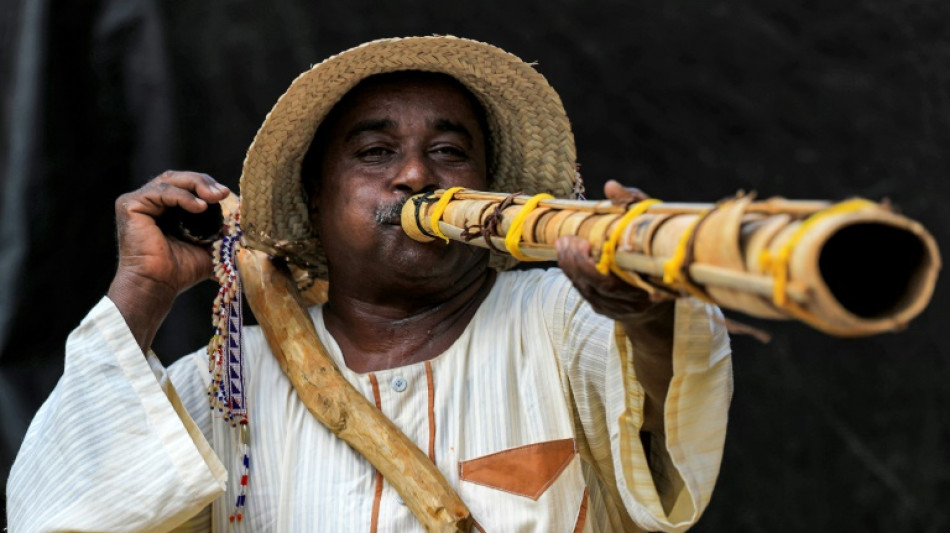
Sudan traditional wind instrument trumpets harvest time / Photo: ASHRAF SHAZLY - AFP

 South Africa economy shrinks ahead of local elections

 CapTLX Expands Institutional-Oriented Platform for Access to U.S. Capital Markets

 UK's Prince George starts at Eton College

 French far right keeps guarded silence over AfD Germany triumph
 Russia-Ukraine talks possible this month, Zelensky says, as Moscow pounds Kyiv

 Turkish Airlines will be new Liverpool shirt sponsor in £300 mn deal

 On London's Brick Lane, a data centre sparks local battle

 Nepal flood death toll rises as rescuers scour tunnels
 France's Mistral sees value soar with 3 bn euro cash infusion
 Nepal glacier saw exceptional heat before collapse caused deadly floods: researcher

 Ethiopia boosts drone production to fight rebels
 Yemen rebels hit Saudi Arabia with wave of strikes, wounding 73

 Nepalis mark a year since deadly protests that toppled government

 Rubio launches Latin America tour to cement US influence

 France tries 14 over deadliest Channel migrant crossing disaster

 Australia threatens hefty fines if big tech fails 'duty of care'
 Zverev romps into quarter-finals as Darderi downed

 Kauai on tornado watch as Hurricane Lowell nears Hawaiian islands

 Pakistan roll the dice in search of consolation win over England

 Yen extends gains as traders eye rate hike, tech rallies again

 'The ber months': Christmas arrives early in the Philippines

 N. Korea calls Russia bridge a sign of tighter ties

 US sanctions threaten to crush Iranian students' dreams
 Former champ Gauff holds off Jovic to reach US Open quarter-finals

 Formation Metals Extends A-Zone 200 Metres to the South and Identifies a New Vein Set, Returning 2.53 g/t Au over 11.8 Metres and 1.41 g/t Au over 20.6 Metres at the Advanced N2 Property

Near the lush fields of his village in Sudan's southern Blue Nile state, Youssef Ismail has crafted a traditional horn-like instrument used for generations to usher in the harvest season.
"We make new wazza instruments every year," Ismail, in his 70s, told AFP about the wooden wind instrument that is often longer than a grown man.
"We learned this craft from our parents."
He assembled pieces of the conical gourd plant, meticulously cut and washed, to create a long trumpet with a bell-shaped end which produces a bright, loud and festive sound.
In the village of East Ganis, like in some other Blue Nile communities, "we use it to celebrate the harvest season", which typically begins in November after the wet season, Ismail explained.
Agriculture is a major economic sector in Sudan, a country of 45 million people and one of the world's poorest.
About 43 percent of its labour force works in agriculture which makes up 30 percent of the economy according to UN and World Bank estimates.
After more than 120 people were killed in clashes over access to land in Blue Nile state in July, the wazza was also played to celebrate a halt in violence, resident Ahmed Idriss said.
Little is known about its history, but the wazza "has strong links to rituals performed by the communities of the Blue Nile", explained Mohammed Soliman, a music professor at Sudan University of Science and Technology.
Dafallah Ali Mustafa, 51, founder of the Sudanese Traditional Music Centre in the capital's twin city of Omdurman, has reserved pride of place for the wazza.
Wazzas, which are particularly common among the ethnic Funj people in Sudan's south, vary in size, with some as long as two metres (6.5 feet).
The size of each instrument determines its tone range, and wazza players perform in a band of up to 13 members.
The band leader "usually plays the smallest instrument", Soliman said.
Some of the players would also use animal horns to tap their wazza for percussive effect.
Ismail, himself a member of a wazza band, said he expects future generations will carry on the tradition.
"We taught our children how to make and play the instrument," he said. "They will keep it alive after we are gone."
A.Moore--AT