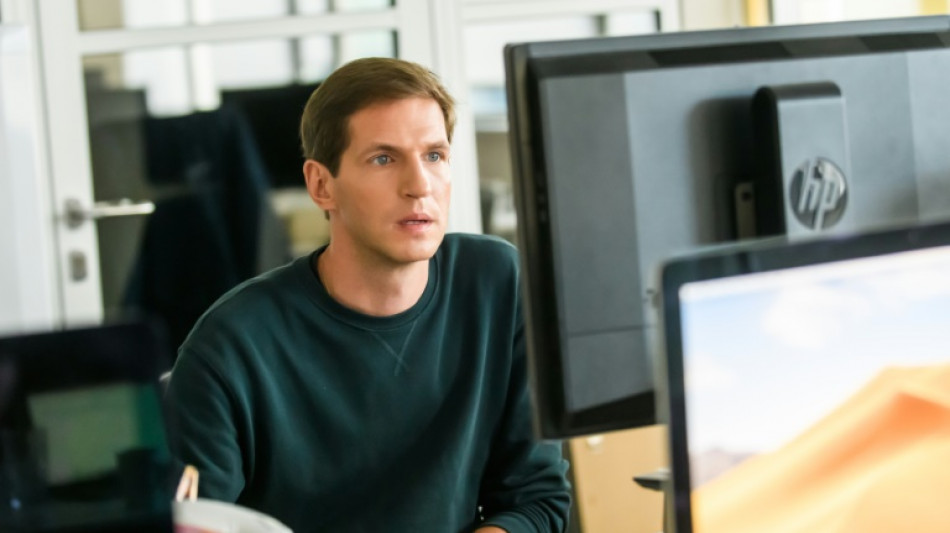
Exiled to Latvia, Russian free media defy Kremlin / Photo: Gints Ivuskans - AFP

 Nepal flood death toll rises as rescuers scour tunnels
 France's Mistral sees value soar with 3 bn euro cash infusion

 Nepal glacier saw exceptional heat before collapse caused deadly floods: researcher

 Ethiopia boosts drone production to fight rebels
 Yemen rebels hit Saudi Arabia with wave of strikes, wounding 73
 Nepalis mark a year since deadly protests that toppled government
 Rubio launches Latin America tour to cement US influence
 France tries 14 over deadliest Channel migrant crossing disaster

 Australia threatens hefty fines if big tech fails 'duty of care'
 Zverev romps into quarter-finals as Darderi downed
 Kauai on tornado watch as Hurricane Lowell nears Hawaiian islands
 Pakistan roll the dice in search of consolation win over England

 Yen extends gains as traders eye rate hike, tech rallies again
 'The ber months': Christmas arrives early in the Philippines
 N. Korea calls Russia bridge a sign of tighter ties
 US sanctions threaten to crush Iranian students' dreams
 Former champ Gauff holds off Jovic to reach US Open quarter-finals
 Battery X Metals to Appoint Accomplished Technology and Consumer Brands Executive Nicholas Reichenbach to Board of Directors
 Equitech-Bio Expands Reagent Portfolio with New IgG Offering and Publication-Backed Product Validation from Bioz

 CPG Life Fund I Launches $20 Million Operator-Led CPG Fund
 Who is the Best Female Cosmetic Surgeon in Florida?

 CANEX Metals Announces C$6.5 Million Strategic Financing Led By C$3 Million Investment by Eric Fier
 Helio Sets September Roadshow Across Austin, Houston, Phoenix, Scottsdale
 Gaming Realms PLC Announces Interim Results
 Universal Edge Technologies Establishes Senior Advisory Committee, Names Mark Powell and Mark P. Mills as Founding Members
Exiled to Latvia since the invasion of Ukraine, Russian free media have made it their mission to provide independent information to millions of their compatriots subjected to Kremlin propaganda.
"Those who control the information, they control the situation," said Tikhon Dzyadko, editor-in-chief of independent Russian TV channel Dozhd, now headquartered in Riga.
He said the channel's goal was to make it possible for people to access "real information about what is happening and not this propaganda spread by Russian TV stations."
Moscow tries to block what it considers dissident news sites online and has restricted access to top social media sites.
Fortunately "it's possible to get information from Russia through the internet, social media. The digital Iron Curtain is not strong enough," he told AFP.
Dozhd -- which means "rain" in Russian -- suspended operations in early March after authorities blocked its broadcasts, which contained critical coverage of the conflict in Ukraine.
Moscow also introduced prison terms for spreading "fake news" about the Russian military and the war.
"It became impossible to work there. Because even for calling a war "war", we could face up to 15 years in jail," Dzyadko said.
The Latvian government offered that they set up shop in Riga and by mid-July, their shows were back up and running.
Several other newsrooms have also found refuge in the Latvian capital, including Novaya Gazeta Europe and Deutsche Welle's Moscow branch.
The city has also hosted independent news website Meduza since 2014.
Around 300 Russian opposition journalists have moved to the Baltic state since February, according to Dozhd journalist Valeria Ratnikova.
Latvia, whose Russian minority constitutes 30 percent of the population, has also banned all Russia-based TV channels for propaganda, warmongering and as a threat to national security.
- 'Extremism and treason' -
Other journalists, artists and opposition activists from Belarus and Russia have found safety in fellow Baltic states Estonia and Lithuania.
For Dzyadko and his staff, leaving was a no-brainer.
"There was information that our office would be raided by the police and... that our journalists would be arrested and accused of extremism and treason," he said.
"We found tickets to Istanbul and in an hour or so we packed three suitcases, woke up our kids and went to the airport."
Today, around 60 Russians in exile work for Dozhd abroad -- in Riga, France, Georgia and the Netherlands.
The demand is there, according to Dzyadko.
He pointed out that even government polls show that 30 percent of Russians -- or 45 million people, "a huge number" -- are against the Ukraine conflict.
"A lot of people in Russia, they understand everything. They do not support the war, they do not support their President Putin, but they are just afraid to say a word," he said.
"It's not safe. These people, they are eager to get independent information. The challenge is how to get to them."
Ratnikova said in the days following the invasion, "we saw our viewer numbers increase."
"I believe there are thousands, even millions who need us. And it's not just our former audience... With time, many people will begin to doubt," she told AFP.
- 'They prosecute our colleagues' -
Kirill Martynov, deputy editor-in-chief of Novaya Gazeta, a mainstay of investigative journalism in Russia, left in March with a laptop as his only luggage and a plan to publish independent news from abroad.
Novaya Gazeta has since been banned in Russia.
"We were strongly against war and we are still against war even if it's too dangerous for people to say it aloud from Russia," he told AFP.
"And that is why they prosecute our colleagues in Russia."
In Riga, Martynov set up Novaya Gazeta Europe with others in exile.
They printed their first issue in May, in Latvian and Russian, and newspapers from around the world published their articles in solidarity.
They have posted subsequent stories online, sharing them via social media, including YouTube, Telegram and Twitter.
"Russian authorities are still a bit afraid of blocking YouTube for some technical and social reasons," Martynov said.
He added that YouTube has "the hugest media platform in the country because... normal people in Russia don't want to watch national TV."
Dzyadko has strong condemnation for television journalists sowing state propaganda, which he calls "war criminals".
"Misinformation is one of the reasons why this war started and why this war is still going on," he said.
H.Thompson--AT