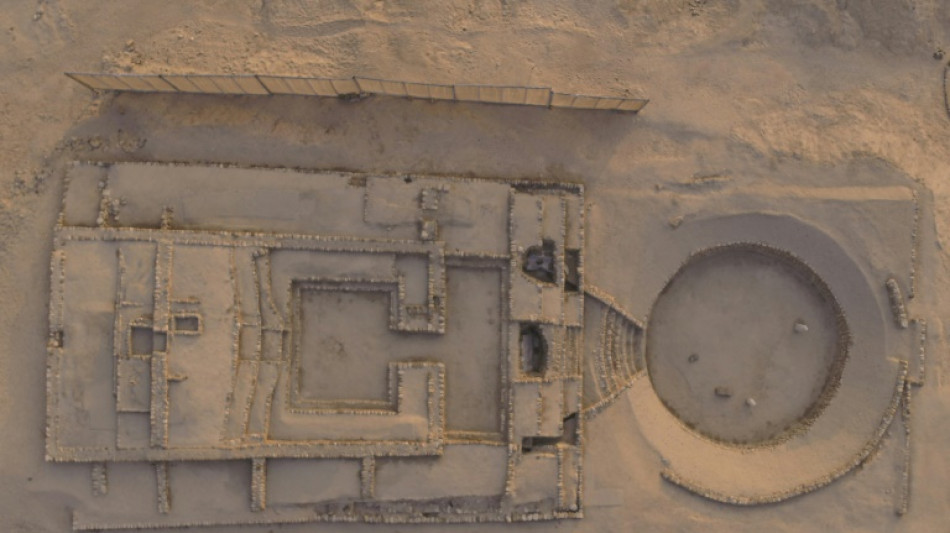
Peruvian citadel that is nearly 4,000 years old opens doors to tourists / Photo: Handout - Zona Arqueologica Caral/AFP

 'I live in fear': 1.5 million Pakistani children sexually exploited online

 Cowboys beat Commanders, Vikings down Bears as star QBs injured

 Braves clinch division title as Red Sox reach MLB playoffs
 Bordeaux-Begles hammer Stade Francais despite Jalibert injury

 Milan and Juventus end blips with home wins

 Bridgeman wins PGA Biltmore title with sizzling 61

 Williams injured as Bears shut down by Vikings

 US warns of rapid escalation in Middle East war

 Germany's far-right AfD celebrates another state election win

 Russia vows revenge for election-day attacks as poll shows ruling party win

 Spaun late shows snatches PGA Championship win

 Conceicao strikes as Juventus beat Atalanta

 Britain, Zverev-inspired Germany, Spain complete Davis Cup finals

 Man Utd salvage Fulham draw as pressure mounts on Carrick

 Spanish civil war drama 'The Black Ball' wins at Toronto festival

 Germany's Merz shaken by far-right and far-left gains in state votes

 Macron welcomes Canada's Carney to French Atlantic territory

 Fiorentina frustrate Napoli with Serie A draw, Como upset

 Five-star Man City top Premier League after Sunderland thriller

 Ukrainian drones hit Moscow on last day of Russian elections

 Multi-Asset Trading Venue Monochrome Exchange Announces IEO of Its Native Token, $MCR
 South Korea break Japan hearts to win Asian Games basketball gold
 Acosta takes first victory at Austrian MotoGP

 PSG president Nasser al-Khelaifi under investigation in France for conflict of interest

 China swim sensation, 13, sets Games record after Japan win early

To the music of conch shell trumpets, a 3,800-year-old citadel of the Caral civilization -- one of the oldest in the world -- opened its doors to visitors in Peru on Saturday, after eight years of study and restoration work.
The archaeological site, known as Penico, was a meeting point for trade between the first human communities on the Pacific coast and those from the Andes and Amazon regions, researchers have said.
Located in the Supe valley, some 110 miles (180 kilometers) north of the Peruvian capital Lima and around 12 miles from the Pacific ocean, Penico was a hilly landscape before exploration work began in 2017.
Archaeologists believe it could hold insights into why the Caral civilization -- which flourished between 3,000 and 1,800 BC -- faded.
At the opening ceremony, artists from the region played pututus -- the traditional shell trumpets -- during an ancestral ritual offering to the Pachamama, Mother Earth, consisting of agricultural products, coca leaves and local drinks.
Penico was an "organized urban center devoted to agriculture and trade between the coast, the mountains and the forest," archaeologist Ruth Shady, who leads research on the site, told AFP.
The site itself dates back to between 1,800 and 1,500 BC, she added.
It was built on a geological terrace 2000 feet (600 meters) above sea level, parallel to a river to avoid flooding.
Research carried out by the Peruvian Ministry of Culture has identified 18 constructions, including buildings and residential complexes.
Researchers believe that it was built at the same time as the first civilizations in the Middle East and Asia.
Shady said researchers are hoping the site can shed light on the crisis they think helped hasten the end of the Caral civilization.
This crisis, she said, was linked to climatic changes that led to droughts and affected agricultural activities in the region.
"We want to understand how the Caral civilization formed and developed over time, and how it came to be in crisis as a result of climate change," she added.
O.Brown--AT