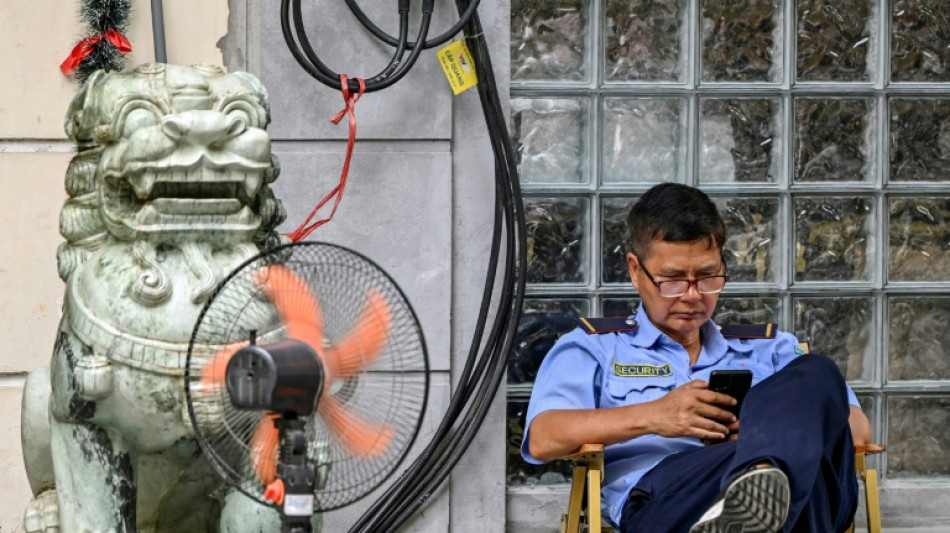
'Draconian' Vietnam internet law heightens free speech fears / Photo: Nhac NGUYEN - AFP/File

 OpenAI calls for US to lead global effort on AI standards

 South African ostriches plucked alive for luxury fashion: report
 US networks halt Trump coverage in revolt over White House ban

 Paramount settles with US states to clear Warner Bros. mega-merger
 Climate crisis a job for world leaders, not just activists: UK FM

 US networks halt Trump coverage over White House ban
 French singer accuses Miley Cyrus of plagiarism

 EU fines Google 403 mn euros for location data breach

 'Best is yet to come,' says De la Fuente after Spain extension

 Why diesel prices are rising more than crude oil

 COP31 host says AI's climate footprint to be a summit priority

 Renewables hit record in 2025, but world must move faster: report

 US media outlets to sue Trump administration after White House ban
 Global stocks rally on lower oil prices, US-China hopes

 EU proposes energy rating for data centres

 Schoolgirl Yu scorches to second gold as doping case rocks Games

 Putin's party secures record score in Russia election

 Haupt Koleksiyonu: Paranın Biz İnsanlar Hakkında Anlattıkları

 Spanish PM says unregulated AI could be 'devastating'

 Yu, 13, smashes record again with second Asian Games gold

 Switzerland to play without Xhaka over fake Covid certificate

 From Korean Chipmakers to Leveraged Semiconductor ETFs: STARTRADER Launches 49 New 24/7 Stock and ETF CFDs

 Thai badminton player first doping case at Asian Games: testers

 Колекція Гаупта: Що гроші розповідають про нас, людей
 German far-right AfD poll winner says Merz 'twilight' has begun

Social media users in Vietnam on platforms including Facebook and TikTok will need to verify their identities as part of strict new internet regulations that critics say further undermine freedom of expression in the communist country.
The law, which comes into force on Christmas Day, will compel tech giants operating in Vietnam to store user data, provide it to authorities on request, and remove content the government regards as "illegal" within 24 hours.
Decree 147, as it is known, builds on a 2018 cybersecurity law that was sharply criticised by the United States, European Union and internet freedom advocates who said it mimics China's repressive censorship of the internet.
Vietnam's hardline administration generally moves swiftly to stamp out dissent and arrest critics, especially those who find an audience on social media.
In October, blogger Duong Van Thai -- who had almost 120,000 followers on YouTube, where he regularly recorded livestreams critical of the government -- was jailed for 12 years on charges of publishing anti-state information.
Months earlier, leading independent journalist Huy Duc, the author of one of the most popular blogs in Vietnam -- which took aim at the government on issues including media control and corruption -- was arrested.
His posts "violated interests of the state", authorities said.
Critics say that decree 147 will also expose dissidents who post anonymously to the risk of arrest.
"Many people work quietly but effectively in advancing the universal values of human rights," Ho Chi Minh City-based blogger and rights activist Nguyen Hoang Vi told AFP.
She warned that the new decree "may encourage self-censorship, where people avoid expressing dissenting views to protect their safety -- ultimately harming the overall development of democratic values" in the country.
Le Quang Tu Do, of the Ministry of Information and Communications (MIC), told state media that decree 147 would "regulate behaviour in order to maintain social order, national security, and national sovereignty in cyberspace".
- Game over -
Aside from the ramifications for social media firms, the new laws also include curbs on gaming for under-18s, designed to prevent addiction.
Game publishers are expected to enforce a time limit of an hour per game session and not more than 180 minutes a day for all games.
Nguyen Minh Hieu, a 17-year-old high school student in Hanoi who admits he's addicted to gaming, told AFP that the new restrictions would be "really tough" to follow -- and to enforce.
Games are "designed to be addictive" he said. "We often spend hours and hours playing match after match."
Just over half of Vietnam's 100 million population regularly plays such games, says data research firm Newzoo.
A large proportion of the population is also on social media, with the MIC estimating the country has around 65 million Facebook users, 60 million on YouTube and 20 million on TikTok.
Under the new laws, these tech titans -- along with all "foreign organisations, enterprises and individuals" -- must verify users' accounts via their phone numbers or Vietnamese identification numbers, and store that information alongside their full name and date of birth.
They should provide it on demand to the MIC or the powerful ministry of public security.
The decree also says that only verified accounts can livestream, impacting the exploding number of people earning a living through social commerce on sites such as TikTok.
Neither Facebook parent company Meta, YouTube owner Google, nor TikTok replied to requests for comment from AFP.
Human Rights Watch is calling on the government to repeal the "draconian" new decree, which the campaign group said threatens access to information and freedom of expression.
"Vietnam's new Decree 147 and its other cybersecurity laws neither protect the public from any genuine security concerns nor respect fundamental human rights," said Patricia Gossman, its associate Asia director.
"Because the Vietnamese police treat any criticism of the Communist Party of Vietnam as a national security matter, this decree will provide them with yet another tool to suppress dissent."
A.Williams--AT