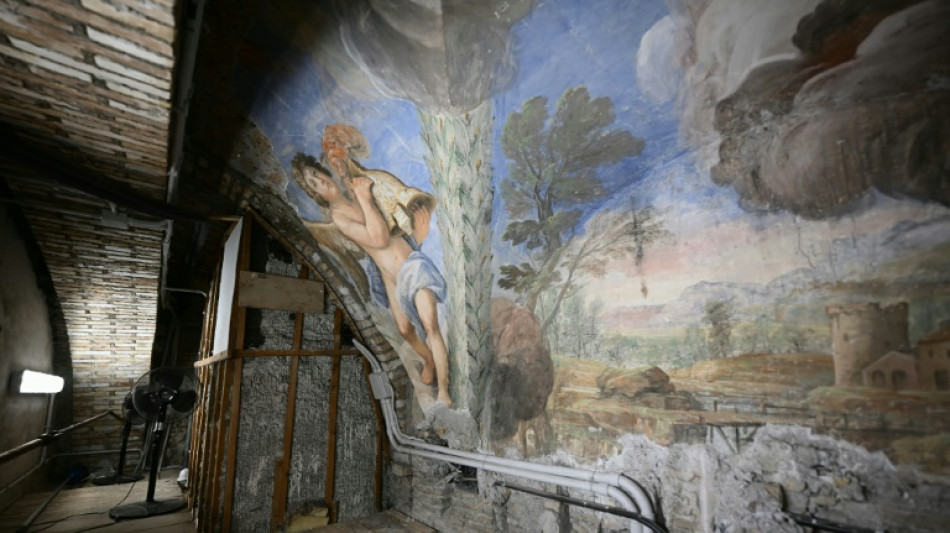
Electrician finds frescoes behind false ceiling in Rome / Photo: Filippo MONTEFORTE - AFP

 Olivier Martinez Seeks Increased Child Support from Halle Berry Following Custody Change

 Joe Biden Makes Surprise Appearance at Trinity College Dublin for Hunter's Medal

 Bank of Korea Governor Shin Hyun-song Appointed First Asian Chair of BIS Payment Committee

 Northern California Jewish Sports Hall of Fame Announces 2026 Inductees

 Readers Debate GTA 6 Spin-offs, Server Strain, and Warner Bros. Decline in Games Inbox
Rosy-cheeked cherubs surrounded by blues, reds and golds have lost none of their brilliance in 17th-century frescoes discovered behind a false ceiling at the Villa Farnesina palace in Rome.
The three paintings were hidden above the vaulted ceiling of what was once the living room of Agostino Chigi, a wealthy banker and Renaissance patron who had the villa built at the start of the 16th century.
Electrician Davide Renzoni stumbled upon them by chance a year ago, after climbing through a trapdoor into the long-forgotten space during maintenance work on the villa, which sits on the banks of the river Tiber.
"I went to get a lamp and when I turned it on, everything appeared: it was a marvel," he told AFP on a visit this week.
Several cherubs hold up a green festoon, while another brandishes a golden helmet.
The frescoes, by a little-known artist, include the coat of arms of the noble Farnese family.
Cardinal Alessandro Farnese bought the villa in 1579 with the idea of connecting it to the Farnese Palace on the other side of the Tiber, though the plan fell through.
The villa, bought by the state in 1927, underwent major restoration work and the frescoes fell into oblivion, curator Virginia Lapenta told AFP.
Their rediscovery last year inspired an exhibition on the 17th century in the grounds of the villa, which has long been renowned for its frescoes by Renaissance master Raphael.
Although they are not accessible to the public for security reasons, visitors can see the newly found frescoes through pictures and videos included in the exhibition, which runs until January 12.
The displays also allow the villa to monitor the frescoes' conservation, Lapenta said.
Ch.P.Lewis--AT