Dirty diapers born again in Japan recycling breakthrough / Photo: Philip FONG - AFP

 'It has to stop': runners protest women's murders in S.Africa district

 Fire erupts near Riyadh airport as Houthis claim strikes

 Cuba works to restore power after another blackout

 England thrash Sri Lanka again to return to top of T20 rankings

 Arsenal thrashed by Brighton, sorry Spurs lose again

 South Korea, Austria qualify for Davis Cup finals

 Seare shocks Ingebrigtsen to win world 5km gold

 Brigitte Bardot widower slams sale of star's belongings

 Aston Villa compound Tottenham's misery despite late rally

 Asian Games offer 'deepest apologies' for South Korea anthem blunder

 Inter Milan and Italy icon Mazzola dies aged 83

 Saudi capital issues first air raid alert since renewed fighting in Yemen

 Martin edges title rival Marquez for Austrian MotoGP pole

 Indonesia accepts Malaysia's help to tackle wildfires

 Indians living in Japan on stand-by to house Asian Games athletes
 Trump signs bill authorizing sweeping Russia sanctions

 Protesters form human chain at Kennedy Center after Trump threat

 Death toll from attack at police HQ in Pakistan rises to 31

 Trump says Denmark to give US 'permanent control' over Greenland security

 New to The Street Broadcasts Tonight at 6:30 PM ET Across the United States, Latin America and MENA, Featuring BioVie, Acurx Pharmaceuticals, Lantern Pharma and SafeSpace Global

 Kennedy Center: future unclear for iconic Washington arts hub

 Trump claims 'infinite' Greenland security deal with Denmark

 Helicopters battle wildfire threatening Ecuador's capital

 Brentford batter Chelsea to undo Alonso's promising start

 Kane hits Bundesliga century as Bayern rout Union
Billions of dirty diapers end up buried or burned every year in Japan -- more from seniors than babies -- but a recycling breakthrough has given them a new lease of life, one hot mess at a time.
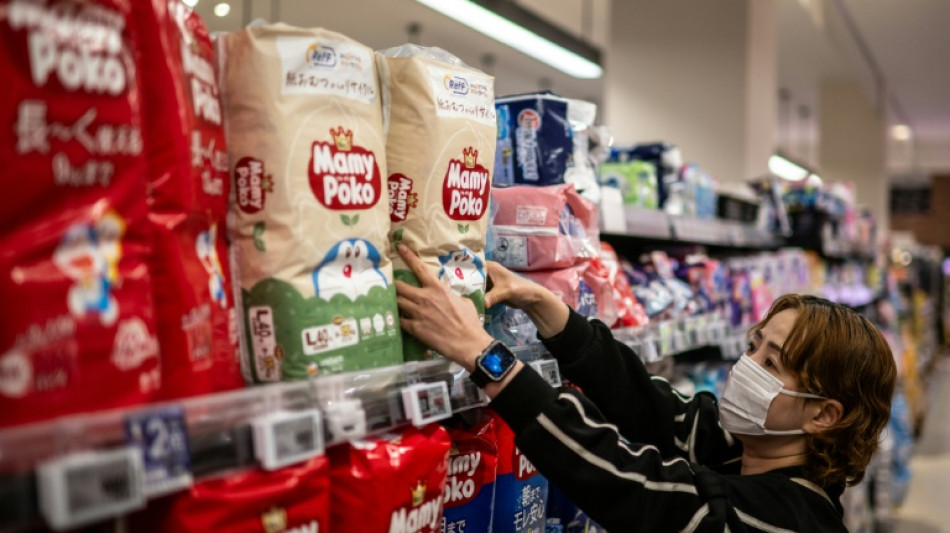
A pilot project, billed as a world first, reuses the main ingredient in nappies to make new ones, offering hopes to ease bloated landfill sites and respond to a growing need for adult diapers in ageing Japan.
"Demand for baby diapers is falling. But a growing number of elderly people wear diapers, and more recently, even pets do too," Takahisa Takahara, president of Japanese hygiene product maker Unicharm, the firm behind the new initiative, told AFP.
"If we can transform the sense of guilt ordinary consumers may feel about using disposable products into something positive, and make using recycled products the norm in society, it will become economically viable," he said.
Unicharm is testing the scheme in two pioneering southern Japanese municipalities, Shibushi and Osaki, which recycle 80 percent of household waste -- four times the Japanese average.
The two localities, home to about 40,000 people, decided to take radical action around 25 years ago after predictions that their communal rubbish dump would be full by 2004.
Now, the landfill site will stay open for another four decades.
In 2024, diapers were included in the recycling drive, with residents required to write their names on designated bin bags.
"Ultimately, our top priority is to reduce our trash and extend the life of the landfill," Shibushi environment official Kenichi Matsunaga told AFP.
- Nappy ending -
The collected diapers are shredded, washed and separated into pulp, plastic and super-absorbent polymer (SAP).
Unicharm has been able to recycle these materials into products with less rigorous sanitary requirements, like toilet paper.
It has also achieved the breakthrough of managing to use the pulp, which makes up the bulk of a diaper, to make new ones.
The process follows a special ozone treatment for sterilisation, bleaching and deodorisation.
By 2028, Unicharm aims to recycle the plastic and absorbent polymer from soiled diapers to make new ones as well, Tsutomu Kido, senior executive officer of Unicharm's recycling business, told AFP.
For now, its recycled products are on sale only in some local stores, priced around 10 percent higher than those with fresh raw materials, or distributed to selected childcare and senior care centres.
The company is also testing a method to cut the amount of water in the recycling process, and aims to team up with 20 municipalities by 2035 to recycle their diapers.
- Ageing nation -
Japan has a poor recycling rate, reusing not even 20 percent of municipal waste, according to the National Institute for Environmental Studies.
That compares to 67 percent in Germany, 44 percent in Britain and around 32 percent in the United States.
Waste per capita, however, is less than two-thirds the OECD average -- a typical American throws almost three times more.
Japan does relatively well on generating electricity by incinerating trash, too.
In the ageing nation, home to almost 100,000 people over 100, diapers and related products are used more by seniors than babies.
In 2024, Japan produced 9.6 billion adult diapers and incontinence pads, compared to eight billion for babies, according to the Japan Hygiene Products Industry Association.
The group predicts Japan will throw away 2.6 million tons of dirty diapers every year by 2030, up from around 2.2 tons in 2020.
By that date, the share of dirty diapers in Japanese trash by weight will rise to 7.1 percent from 5.2 percent in 2020, the environment ministry said.
By 2030, the national government wants at least 100 of more than 1,700 municipalities to start recycling diapers, or at least talk about it.
M.O.Allen--AT



