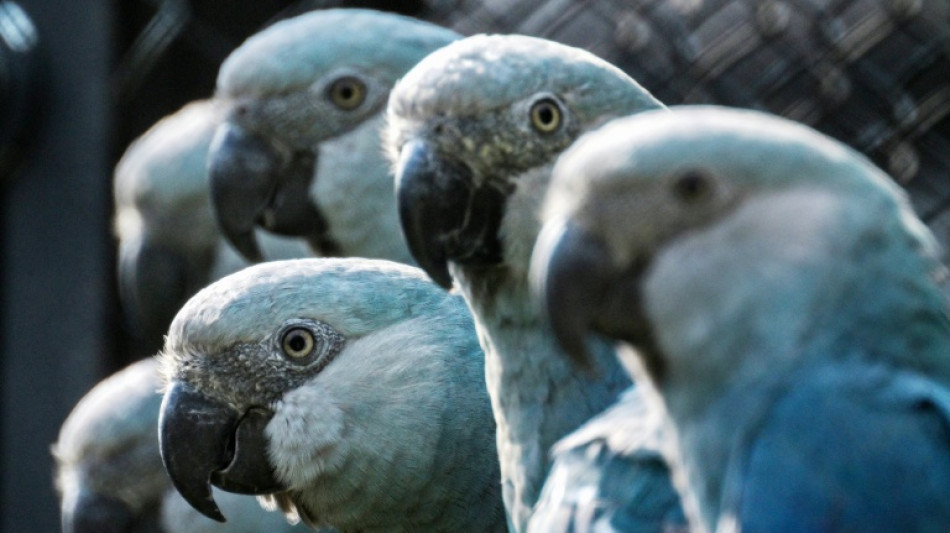
Brazil police probe plight of near-extinct blue parrot / Photo: Nelson ALMEIDA - AFP/File

 IFFI Opening Film 'Fatherland' Addresses Global Divisions Through Post-War Lens

 Phoenix Dispensaries Offer Green Wednesday and Thanksgiving Cannabis Deals

 Police Departments Deploy AI-Generated 'Grand Theft Auto VI' Recruitment Ads

 FlatRx Publishes a Dated Price Comparison of Compounded Tirzepatide at 27 U.S. Telehealth Programs Counted at a 10 mg Weekly Dose

 Abanico Coffee Roasters Opens Second San Francisco Location in Inner Sunset

Brazilian police said Wednesday they were probing the outbreak of a lethal virus among some of the last Spix's Macaws, one of the world's rarest birds -- made famous as the blue parrot in the 2011 animated film "Rio."
The conservation of the Spix's macaw has been the subject of a fierce battle between private breeders and the government.
The Spix's macaw was last seen in the wild 25 years ago.
In 2020, a group of captive-bred birds was brought from Germany for a program to reintroduce them to their natural habitat in northeast Brazil.
Last week, Brazil's conservation agency, ICMBio, said that all 11 surviving Spix's macaws that had been released to the wild have tested positive for the incurable circovirus, which is considered deadly.
On Tuesday, it reported another 20 in captivity had tested positive.
The agency has fined the breeding center 1.8 million reais ($336,000) for failing to implement biosafety protocols to curb the spread of the virus.
In a statement, police said they had seized cellphones and computers from the Spix's Macaw Breeding Center as part of "Operation Blue Hope".
"Those under investigation may face charges of spreading a disease capable of harming wildlife, causing death to wild animals, and obstructing environmental inspections," said police.
The center had resisted efforts to recapture the wild Spix's macaws, which a court ordered them to do in October.
In statements sent to AFP, the breeding center said only five of 103 macaws under its care had tested positive for the virus, rejecting accusations of negligence.
It argued that tropical parrots such as the Spix's macaw were "especially resistant to circovirus."
It said it was "completely calm" over the police investigation.
Circovirus causes beak and feather disease in parrot species but poses no risk to humans.
ICMBio said the interpretation of test results was "not simple".
"No positive Spix's macaw is necessarily doomed, but it is also not certain that, after a negative result, they are cured," it said.
"We are talking about a Brazilian bird of high conservation value," said Claudia Sacramento, who is coordinating the response to the outbreak at ICMBio.
"Those responsible for the contamination must be held accountable."
The breeding center is a partner of the German Association for the Conservation of Threatened Parrots (ACTP), which holds 75 percent of the world's registered Spix's macaws, according to ICMBio.
Brazil terminated its partnership with ATCP in 2024 after the German organization sold 26 of the birds to a private zoo in India without its consent.
P.Smith--AT