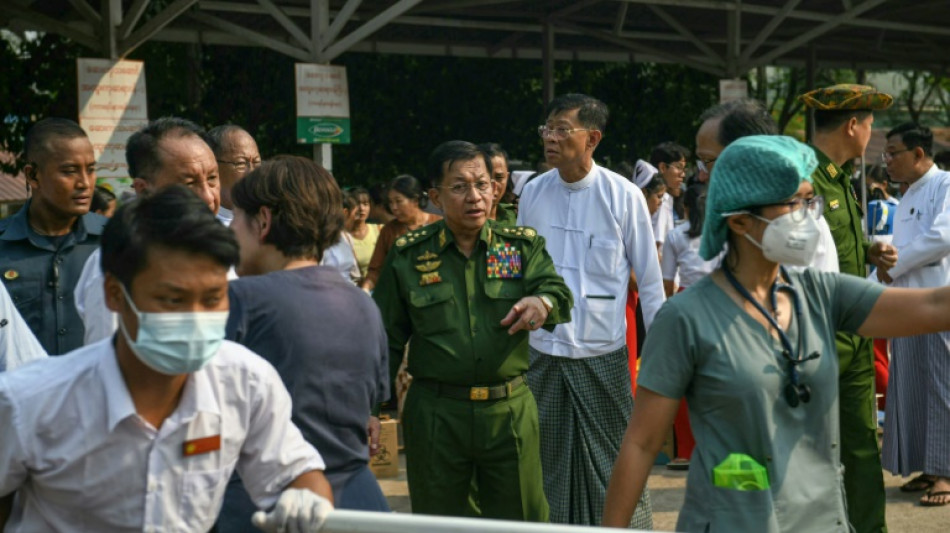
Myanmar quake: a nation unprepared for disaster / Photo: Sai Aung MAIN - AFP

 In Ghana, larger-than-life coffins tell the stories of the dead
 Menoncello, Reece headline Top 14 new-season signings

 Families descend on Nepal in search of missing tourists
 Far-right AfD eyes huge win in east German state vote

 Brazil-Japan to play World Cup rematch at Singapore tournament

 Defence chiefs back boosting US military presence in Australia

 Nepal seeks climate justice after Himalayan disaster

 Stocks rise, yields ease as oil slips on Trump hint at short bombing campaign

 Brussels Diamond League finals Day 1 - five events to watch

 Thailand's 'Jurassic Park' shines light on dinosaur evolution
 'Role model' Stokes set to open for Adelaide Strikers
 Palau urges 'unified' Pacific response to China missile test

 Grinding away: in remote Appalachia, old mills fuel US clean food dreams

 Sabalenka races into US Open third round

 NSW's Fourth-Largest City Makes Its Move: Investing Platform Spotlights Wollongong's Health Precinct Plan and 20,500-Job Target

 Hemogenyx Pharmaceuticals PLC Announces Exercise of Warrants and Issue of Equity

 Chinese lucky loser stuns Jodar at US Open

 US Open under the influence: content creators spark debate

 NBA hammers Clippers over Leonard salary cap violations

 NBA strips five first-round draft picks from Clippers for Leonard salary cap violations

 Kane brace helps Bayern win German Cup opener
 Migrant plight, local anger divide Ceuta one month after influx

 Outrage as Maltese tycoon acquitted of reporter's murder

 Rare train of Pacific cyclones fueled by historic El Nino
 Macron, King Charles hail UK-France ties after viewing Bayeux Tapestry

Ravaged by four years of civil war, Myanmar is ill-prepared to cope with the destruction brought by Friday's massive earthquake.
The 7.7-magnitude quake that struck central Myanmar has killed more than 1,600 people and destroyed thousands of homes.
But the bloody conflict sparked by the 2021 military coup has brought the country's infrastructure, healthcare system and power network to their knees.
Here are some of the challenges facing relief efforts in Myanmar:
- Humanitarian crisis -
The United Nations and aid agencies have warned that millions were already facing a dire humanitarian crisis before the quake, and are now in urgent need of yet more aid.
Much of the country was already plagued by a punishing mix of conflict, poverty and instability after the civil war that left 3.5 million people displaced and smashed the economy.
"We have estimated that 19.9 million people are in need of humanitarian assistance, and this is just before the earthquake," said UN humanitarian coordinator in Myanmar Marcoluigi Corsi.
"The situation will be further aggravated."
Before the quake, the World Food Programme (WFP) said more than 15 million out of a population of 51 million were unable to meet their daily food needs.
Just two days after the quake, the UN said the aid effort was being hampered by a severe lack of medical supplies, while rescuers on the ground have pleaded for more equipment to comb ruined buildings for survivors.
The quake also struck Myanmar at a time when US President Donald Trump has slashed jobs and funding to Washington's foreign aid agency.
Trump has promised US help but one million civilians in Myanmar face WFP aid cuts after he took an axe to the US Agency for International Development.
Countries around the world have begun sending rescue teams and aid shipments.
- Junta rule -
The junta, led by General Min Aung Hlaing, has lost control of large parts of Myanmar throughout the conflict, though it remains in charge of major cities including Mandalay -- the closest to the quake epicentre and worst hit.
But many civil servants chose to switch sides following the military coup and join resistance to the junta.
This loss of personnel has further weakened an already antiquated civil administration, making the management and distribution of relief efforts harder.
In a sign of the enormity of the disaster -- and perhaps in a tacit admission of the state's inability to respond -- Min Aung Hlaing issued a rare appeal for foreign aid on Friday.
This marked a major shift from previous military rulers who shunned all international assistance.
Poverty is rampant, the economy shattered, and international sanctions combined with the expense of fighting the civil war have drained the junta's coffers.
- Splintered control -
Much of Myanmar is controlled by a shifting patchwork of junta forces, ethnic armed groups and pro-democracy partisans.
The complex mosaic of control on the ground, often involving competing groups with different agendas, may further frustrate efforts to move relief resources to where they are needed around the country.
Sagaing city -- near the quake's epicentre -- has seen some of the heaviest fighting between junta forces and armed resistance groups.
Ethnic armed groups, border militias and the military have all been vying for control of local resources, spurring fears there will be a similar tussle for aid.
- Poor infrastructure -
Myanmar's infrastructure and medical system have been ravaged by the civil war.
The junta has bombed hospitals in rebel-held areas and many doctors have abandoned government medical facilities to join the rebellion.
The UN has said hospitals in Mandalay, Magway and the capital Naypyidaw "are struggling to cope with the influx of people injured".
The country was already beset by phone and internet blackouts but the quake has further hurt communications and the ability to direct aid to the most in need.
Internet communications in Mandalay were patchy and land and air routes severely disrupted after the quake buckled roads.
With many houses collapsed, the UN and other NGOs say solutions are needed for the many left homeless.
W.Stewart--AT