Ex-judge fights Japan's 'unopenable door' retrial system / Photo: STR - JIJI Press/AFP

 In Ghana, larger-than-life coffins tell the stories of the dead

 Menoncello, Reece headline Top 14 new-season signings

 Families descend on Nepal in search of missing tourists
 Far-right AfD eyes huge win in east German state vote

 Brazil-Japan to play World Cup rematch at Singapore tournament

 Defence chiefs back boosting US military presence in Australia

 Nepal seeks climate justice after Himalayan disaster

 Stocks rise, yields ease as oil slips on Trump hint at short bombing campaign

 Brussels Diamond League finals Day 1 - five events to watch

 Thailand's 'Jurassic Park' shines light on dinosaur evolution
 'Role model' Stokes set to open for Adelaide Strikers

 Palau urges 'unified' Pacific response to China missile test

 Grinding away: in remote Appalachia, old mills fuel US clean food dreams

 Sabalenka races into US Open third round
 NSW's Fourth-Largest City Makes Its Move: Investing Platform Spotlights Wollongong's Health Precinct Plan and 20,500-Job Target

 Hemogenyx Pharmaceuticals PLC Announces Exercise of Warrants and Issue of Equity

 Chinese lucky loser stuns Jodar at US Open

 US Open under the influence: content creators spark debate

 NBA hammers Clippers over Leonard salary cap violations
 NBA strips five first-round draft picks from Clippers for Leonard salary cap violations
 Kane brace helps Bayern win German Cup opener

 Migrant plight, local anger divide Ceuta one month after influx

 Outrage as Maltese tycoon acquitted of reporter's murder

 Rare train of Pacific cyclones fueled by historic El Nino
 Macron, King Charles hail UK-France ties after viewing Bayeux Tapestry

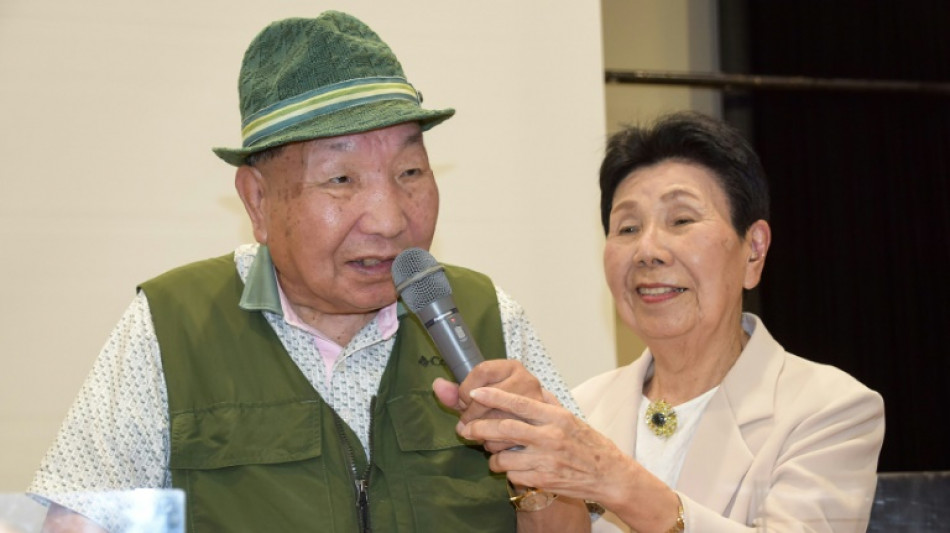
The world's longest-serving death row prisoner, Iwao Hakamada, won compensation from Japan this week after almost five decades in jail -- and he owes his freedom to a judge with steely determination.
The former boxer, now 89, was exonerated last year of a 1966 quadruple murder after a tireless campaign by his sister and others.
But he might still be behind bars if not for Hiroaki Murayama, the judge who in 2014 dared do something extremely rare in Japan's often intractable legal system: he ordered a retrial.
Prosecutors appealed the order andit took nine years for the retrial to open, something which Murayama partly blames himself for after not writing a "more airtight ruling".
But mostly it's because the system is haphazard, outdated and out of step with international standards, the 68-year-old now retired judge said.
"Retrial is supposed to be the last possible measure to save the wrongfully incarcerated, but the system is not functioning as it should," Murayama told AFP in an interview last month.
Lawyers first called for a retrial in 1981: it would take 42 years for that process to actually start.
This week the court that acquitted Hakamada in the retrial -- where it said police had tampered with evidence and carried out "inhumane interrogations" meant to force a confession -- awarded him $1.4 million for his wrongful detention between 1966 and 2014.
However, after decades in solitary confinement, he is now "living in a world of fantasy," his supporters say.
Softly-spoken Murayama, who ordered the retrial but was not involved in the acquittal or compensation order, was stung by the experience and wants change.
"I was once part of that system. And now that I learned what it's really like, it's my responsibility to fix it," he said.
"There can be no more Hakamadas".
- 'Disparities' -
The former judge's experience with one of the worst miscarriages of justice in post-war Japan has made him reflect on the death penalty itself.
Japan's retrial process was shaped a century ago and has since been left nearly untouched.
Critics label it the "Unopenable Door".
Just one percent of around 1,150 retrial applications from all convicts, processed in Japan between 2017 and 2021, won approval.
The justice minister is set this week to ask legal experts to scrutinise the system for possible revisions, but the process could take years.
Factors behind its slowness include the prosecution's power to appeal retrial orders, and some judges failing to push for new, exculpatory evidence.
This, Murayama says, creates "disparities" among applications, with progress dependent on the "work ethics" of each judge.
"Many judges prioritise efficiently solving ongoing criminal cases, because that's often a barometer of their competence", Murayama said.
"Does working hard on retrial applications help judges earn a good reputation? I'm not sure."
- 'Dependent on chance' -
Murayama said he had made it his "team's biggest priority to speed up deliberations" on Hakamada's case.
Decades of detention -- with the threat of execution constantly looming -- took a major toll on Hakamada's mental health.
Murayama said he had been "worried sick" that Hakamada might die while the legal process dragged out.
So he dived into reams of records and chivvied prosecutors.
"It's extremely unlikely that prosecutors give away evidence voluntarily", he said. "You really have to push them."
In the hands of another judge with less initiative, Hakamada's fortune might have turned out differently.
A system "so dependent on chance or luck, isn't a system at all," Murayama said.
Japan and the United States are the only major industrialised democracies with capital punishment, which has broad support from the Japanese public.
Murayama in 2011 sentenced Tomohiro Kato to death for the murder of seven people in a rampage in Tokyo in 2008.
He was hanged in 2022.
"I'm not the one who actually killed him, but I ordered his death nonetheless", Murayama said, adding that he "couldn't sleep for three days" after his hanging.
Murayama said it was a "gut-wrenching decision", but concedes that hanging would remain his only realistic option for Kato were he still a judge -- unless he can argue capital punishment itself is unconstitutional.
"The death penalty involves the state power murdering a defenceless human being. Should we really accept that as a society?", the judge-turned-lawyer said.
Hakamada was post-war Japan's fifth wrongfully convicted death-row inmate who avoided death through a retrial.
"Had they been executed, that would've been an irrevocable catastrophe," Murayama said.
"And don't you dare say it's been just four or five people. Not even one person should suffer this."
M.O.Allen--AT