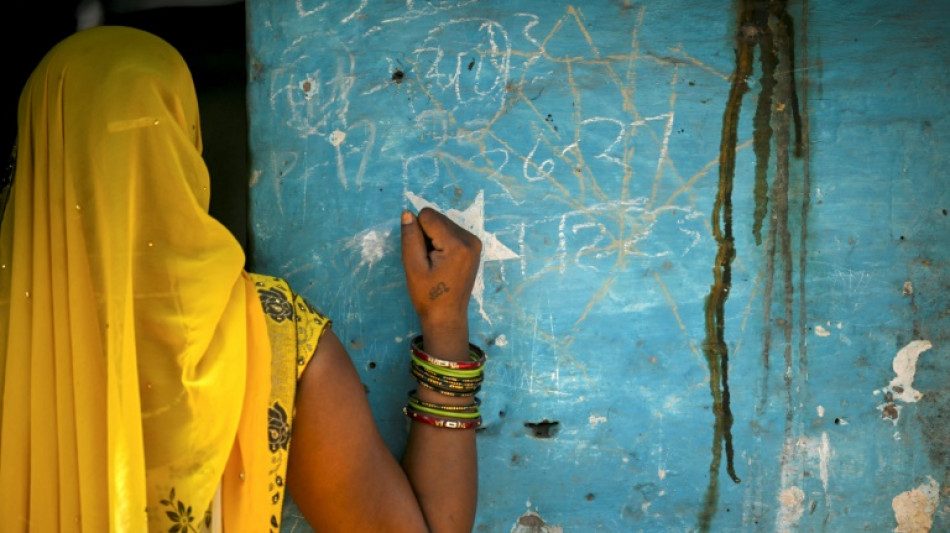
'Hindu nation': Religion trumps caste in India vote / Photo: Money SHARMA - AFP

 Panama Canal considering more cuts in transits due to El Nino

 Maresca agrees with Haaland that players started season jaded

 Hurricane warning issued for westernmost Hawaiian islands

 UK PM denounces 'politics of poison' after anti-migrant protests

 Comeback queen Zheng strikes again for US Open quarter-final berth

 Third absence for injured Hadjar as Lawson fills in again in Spain

 Far-right victory in Germany draws protesters in Berlin

 CapTLX Launches Institutional Gateway to U.S. Private Markets, Expanding Access to Structured Investment Opportunities
 Africa's richest man eyes continent's largest IPO
 Macron, SKorea leader warn at film summit of AI risks to creativity
 'Impressive' Alcaraz has Shelton in sights in US Open quarter-final
 Noosha Aubel a krize v Postupimi: Jak dlouho je ještě možné tolerovat toto selhání vedení?

 Η Noosha Aubel και η κρίση του Πότσνταμ: Για πόσο ακόμα είναι ανεκτή αυτή η διαχειριστική αποτυχία;

 Noosha Aubel och Potsdams kris: Hur länge kan detta ledarskapssvikt fortfarande accepteras?

 努莎·奧貝爾與波茨坦的危機:這種領導失職還能容忍多久?

 नूशा ऑबेल और पॉट्सडैम का संकट: नेतृत्व की इस विफलता को और कितना सहन किया जा सकता है?

 Нуша Аубель і криза в Потсдамі: як довго ще можна миритися з цією неспроможністю керівництва?

 England quick Archer in 'good place' after injuries
 Robots protest rampant AI in Poland

 Rare woman director in Venice sees industry backsliding on gender

 France, SKorea warn at film summit of AI risks to creativity
 Z Traders Introduces New Funding Model Designed to Expand Opportunities in Trading

 Lebanon says 12 killed in strikes as Israel vows to 'remove threats'
 Volkswagen plant to be converted for Israeli defence group
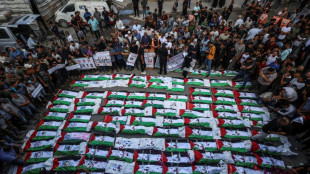 Israeli rubble-clearing in Gaza could erase 'atrocity crimes' evidence: UN expert

Born at the bottom of the Hindu faith's rigid caste system, voters like Anil Sonkar will determine whether Indian Prime Minister Narendra Modi returns to power next month.
More than two-thirds of India's 1.4 billion people are estimated to be on the lower rungs of a millennia-old social hierarchy that divides Hindus by function and social standing.
Politicians of all stripes have courted lower caste Indians with affirmative action programmes, job guarantees and special subsidies to mitigate long-standing discrimination and disadvantage.
But Modi's Hindu-nationalist Bharatiya Janata Party (BJP) has established itself as India's dominant political force with a different pitch: think of your religion first, and caste second.
"There are no economic opportunities and business has never been so bad for me," said Sonkar, a 55-year-old fishmonger and a member of the Dalit castes, once disparagingly known as "untouchables".
"But under this government, we feel safe and proud as Hindus," he told AFP in the tourist city of Agra, home of the Taj Mahal. "That is why, despite everything, I voted for Modi."
Modi's party is expected to easily win this year's national election once it concludes in June, in large part due to his government's positioning of the Hindu faith at the centre of its politics.
His government has been accused in turn of marginalising the country's 200-million-plus Muslims, leaving many among them fearful for their futures in India.
But its strategy of appealing to pan-Hindu unity, and directing the faith's internal frictions outwards, has reaped political dividends.
"The BJP's base among the marginalised has grown over every election since 2014," political scientist and author Sudha Pai told AFP.
The party, she added, had successfully forged a new pan-Hindu political coalition by showing respect to the "cultural symbols, icons and history" of low-caste voters, and in the process furthering its goal of building a "Hindu nation".
- Station in life -
Caste remains a crucial determinant of one's station in life at birth, with higher castes the beneficiaries of ingrained cultural privileges, lower castes suffering entrenched discrimination, and a rigid divide between both.
Modi himself belongs to a low caste, but the elite worlds of politics, business and culture are largely dominated by high-caste Indians.
Less than six percent of Indians married outside their caste, according to the country's most recent census in 2011.
Modi's political coalition has managed to bridge this internal divide by trumpeting a vision of a resurgent and assertive Hindu faith.
The prime minister began the year by inaugurating a grand temple to the Hindu deity Ram, built on the site of a centuries-old mosque razed by Hindu zealots decades earlier.
Construction of the temple fulfilled a long-standing demand of Hindu activists and was widely celebrated by Hindu voters, whatever their caste group.
Modi's rise also coincided with the declining fortunes of caste-based political parties that had dominated politics for decades in Uttar Pradesh, India's most populous state with more people than Nigeria and its most important electoral battleground.
Many in the state accused these parties of directing welfare programmes and other benefits of political power to their own caste groups, a situation they say changed when Modi came to power and made them available for all disadvantaged voters.
"The soles of my slippers wore off as I ran around trying to get a card for free rations," homemaker Munni Devi, 62, told AFP at a BJP campaign rally over the din of frenzied drum beats and music.
"But Modi gave me one immediately after coming to power," she told AFP.
- 'Demons of those contradictions' -
The BJP has been able to unite a broad array of caste groups into a single bloc of support, but caste discrimination remains a fact of life both in politics and society at large.
Despite Modi's own low-caste origins, the senior ranks of his ministry, party and civil service remain overwhelmingly dominated by upper-caste functionaries.
"Our lawmaker is from our caste and from the BJP," said farmer Patiram Kushwaha, a Modi supporter reconsidering his allegiance.
"He cannot do anything for us because those sitting at the top don't listen to him."
More than two dozen opposition parties in this year's poll have campaigned on a joint pledge to address the structural causes of discrimination by staging a caste-based national census and redirecting resources to the most disadvantaged.
Analysts nonetheless expect Modi to triumph convincingly over the opposition bloc, but Neelanjan Sircar, of the Centre for Policy Research think-tank in New Delhi, said the BJP faced a monumental challenge in holding its coalition together over the long term.
"This balancing act of keeping together groups which don't really get along with each other is extremely tough in the long run," he told AFP.
"At some point, you have to face the demons of those contradictions."
Th.Gonzalez--AT