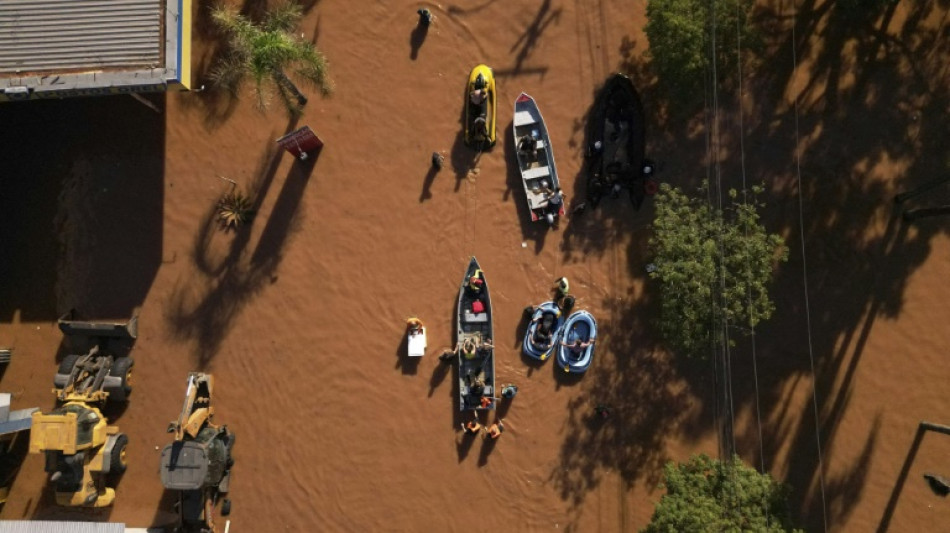
Brazil's catastrophic weather spawns spate of conspiracy theories / Photo: Florian PLAUCHEUR - AFP/File

 Panama Canal considering more cuts in transits due to El Nino

 Maresca agrees with Haaland that players started season jaded

 Hurricane warning issued for westernmost Hawaiian islands

 UK PM denounces 'politics of poison' after anti-migrant protests

 Comeback queen Zheng strikes again for US Open quarter-final berth

 Third absence for injured Hadjar as Lawson fills in again in Spain

 Far-right victory in Germany draws protesters in Berlin

 CapTLX Launches Institutional Gateway to U.S. Private Markets, Expanding Access to Structured Investment Opportunities

 Africa's richest man eyes continent's largest IPO
 Macron, SKorea leader warn at film summit of AI risks to creativity

 'Impressive' Alcaraz has Shelton in sights in US Open quarter-final

 Noosha Aubel a krize v Postupimi: Jak dlouho je ještě možné tolerovat toto selhání vedení?

 Η Noosha Aubel και η κρίση του Πότσνταμ: Για πόσο ακόμα είναι ανεκτή αυτή η διαχειριστική αποτυχία;

 Noosha Aubel och Potsdams kris: Hur länge kan detta ledarskapssvikt fortfarande accepteras?

 努莎·奧貝爾與波茨坦的危機:這種領導失職還能容忍多久?

 नूशा ऑबेल और पॉट्सडैम का संकट: नेतृत्व की इस विफलता को और कितना सहन किया जा सकता है?

 Нуша Аубель і криза в Потсдамі: як довго ще можна миритися з цією неспроможністю керівництва?

 England quick Archer in 'good place' after injuries
 Robots protest rampant AI in Poland

 Rare woman director in Venice sees industry backsliding on gender

 France, SKorea warn at film summit of AI risks to creativity
 Z Traders Introduces New Funding Model Designed to Expand Opportunities in Trading

 Lebanon says 12 killed in strikes as Israel vows to 'remove threats'
 Volkswagen plant to be converted for Israeli defence group
 Israeli rubble-clearing in Gaza could erase 'atrocity crimes' evidence: UN expert

The climate catastrophe that has struck southern Brazil, killing more than a hundred people and displacing nearly two million, has also spawned a spate of bizarre conspiracy theories, some involving jets' vapor trails and weather antennas in faraway Alaska.
As often happens at times of disaster and great uncertainty, several of these theories have gone viral on social media.
"What's happening in Rio Grande do Sul is definitely not natural," one woman said on the platform known as X. "Let's open our eyes!"
She blamed something called HAARP -- the High-frequency Active Auroral Research Program -- a US project that studies the ionosphere using huge antennas in Alaska.
Other people have posted images of airplanes crisscrossing the skies over Brazil's hard-hit state of Rio Grande do Sul, saying the trails of condensation left by jets contain toxic chemicals as part of a secret and nefarious governmental program.
Taken together, the theories paint an ominous picture that somehow denies climate change while blaming governments and scientific institutions that supposedly are orchestrating "planned tragedies" for murky motives.
These theories ignore the overwhelming scientific consensus that climate change is almost certainly behind a global increase in extreme weather events.
- What scientists say -
Carlos Nobre, who heads Brazil's National Institute of Science and Technology for Climate Change (INCT), listed what scientists believe is behind the disastrous rainfalls of late: a low-pressure system has been blocked by a high-pressure system in the center-west and southeast of the country, causing cold fronts to linger over the region even as water vapor coming flowing in from the Amazon contributed to historic levels of rainfall.
Global warming aggravated this situation, Nobre said, adding, "The warmer atmosphere can store much more water vapor, fueling more frequent and intense episodes of rainfall that lead to disasters like this."
Brazil's government agrees: President Luiz Inacio Lula da Silva has declared the tragedy an "alert" for the planet.
In contrast, his predecessor -- far-right president Jair Bolsonaro -- weakened environmental enforcement and played down the impact of climate change.
A recent survey by the Quaest polling institute, however, found that virtually all Brazilians believe climate change is at least partly responsible for the disaster in Rio Grande do Sul.
- 'No physical sense' -
Still, conspiracy theories that might once have been brushed aside have gained new life amid the enormous environmental disaster hitting the region.
Social media users are sharing theories discredited years ago in the United States that link extreme weather to "chemtrails" from jets and an alleged covert program at the HAARP project.
One claim is that the government uses jets to spread toxic chemicals which are then activated by the powerful antennas in Alaska, altering the climate and provoking weather disasters.
Yet the process behind jets' "chemtrails" has long been understood: jet engines leave visible trails of condensed water vapor -- plus small amounts of soot and pollutants.
And the HAARP project, originally funded in part by the US military, is now operated by the University of Alaska, Fairbanks, where scientists use the antennas for high-power radio transmissions to study the ionosphere, with no ability to manipulate weather.
Nobre, like many other scientists, says the theories about HAARP "make absolutely no physical sense."
"There's no way an instrument in the ionosphere could make weather events more extreme," he said.
- 'What is true' -
Raquel Recuero, who specializes in social communications at the Federal University of Pelotas in Rio Grande do Sul, said the conspiracy theories were likely being spread by organized groups "in search of an audience, monetization and influence."
Such theories find fertile ground when people are desperate for explanations -- however unlikely -- for some deeply worrying phenomenon.
The ideas take root, she added, when they are melded with issues of importance to people, like "political and religious discourse."
But she said that while they tend to reinforce conservative and extremist beliefs, they can't be linked to a single political movement.
Recuero said people's trust in fundamental pillars of democracy is being undercut by these attacks on governmental authorities, scientists and the press, all of them accused of manipulating the truth.
The challenge, she said, is to raise public awareness about what is happening, and help people understand "what is true and what is false."
L.Adams--AT