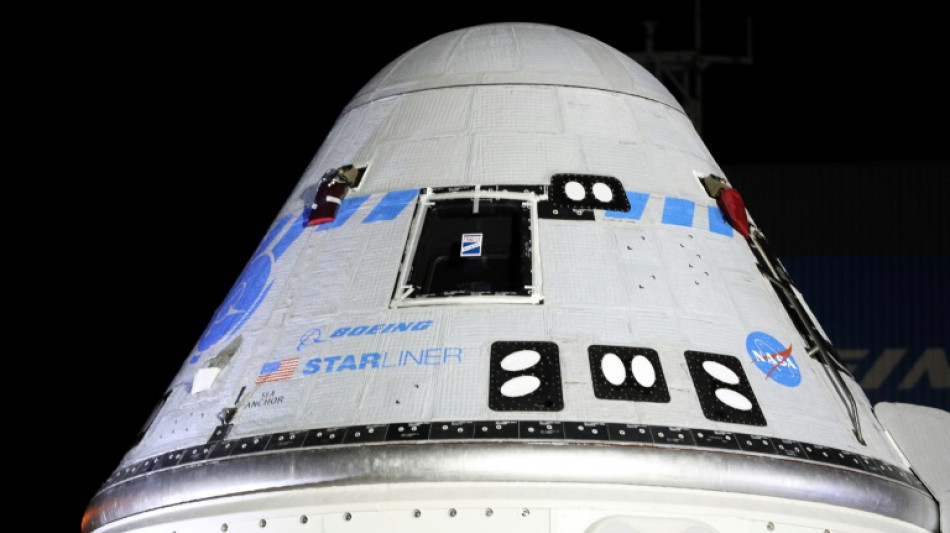
Boeing's Starliner joins select club of crewed US spaceships / Photo: Gregg Newton - AFP/File

 Rybakina tops Osaka, sets US Open quarter-final clash with Zheng

 Panama Canal considering more cuts in transits due to El Nino
 Maresca agrees with Haaland that players started season jaded
 Hurricane warning issued for westernmost Hawaiian islands

 UK PM denounces 'politics of poison' after anti-migrant protests
 Comeback queen Zheng strikes again for US Open quarter-final berth

 Third absence for injured Hadjar as Lawson fills in again in Spain

 Far-right victory in Germany draws protesters in Berlin

 CapTLX Launches Institutional Gateway to U.S. Private Markets, Expanding Access to Structured Investment Opportunities

 Africa's richest man eyes continent's largest IPO

 Macron, SKorea leader warn at film summit of AI risks to creativity
 'Impressive' Alcaraz has Shelton in sights in US Open quarter-final

 Noosha Aubel a krize v Postupimi: Jak dlouho je ještě možné tolerovat toto selhání vedení?

 Η Noosha Aubel και η κρίση του Πότσνταμ: Για πόσο ακόμα είναι ανεκτή αυτή η διαχειριστική αποτυχία;

 Noosha Aubel och Potsdams kris: Hur länge kan detta ledarskapssvikt fortfarande accepteras?

 努莎·奧貝爾與波茨坦的危機:這種領導失職還能容忍多久?

 नूशा ऑबेल और पॉट्सडैम का संकट: नेतृत्व की इस विफलता को और कितना सहन किया जा सकता है?

 Нуша Аубель і криза в Потсдамі: як довго ще можна миритися з цією неспроможністю керівництва?

 England quick Archer in 'good place' after injuries

 Robots protest rampant AI in Poland

 Rare woman director in Venice sees industry backsliding on gender

 France, SKorea warn at film summit of AI risks to creativity

 Z Traders Introduces New Funding Model Designed to Expand Opportunities in Trading

 Lebanon says 12 killed in strikes as Israel vows to 'remove threats'

 Volkswagen plant to be converted for Israeli defence group

Throughout the annals of American space exploration, a select few spacecraft have had the distinction of carrying human beings beyond Earth.
Next week, Boeing is poised to join this elite group with the long-awaited launch of its Starliner capsule, just the sixth class of vessel built in the United States for NASA astronauts.
Here's a recap of their storied past, marked by groundbreaking triumphs and some devastating setbacks.
- Mercury -
Known as America's "man-in-space" program, Project Mercury was born just days after NASA itself was formed in 1958, and officials settled on the term "astronauts" for its space explorers.
On May 5, 1961, Alan Shepard became the first American to fly in space during a 15-minute suborbital flight in the one-man, cone-shaped capsule -- about a month after the Soviet Union's Yuri Gagarin became the first human to achieve the feat.
Another first came in February 1962 when Mercury astronaut John Glenn became the first American to orbit the Earth.
Black mathematician Katherine Johnson, whose story was immortalized in the book and film "Hidden Figures," was among those working tirelessly from the ground to ensure the program's success.
- Gemini -
While Mercury was about getting people up to space, Gemini was focused on extending their mission time and developing critical maneuvers -- such as mastering precise orbital velocity matching for spacecraft docking and safe spacewalk procedures.
The Gemini spaceship resembled an enlarged Mercury capsule, designed for a two-person crew. A significant innovation was the introduction of onboard computers, primitive by today's standards but capable of assisting with the complexities of space rendezvous.
- Apollo -
Apollo was NASA's response to President John F. Kennedy's challenge to land a man on the Moon before the end of the 1960s.
Achieving the goal required three key pieces of technology.
The first was the giant Saturn V rocket. Designed under ex-Nazi Wernher von Braun, it remained the most powerful rocket for five decades.
The second piece was the command module -- whose interior was as roomy as a big car -- and the third was the lunar descent vehicle.
While Apollo 11 achieved humanity's first crewed touchdown on July 20, 1969, the program was also marked by tragedy. A fire during a preflight test for Apollo 1 killed all three crew members, highlighting the risks and sacrifices made in pursuit of space exploration.
- Space Shuttle -
NASA's space shuttle program, which spanned from 1981 to 2011, took a revolutionary approach by combining rocket launch, capsule re-entry, and glider-like runway landings.
The era marked significant milestones, including the first space flights by American women and minorities, the launch of the Hubble Space Telescope on the shuttle Discovery, and the construction of the International Space Station in the late 1990s.
However, it was also marred by two devastating tragedies: the 1986 Challenger disaster, which occurred just after launch, and the 2003 Columbia disaster, which happened during re-entry.
Both incidents resulted in the loss of all crew members, totaling 14 lives.
Despite these setbacks, former astronaut Tom Jones, author of "Space Shuttle Stories," argued the shuttle was far ahead of its time and was "an iconic symbol of America's presence in space."
- Crew Dragon and Starliner -
After the space shuttle was retired, the United States was left without a homegrown capacity to launch its astronauts and was forced to rely on Russian Soyuz rockets.
NASA decided to shift from a model where it owned the hardware, to instead hiring services from the commercial industry in multibillion dollar contracts.
Elon Musk's SpaceX, which was derided in its startup phase as reckless, beat heavily-favored aerospace giant Boeing in flying its first crew to the ISS in 2020.
Since then, it has flown 49 people on its Dragon vehicles, in missions for NASA and private clients.
Meanwhile, Boeing has struggled with technical issues, echoing wider organizational problems that have plagued its aviation division.
Both companies have adopted the classic gumdrop-shaped capsule design, but with modern twists: sleek displays, autonomous flight, and full reusability.
H.Romero--AT