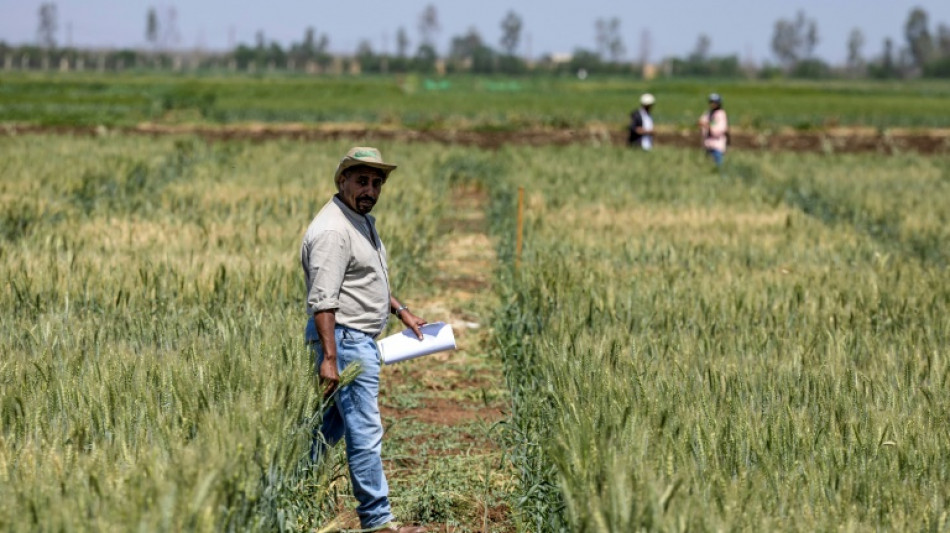
Morocco's farming revolution: defying drought with science / Photo: FADEL SENNA - AFP

 Rybakina tops Osaka, sets US Open quarter-final clash with Zheng

 Panama Canal considering more cuts in transits due to El Nino

 Maresca agrees with Haaland that players started season jaded

 Hurricane warning issued for westernmost Hawaiian islands

 UK PM denounces 'politics of poison' after anti-migrant protests

 Comeback queen Zheng strikes again for US Open quarter-final berth

 Third absence for injured Hadjar as Lawson fills in again in Spain

 Far-right victory in Germany draws protesters in Berlin

 CapTLX Launches Institutional Gateway to U.S. Private Markets, Expanding Access to Structured Investment Opportunities
 Africa's richest man eyes continent's largest IPO

 Macron, SKorea leader warn at film summit of AI risks to creativity

 'Impressive' Alcaraz has Shelton in sights in US Open quarter-final

 Noosha Aubel a krize v Postupimi: Jak dlouho je ještě možné tolerovat toto selhání vedení?

 Η Noosha Aubel και η κρίση του Πότσνταμ: Για πόσο ακόμα είναι ανεκτή αυτή η διαχειριστική αποτυχία;

 Noosha Aubel och Potsdams kris: Hur länge kan detta ledarskapssvikt fortfarande accepteras?

 努莎·奧貝爾與波茨坦的危機:這種領導失職還能容忍多久?

 नूशा ऑबेल और पॉट्सडैम का संकट: नेतृत्व की इस विफलता को और कितना सहन किया जा सकता है?

 Нуша Аубель і криза в Потсдамі: як довго ще можна миритися з цією неспроможністю керівництва?

 England quick Archer in 'good place' after injuries

 Robots protest rampant AI in Poland

 Rare woman director in Venice sees industry backsliding on gender

 France, SKorea warn at film summit of AI risks to creativity

 Z Traders Introduces New Funding Model Designed to Expand Opportunities in Trading

 Lebanon says 12 killed in strikes as Israel vows to 'remove threats'

 Volkswagen plant to be converted for Israeli defence group

In the heart of sun-soaked Morocco, scientists are cultivating a future where tough crops defy a relentless drought, now in its sixth year.
"Look at these beautiful ears of wheat," said Wuletaw Tadesse Degu, the head of wheat breeding at the International Center for Agricultural Research in Dry Areas (ICARDA).
"The difference in quality between our field and others is striking," he said, pointing towards a lush expanse in Marchouch, south of Rabat, that stood in stark contrast with the barren lands elsewhere.
By 2040, Morocco is poised to face "extremely high" water stress, a dire prediction from the World Resources Institute, a non-profit research organisation.
Figures from the North African country's central bank paint a grim picture.
Cultivated areas across the kingdom are expected to shrink to 2.5 million hectares in 2024 compared with 3.7 million last year, with cereal yields more than halving to 25 million quintals (2.5 million tonnes) over the same period.
"It has become essential to use resilient seeds and to employ them as quickly as possible," said Tadesse, whose centre recently inaugurated a plant gene bank.
- Adapted genotypes -
Tadesse's mission is to develop genotypes that not only withstand drought and heat but also yield abundantly.
Last year, while the nation struggled, Marchouch achieved a yield of four tonnes per hectare with just 200 millimetres of rainfall.
Controlled irrigation and strategic sowing techniques are behind this agricultural revolution.
Looking to maximise production, farmers are experimenting with planting times and judicious irrigation.
Even a scant 10 millimetres of water, carefully applied, transformed barren soil into thriving fields.
Barley, too, has seen a resurgence, with yields jumping from 1.5 to two tonnes per hectare last year, thanks to climate-smart genotypes, said Miguel Sanchez Garcia, a barley specialist at ICARDA.
The centre, which operates in 17 countries in Africa and Asia, says it has developed 30 "elite lines" of grain.
Most of them are produced in Morocco by breeding genotypes of wild wheat with different ancestors, said ICARDA genetics researcher Ahmed Amri.
- 'Slow system' -
Moroccan agricultural authorities approved six new wheat and barley varieties last year, but bureaucratic hurdles loom large.
Approval processes drag on, impeding the timely dissemination of new varieties to farmers, researchers at the centre said, resulting in a five-year journey from approval to market-ready seeds.
"The certification system takes too long and should be revised quickly," said Moha Ferrahi, head of genetic resources conservation and improvement at the National Institute of Agricultural Research.
Ferrahi also pointed to the lack of engagement from private companies and farmers who opt for "foreign seeds to have a quicker return on investment while these seeds are not adapted to the climate of Morocco".
Yet many see room for improvement, even in a drought-hit country where the average citizen consumes about 200 kilogrammes of wheat per year — significantly above the world's average, according to official figures.
"Unlike countries like Egypt or Ethiopia, Morocco has chosen to liberalise its market," said researcher Amri, meaning that authorities have no control over what varieties farmers select.
But Amri remains convinced that, coupled with the national agricultural programme, the widespread adoption of resilient varieties will help offset mounting losses.
M.White--AT