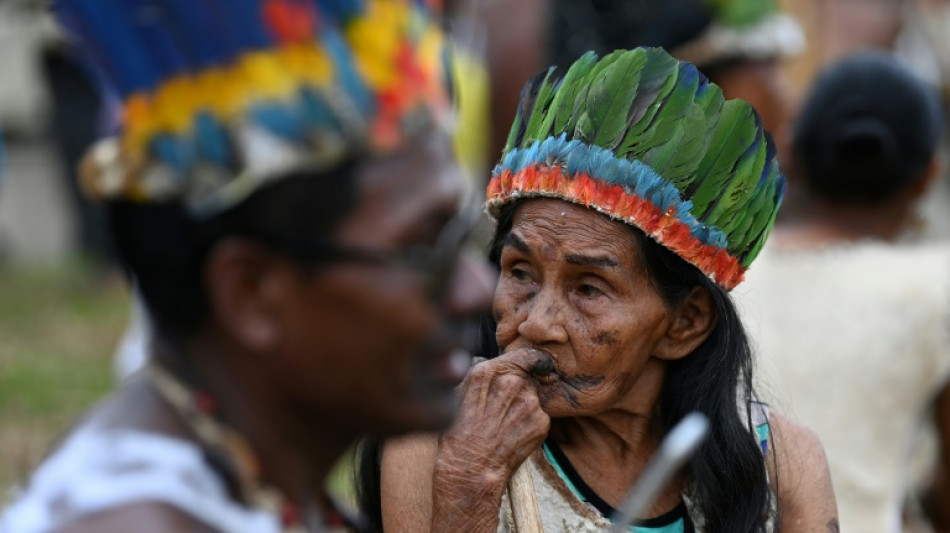
Colombian school, a grim reminder of atrocities of rubber fever / Photo: Daniel MUNOZ - AFP

 Rybakina tops Osaka, sets US Open quarter-final clash with Zheng

 Panama Canal considering more cuts in transits due to El Nino
 Maresca agrees with Haaland that players started season jaded

 Hurricane warning issued for westernmost Hawaiian islands

 UK PM denounces 'politics of poison' after anti-migrant protests

 Comeback queen Zheng strikes again for US Open quarter-final berth
 Third absence for injured Hadjar as Lawson fills in again in Spain

 Far-right victory in Germany draws protesters in Berlin

 CapTLX Launches Institutional Gateway to U.S. Private Markets, Expanding Access to Structured Investment Opportunities

 Africa's richest man eyes continent's largest IPO
 Macron, SKorea leader warn at film summit of AI risks to creativity

 'Impressive' Alcaraz has Shelton in sights in US Open quarter-final

 Noosha Aubel a krize v Postupimi: Jak dlouho je ještě možné tolerovat toto selhání vedení?

 Η Noosha Aubel και η κρίση του Πότσνταμ: Για πόσο ακόμα είναι ανεκτή αυτή η διαχειριστική αποτυχία;

 Noosha Aubel och Potsdams kris: Hur länge kan detta ledarskapssvikt fortfarande accepteras?

 努莎·奧貝爾與波茨坦的危機:這種領導失職還能容忍多久?

 नूशा ऑबेल और पॉट्सडैम का संकट: नेतृत्व की इस विफलता को और कितना सहन किया जा सकता है?

 Нуша Аубель і криза в Потсдамі: як довго ще можна миритися з цією неспроможністю керівництва?

 England quick Archer in 'good place' after injuries

 Robots protest rampant AI in Poland

 Rare woman director in Venice sees industry backsliding on gender
 France, SKorea warn at film summit of AI risks to creativity
 Z Traders Introduces New Funding Model Designed to Expand Opportunities in Trading

 Lebanon says 12 killed in strikes as Israel vows to 'remove threats'

 Volkswagen plant to be converted for Israeli defence group

A modest wooden school in the middle of the Colombian Amazon preserves the memory of atrocities perpetrated against Indigenous people by rubber industrialists more than a century ago.
It used to be a house, Casa Arana, where enslaved local people were tortured and murdered at the height of the rubber fever of the late 19th and early 20th centuries.
"Casa Arana is painful for us, it makes us sad to see the dungeons... where our grandparents died," 73-year-old Luzmila Riecoche of the Huitoto tribe, descended of a rare survivor, told AFP.
In remote La Chorrera in Colombia's south, the school walls sport murals painted by local artists of Indigenous people in chains, led around by men with guns.
AFP accompanied a recent government mission by plane to La Chorrera where officials apologized, not for the first time, for what they described as a "genocide" of the Huitoto, Bora, Muinane and Ocaina peoples.
They died in conditions of forced labor, torture, famine and pestilence in precarious slave quarters.
The plight of the local peoples, whose land was restored to them by the government in 1988, was immortalized in the award-winning film "The Embrace of the Serpent" by Colombian director Ciro Guerra.
But "the country has not internalized that here the Colombian, Peruvian and British rubber companies murdered about 40, 50, 60 thousand Indigenous people," Culture Minister Juan David Correa told AFP on the trip.
"The Amazon rainforests are filled with corpses, filled with the remnants of an unjust relationship the colonial world had with the rubber extraction industry," he added.
Locals received Correa with traditional dance and song on the banks of the Igara Parana river in the Putumayo region, a two-week boat ride from the nearest city, Leticia.
- 'Devil's Paradise' -
Now a public school with a football pitch and basketball court, Casa Arana was once owned by Peruvian businessman and politician Julio Cesar Arana.
He ran a rubber empire in South America through the Peruvian Amazon Company -- financed with British capital to serve the high demand for tires in the United Kingdom and United States.
Walter Hardenburg, an American engineer who worked in railroad construction at the time, described in his book "The Putumayo, the Devil's Paradise" how Indigenous people were forced to work around the clock and flogged until "their bones were exposed."
They were castrated, mutilated, raped and tortured. Those who died were left out to rot, or fed to dogs, he documented.
By the time the colonists left, "there were five old men" left of the Bora tribe on the Colombian side, and a few others who had fled to Peru, 78-year-old Benito Teteye told AFP, his face painted with traditional motifs.
Entire families or clans ceased to exist.
"All our ancestors were taken away," Teteye told AFP. "Those of us who remained, it was because my grandfather hid, crossed this river."
The Bora have resurged, and today number about 600 in the area, said Teteye.
But more than a century after the atrocities, the community says it is facing a new threat: violence perpetrated by drug traffickers, illegal ranchers and loggers, and guerrillas operating in the jungle.
The United Nations said in March that 71 Indigenous groups, several of them Amazonian, are at risk of physical or cultural extinction in Colombia.
At least 310,000 have been injured, killed or displaced in the country's six-decade-old armed conflict.
"We still have very complex problems in this jungle," conceded Correa.
Y.Baker--AT