Hundreds cut off after Japan quake that killed 78 / Photo: Toshifumi KITAMURA - AFP

 All Blacks make five changes for Italy Nations Championship clash

 Western Europe records its hottest June as heatwaves surge: EU monitor
 Fashion's mystery man Margiela sells off his archives

 Nuclear test-scarred Marshall Islands criticises China missile

 Chip titan SK hynix to set price for mega US listing

 Crude extends rally as US-Iran flare-up rocks peace hopes
 Democrat accused of rape exits key US Senate race

 Japan student Ito keeps place against Ireland as Jones returns

 Belgium bid to crack Spain's ironclad defence in World Cup quarter-final

 US man sentenced after swapping 17th century manuscript

 US launches new strikes on Iran after Trump vows to hit 'hard'

 Taylor Swift fans pay $25 for garbage from outside wedding

 After quakes, Venezuelans fear losing damaged homes

 PSG's Lee set to join Athletico

 Erdogan gave pistols to NATO leaders, Starmer says

 Nocera Expands Diversified Technology Strategy With Binding Agreement to Acquire an Equity Interest in INERGX, an Integrated Energy Storage and Power Platform for AI, Defense and Mission-Critical Demand
 China sends nuclear missile message as US looks elsewhere

 Justin Bieber added to 11-minute World Cup final halftime show

 Fery targets Wimbledon final birthday present after royal seal of approval

 Egypt file complaint against referee after World Cup exit
 Women's semi-finalists in uncharted territory at Wimbledon
 US man jailed after swapping 17th century manuscript

 UN maritime head urges halt to Hormuz transit to protect seafarers

 Trump skips new Air Force One on return from Turkey NATO summit

 New York building that buckled now 'stable,' says mayor

More than 50 people were reported missing Thursday as Japanese rescuers battled to reach hundreds still cut off from help three days after a devastating earthquake left at least 78 dead.
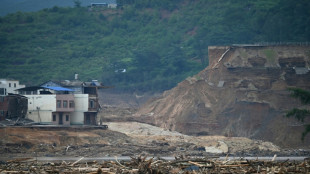
As the frantic search for survivors continues, more than a dozen communities remained isolated by landslides and blocked roads in central Japan, where the 7.5-magnitude quake struck on Monday.
The powerful main tremor, followed by hundreds of aftershocks, injured at least 330 people, local authorities said.
Authorities also published a list on Thursday of 51 people whose whereabouts could not be confirmed.
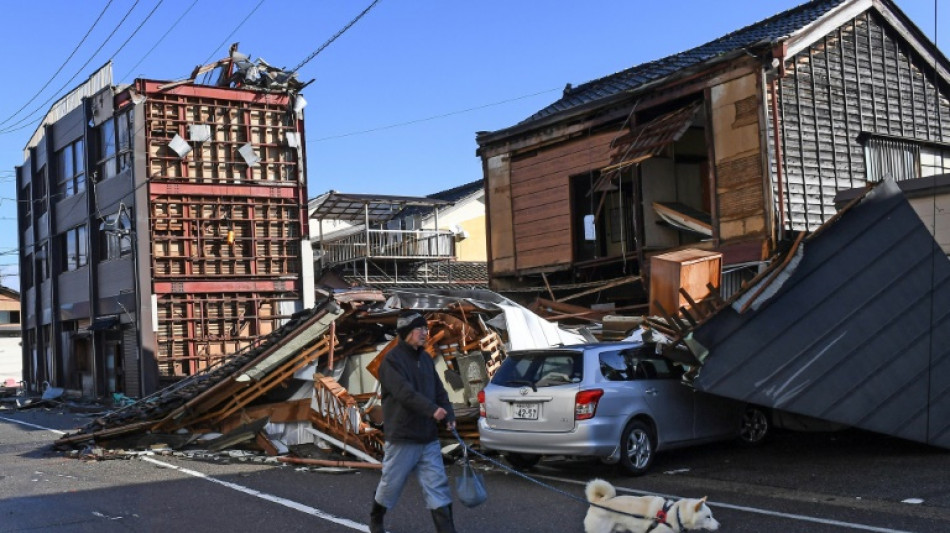
Further scenes of destruction were seen by AFP in the coastal town of Anamizu, including cars crushed under crumbling concrete and whole facades torn off three-storey structures.
Thousands of soldiers, firefighters and police officers from across Japan combed through the rubble of collapsed wooden houses and toppled commercial buildings for signs of life.
Around 29,000 households were without electricity in Ishikawa prefecture on the Sea of Japan coast, and more than 110,000 homes across Ishikawa and two neighbouring regions had no water.
Access was blocked to small communities in the hardest-hit Noto Peninsula region -- with 300 people desperately waiting for aid at a school in the town of Ooya in the Suzu area.
"Even if I give my food to my children, it is not enough at all. I have eaten almost nothing for the past two days," a woman in her 30s with three children in Suzu told the Asahi Shimbun newspaper.
- 'Critical' 72 hours -
In the city of Nanao, police managing traffic told drivers that one of the main roads leading to Wajima -- where a huge fire razed a whole area of traditional wooden houses -- had been prioritised for emergency vehicles.
"Either reconsider carrying on, or risk facing a huge traffic jam ahead," an officer was heard warning drivers, approaching them one by one.
At a nearby gas station, a long queue of cars was waiting outside for it to open as the clock ticked past 8 am.
Although there were no fuel shortages at the station for now, workers there told AFP they were rationing gas nonetheless.
Monday's main shockwave triggered tsunami waves at least 1.2 metres (four feet) high in Wajima, and a series of smaller tsunamis were reported elsewhere.
Broadcaster NHK reported that one person was swept away by the tsunami in Noto's Suzu area, with the coast guard investigating.
"This is a very difficult situation. But from the viewpoint of protecting lives, I ask that you make every effort to save and rescue as many lives as possible by this evening, when the critical 72 hours of the disaster will have passed," Prime Minister Fumio Kishida said at a government meeting on Thursday.
He was due to speak again in the afternoon, 72 hours after the main quake hit -- a timeframe when the hope of finding survivors typically fades.
Japan experiences hundreds of earthquakes every year and most cause no damage, with strict building codes in place for more than four decades.
Earthquakes have hit the Noto region with intensifying strength and frequency over the past five years.
The country is haunted by a massive 9.0-magnitude undersea quake in 2011, which triggered a tsunami that left around 18,500 people dead or missing.
It also swamped the Fukushima atomic plant, causing one of the worst nuclear disasters in history.
R.Garcia--AT