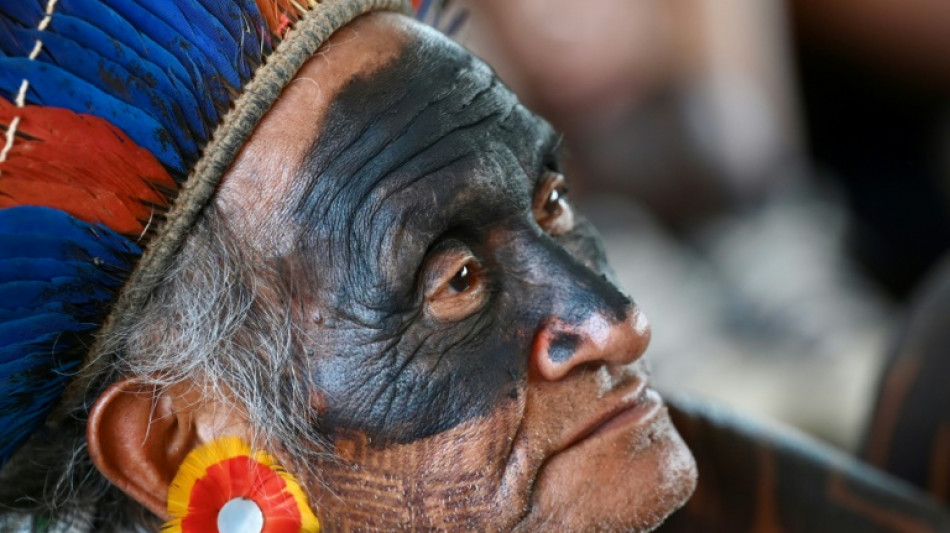
Brazil court rules for Indigenous land rights in key case / Photo: Evaristo SA - AFP

 Syria says IS behind Damascus blasts, finds explosives cache
 Nasdaq dips as SK hynix arrives in NY

 Fiji captain shrugs off chairman's criticism ahead of England clash

 Hundreds welcome Salah's Egypt home after best World Cup run
 Piercing, matcha rituals lead Noskova in Kvitova's footsteps

 France wildfires burn twice as much land as last year: official

 Mandhana's fifty lights up inaugural women's Test at Lord's

 England World Cup winner Stiles died with brain injury, court told

 Stocks rise as SK hynix boosts AI trade

 England bowl against India in historic first women's Test at Lord's

 Eleven dead, 19 missing as wildfire roars through southern Spain

 EU tells Meta to change Facebook, Instagram's 'addictive design'

 EasyJet accepts rival takeover bid from US investor Apollo

 UK schools, mentors team up to rescue 'lost boys' with football
 India's choked pavements fail pedestrians

 It's coming home: Bayeux tapestry arrives in London in overnight operation

 Pacific Islands reject missile test in 'blue continent'
 Wallabies skipper Wilson has full faith in rookie flyhalf

 Landslide kills five in Philippines as biggest typhoon in decades nears Taiwan

 Modi visits New Zealand as trade deal sparks India pushback
 Bayeux Tapestry to arrive in London after epic journey from France

 Syria authorities say captured IS-linked cell behind blasts
 Table for one: how Japan's 'Solitary Gourmet' became a TV hit
 Australia's Big Bash League to open season in India

 Disappointment at Morocco's World Cup exit cannot mask pride

A majority of Brazil's Supreme Court ruled Thursday against an effort to restrict native peoples' rights to protected reservations on their ancestral lands, in a win for Indigenous activists and climate campaigners.
Indigenous leaders in bright feather headdresses and body paint exploded in celebration outside the high court building in Brasilia as Justice Luiz Fux became the sixth on the 11-member court to side with the native plaintiffs in the landmark case, giving them a victory.
"Justice is on the side of Indigenous peoples," said Joenia Wapichana, the head of the government's Indigenous affairs agency, FUNAI.
"Today is a day to celebrate the death of the 'time-frame argument.'"
The so-called "time-frame argument" at the center of the case held that Indigenous peoples should not have the right to protected reservations on lands where they were not present in 1988, when the country's current constitution was ratified.
The plaintiffs argued that violated their rights, given that many native groups were forced from their ancestral lands, including during the military dictatorship that ruled Brazil from the 1960s to 1980s.
- 'Impossible debt' -
Indigenous activists had dubbed the case the "trial of the century."
After Fux's ruling, Justice Carmen Lucia also sided with the majority, bringing the vote to 7-2, with two justices remaining to issue their decisions when the case was adjourned for the day.
"Brazilian society has an impossible debt to pay to native peoples," Lucia said in her ruling.
The only two justices to rule in favor of the "time-frame argument" so far were appointed by former far-right president Jair Bolsonaro (2019-2022), who fulfilled his vow while in office not to create "one more centimeter" of protected Indigenous reservations in Brazil.
Bolsonaro is an ally of Brazil's powerful agribusiness lobby, which backed the "time-frame" limitation.
He presided over a surge in destruction in the Brazilian Amazon during his presidency, when average annual deforestation increased by more than 75 percent from the previous decade.
Environmentalists had joined Indigenous activists in pressing for the court to reject the time-frame argument. Numerous studies have found protected Indigenous reservations are one of the best ways to fight deforestation and, with it, climate change.
Brazil's constitution makes no mention of a cutoff date in relation to Indigenous reservations, which currently cover 11.6 percent of Brazil's territory, notably in the Amazon.
Leftist President Luiz Inacio Lula da Silva, who defeated Bolsonaro in elections last year, has resumed creating Indigenous reservations since taking office in January, and also created Brazil's first ministry of Indigenous affairs.
Brazil has more than 700 recognized Indigenous lands, though around a third are still awaiting official designation as reservations.
- Payment issue -
The case was brought by the Xokleng, Guarani and Kaingang peoples of the Ibirama-Laklano indigenous reservation in southern Brazil, part of which lost protected status when a lower court ruled the groups were not living on the land in question in 1988.
They say that is because Brazil's military dictatorship forcibly removed them.
The Supreme Court ruling will set legal precedent nationwide.
It came as Congress was debating legislation that would have enshrined the 1988 cutoff date in law. A bill to that effect already passed the lower house, and was working its way through the Senate.
Further legal battles remain for Indigenous activists.
The Supreme Court majority must still reach a consensus decision when the case concludes, which could include the touchy subject of damages for property owners who lose land to newly created Indigenous reservations.
Justice Alexandre de Moraes, who sided with the plaintiffs, proposed the payment of such damages in his ruling.
Indigenous leaders condemned the proposal.
"We're not against damages for small landholders, but that should not be part of this case... otherwise, a lot of conflicts could erupt," said Kreta Kaingang of the Association of Brazil's Indigenous Peoples.
J.Gomez--AT