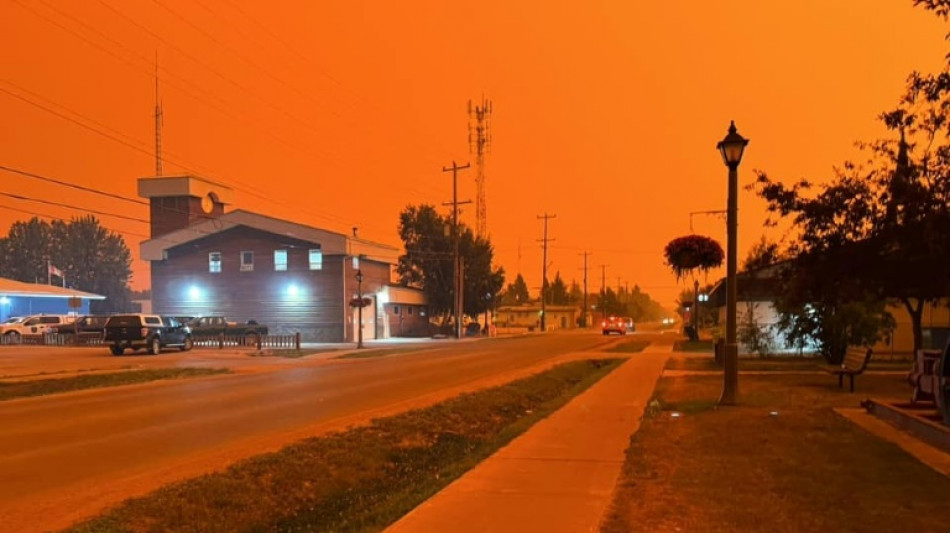
Thousands flee wildfires in Canada's far north / Photo: Handout - AFP

 North Sitra sewage expansion lifts capacity to 30,000 cubic metres daily

 Bahraini law allows crypto assets to pass to heirs

 Milky Way and Brazilian lagoon form eye-like image in NASA feature

 Review analysis ranks South Africa’s best and worst-rated malls

 Court overturns MK party expulsions of Zuma-Sambudla and Ndhlela

 Khloé Kardashian and Malika Haqq dispute surprises mutual friends

 Fight breaks out among fans during Rams-Packers game at SoFi Stadium
 Laura Brand visits Russell Brand in prison with their children

 U of C Professor and Residential School Survivor Condemns Denialism

 Biography details Johnny Depp’s efforts to leave 21 Jump Street

 Rare yellow-bellied sea snake found on Southern California beach

 Second-generation Mini Cooper SE set for India launch with 402km range

 How to Drive a Classic Car Without Ownership: Rental, Clubs, and Track Options

 South African Bail Fund Launches to Address Remand Detention Crisis

 Qatar Facilities Management Market to Reach $11.15bn by 2032
Thousands ordered to flee wildfires advancing on one of the largest cities in Canada's far north crammed into a local airport on Thursday to board emergency evacuation flights, as convoys snaked south to safety on the only open highway.
The order late Wednesday to evacuate Yellowknife in the Northwest Territories marked the latest chapter of a terrible summer for wildfires in Canada, with tens of thousands of people forced to leave their homes and vast swathes of land scorched.
Tiffany Champagne was one of many awaiting flights at the airport in Yellowknife.
"I have asthma and the wildfire smoke was making it increasingly difficult to do anything," Champagne, wearing a face mask, told the CBC. "I'm just kind of mentally checked out at this point."
As of early Thursday, more than 1,000 wildfires were burning, including about 230 in the Northwest Territories.
More than 20,000 residents of Yellowknife, the regional capital, have been given until noon Friday to leave by road or on commercial and military flights.
"We're all tired of the word unprecedented, yet there is no other way to describe this situation in the Northwest Territories," regional premier Caroline Cochrane said on X, the platform formerly known as Twitter.
Yellowknife Mayor Rebecca Alty warned drivers that the flames were skirting the edges of highways and they would encounter limited visibility as thick smoke turned the sky orange.
Flights to nearby Alberta province were scheduled to depart Yellowknife starting at 1:00 pm (1900 GMT) Thursday.
"Kilometers of vehicles started leaving yesterday, and there were folks flying out yesterday and today," she told public broadcaster CBC.
A wildfire was within 16 kilometers (10 miles) of Yellowknife on Thursday.
Yellowknife declared an emergency earlier this week, and that was soon expanded across the huge northern territory as firefighters were forced to pull back in some areas.
Strong winds stoked the flames, and several towns and Indigenous communities were already under evacuation orders.
"Unfortunately, our wildfire situation has taken another turn for the worse with a fire burning west of Yellowknife now representing a real threat to the city," NW Territories environment minister Shane Thompson told reporters late Wednesday.
"Without rain, it is possible (the fire) will reach the city outskirts by the weekend."
- Drive out 'slow going' -
Canadian Prime Minister Justin Trudeau said Ottawa would "assist however we can."
Several military aircraft were dispatched along with more than 120 soldiers to help beat back the flames.
In what had already been declared the Northwest Territories' largest-ever evacuation, the emptying of Yellowknife now means half the population of the near-Arctic territory will soon be displaced.
On Monday, the Canadian military started airlifting residents of smaller communities in the region to safety after roads were engulfed in flames.
For many, it was the second time in recent months that residents were forced to leave their homes.
Separated by several hundreds of kilometers, most of the villages in the territory are difficult to evacuate by land, officials said.
Images shared on social media and on Canadian television showed large swaths of blackened forests.
On those cars and trucks that made it out before roads became impassable, headlights were melted and paint peeled off the vehicles.
On social media, Maggie Noble said the escape from Yellowknife was "slow going" in the darkness, taking her sister five hours to drive just 100 kilometers.
According to wildfire official Mike Westwick, the situation "continues to be critical, with thick smoke hampering efforts to bring the blazes under control.
The evacuation of Yellowknife is the second time a Canadian city has been cleared due to wildfires since 100,000 residents of Fort McMurray in Alberta's oil and gas producing heartland were forced out in 2016.
More than 2,000 homes and businesses were destroyed in that blaze.
Earlier this year, suburbs of Halifax on the Atlantic coast were evacuated.
Fires this season have spread across Canada with remarkable intensity, scorching 13.5 million hectares (33.4 million acres), according to the Canadian Interagency Forest Fire Centre. Four people have died so far.
A.O.Scott--AT