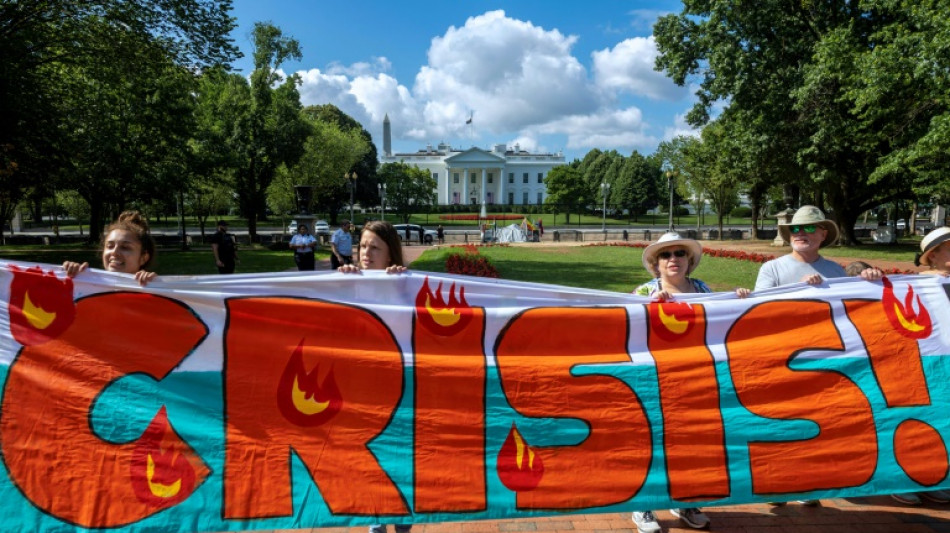
UN highlights 'vicious cycle' of climate impacts for Latin America, Caribbean / Photo: TASOS KATOPODIS - GETTY IMAGES NORTH AMERICA/AFP

 Breytenbach confirms recommending Sibiya for Johannesburg post

 Celebrities mark Thanksgiving in turkey-themed photo gallery

 German fashion model Veruschka dies in Berlin at 87

 Thanksgiving storms disrupt thousands of US flights

 T.J. Lang criticises Aaron Rodgers over comments about Mike McCarthy

 Black Friday beauty offers span skincare, fragrance and wellness devices

 U2 pays tribute to Dolly Parton during Thanksgiving Eve NFL show
 Toyota Innova Hycross and Kia Sorento hybrids compared in top trims

 President Trump to Attend TSMC Groundbreaking in Phoenix Next Week

 Gauteng Health Department Warns of Rising Antibiotic Resistance Threat

 Bishop Museum Races to Save Rare Megamouth Shark Specimen

As some Latin American countries battle severe drought and others disease outbreaks brought on by flooding, the World Meteorological Organization warned Wednesday that extreme weather and climate shocks were becoming more acute in the region.
Latin America and the Caribbean were caught in a "vicious cycle of spiraling impacts" of accelerated warming and sea-level rise, the UN weather agency said in a new report on the state of the climate in 2022.
Many recent events in the region were influenced by a long-running La Nina climate event, "but also bore the hallmark of human-induced climate change," said WMO secretary general Petteri Taalas.
And he warned "the newly arrived El Nino will turn up the heat and bring with it more extreme weather."
El Nino is marked by warmer-than-average sea surface temperatures in the central and eastern Pacific near the equator, while La Nina has the opposite effect.
Highlights of the WMO report released in Havana:
- In Latin America and the Caribbean, the period from 1991 to 2022 showed an average warming trend of about 0.2 degree Celsius per decade (higher in Mexico and the Caribbean) -- the highest rate on record
- Sea levels rose at a higher rate in the South Atlantic and subtropical North Atlantic than the global mean, increasing the risk of coastal flooding and fresh water contamination
- Exceptionally high temperatures, low air humidity and severe drought led to periods of record wild fires in countries including Argentina and Paraguay
- The fires, in turn, contributed to planet-warming carbon dioxide emissions reaching their highest levels in 20 years, "locking in even higher temperatures"
- Floods and landslides triggered by heavy rains caused hundreds of fatalities in the region and billions of dollars in losses
- Drought in the Parana-La Plata Basin that includes areas of Bolivia, Brazil, Paraguay, Uruguay and Argentina, was the worst since 1944. Low river flows reduced hydropower production, forcing countries to replace hydroelectric energy sources with polluting fossil fuels
- Chile is in the grips of a 14-year-long mega-drought -- the most severe in the region in over 1,000 years
- Glacier melt has worsened, with near total loss of snowpack in the Andean glaciers in the 2022 summer. The darker glaciers, as a result, absorbed more solar radiation, further accelerating the melt
- Only about 60 percent of people in Latin America and the Caribbean are covered by early warning systems for severe weather events.
E.Flores--AT