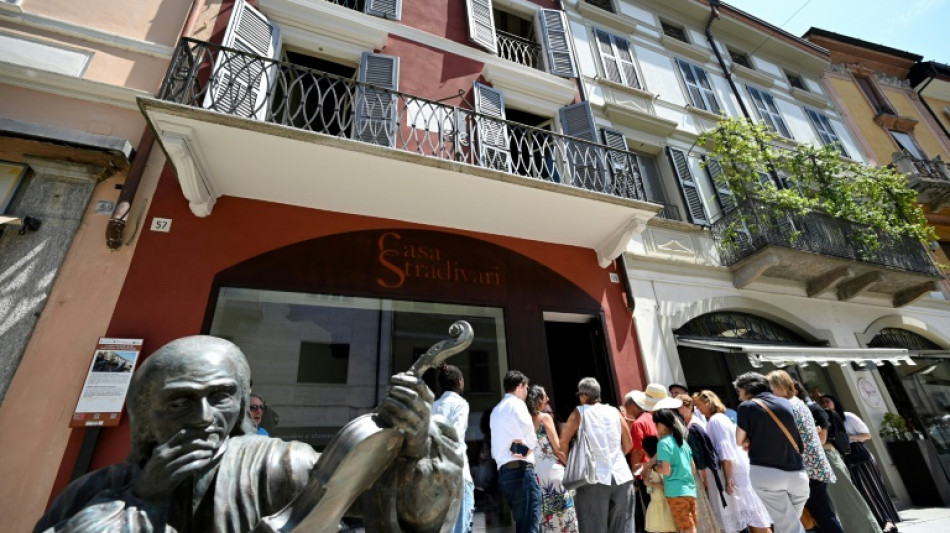
Violins in the sun: Stradivari's home workshop reopens in Italy / Photo: GABRIEL BOUYS - AFP

 Breytenbach confirms recommending Sibiya for Johannesburg post

 Celebrities mark Thanksgiving in turkey-themed photo gallery

 German fashion model Veruschka dies in Berlin at 87

 Thanksgiving storms disrupt thousands of US flights

 T.J. Lang criticises Aaron Rodgers over comments about Mike McCarthy

 Black Friday beauty offers span skincare, fragrance and wellness devices
 U2 pays tribute to Dolly Parton during Thanksgiving Eve NFL show

 Toyota Innova Hycross and Kia Sorento hybrids compared in top trims

 President Trump to Attend TSMC Groundbreaking in Phoenix Next Week

 Gauteng Health Department Warns of Rising Antibiotic Resistance Threat

 Bishop Museum Races to Save Rare Megamouth Shark Specimen

For over three centuries, music lovers the world over have been trying to unlock the secrets of Antonio Stradivari's prized string instruments.
Budding luthiers and young musicians can now get a step closer to the master by honing their skills in his original house and workshop, which have been transformed into a centre of learning and a musical pilgrimage site in northern Italy.
"The Stradivarius myth was born between these walls, and it was here that (Stradivari's) vision of the violin's perfect resonance began to germinate", said violinist Fabrizio von Arx, who set up the foundation which restored the house in Cremona.
"It's magic, I feel the vibrations", the 47-year-old Italian-Swiss violinist told AFP as he walked around the medieval building, home to the famous luthier, whose instruments took the Latin form of his name, Stradivarius, between 1667 and 1680.
The centre opened to visitors this week.
The original beams in the living room have been restored. Gone, however, are traces of Stradivari's workshop on the ground floor, which was moved to another house in Cremona and later demolished.
Two work benches have now been set up in its place, which fledgling stringed instrument craftsmen and women will be able to use. Young musicians will also attend masterclasses here.
A highlight of the house -- where Stradivari lived with his first wife and their six children -- is the covered terrace on the roof, which has entered into folklore.
"This is where he hung his violins to dry them in the light of the setting sun. Hence the enigmatic colour of their varnish, between red, brown and orange", von Arx said.
Cremona is home to luthiers from all over the world, and Stradivari used the same varnish as others in the town, von Arx said.
One of the secrets of the Stradivarius sound is believed to be the violins' exposure to the elements on this terrace, explained von Arx.
"With the heat and humidity that prevails in Cremona, the wood of the violins moves a lot and then stabilises better," he said.
After work, the master "spent time in the living room with his musician friends to listen to his violins, and perfect them with their help."
- Unequalled master -
Of the 1,100 violins, cellos, violas and other stringed instruments made by Stradivarius, who died in 1737 aged 93, some 650 survive.
The "Lady Blunt" Stradivarius, which sold for $15.89 million in 2011, holds the record for the price fetched by a violin at auction.
French violin maker Benedicte Friedmann, 48, is one of more than 180 luthiers based in Cremona, a city with fewer than 70,000 inhabitants.
Chisels, pairing tools, bandsaws and small planes hang on the wall above her workbench where she carefully finishes a violin neck, and prepares to apply the varnish to the instrument, string it, and add the bridge.
It usually takes Friedmann around six weeks to finish her creations, using the same techniques as 300 years ago.
"The only thing that has changed are the tools, which have been slightly modernised," said the trained violinist, who tests her creations herself.
Friedmann told AFP there was no "miracle formula" for a Stradivarius, but perhaps the master's success lay in how he varnished his creations.
"The varnish is very important from an acoustic point of view, because if it is too hard, it prevents the violin from vibrating," she said.
Stradivari achieved "acoustic and aesthetic perfection," said Friedmann, calling him the "unequalled master."
Fausto Cacciatori, curator of Cremona's nearby Violin Museum, said the secret was Stradivarius himself, "his extraordinary abilities, his craftsmanship".
"He was a man who never stopped experimenting, always searching for the perfect sound."
Y.Baker--AT