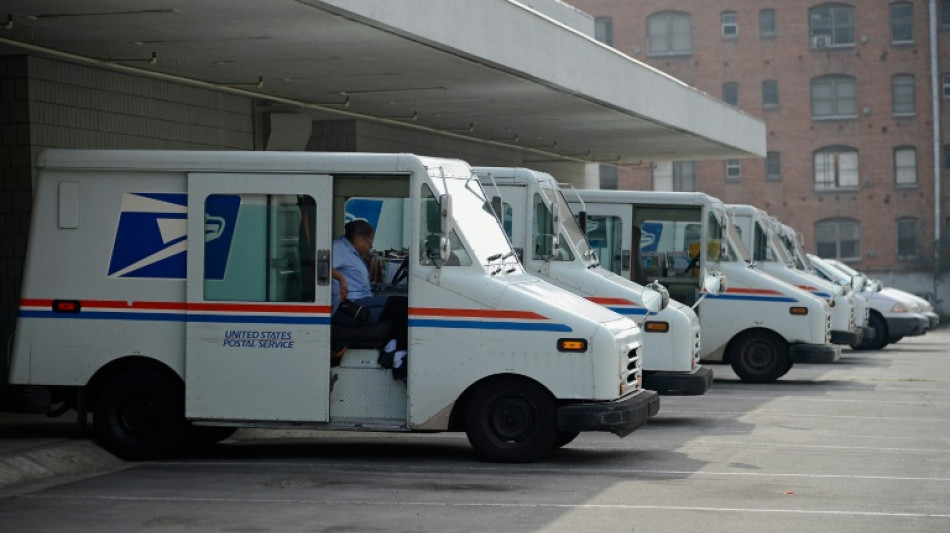
US high court sets new rule for firms requiring work on religious holidays / Photo: KEVORK DJANSEZIAN - GETTY IMAGES NORTH AMERICA/AFP/File

 Breytenbach confirms recommending Sibiya for Johannesburg post

 Celebrities mark Thanksgiving in turkey-themed photo gallery

 German fashion model Veruschka dies in Berlin at 87
 Thanksgiving storms disrupt thousands of US flights

 T.J. Lang criticises Aaron Rodgers over comments about Mike McCarthy

 Black Friday beauty offers span skincare, fragrance and wellness devices

 U2 pays tribute to Dolly Parton during Thanksgiving Eve NFL show

 Toyota Innova Hycross and Kia Sorento hybrids compared in top trims

 President Trump to Attend TSMC Groundbreaking in Phoenix Next Week

 Gauteng Health Department Warns of Rising Antibiotic Resistance Threat

 Bishop Museum Races to Save Rare Megamouth Shark Specimen

The US Supreme Court set a tougher standard Thursday for companies to be able to claim "undue hardship" when requiring employees to work on religious holidays.
It ruled unanimously in the case of former postal worker Gerald Groff, whose requests to not work on Sundays due to his Christian beliefs were not accommodated by the US Postal Service (USPS).
Groff resigned after not meeting USPS requirements to work some Sundays and sued on the basis of his constitutional right to practice his faith.
Successive lower courts had rejected his complaint, saying USPS made efforts to accommodate him and had proved under the legal standard that it would suffer "undue hardship" to its business if it had to find other workers to fill his spot.
In their ruling, the high court justices did not focus on Groff's religious rights.
Instead, the issue was how "undue hardship" was defined -- how much difficulty a business would have to incur to justify forcing a worker to work on a religious holiday.
A 46-year-old precedent case, Trans World Airlines v. Hardison, said "undue hardship" could be defined as anything more than minimal -- "de minimis" -- cost to the business.
"De minimis" then became a standard that religious rights advocates say essentially allowed businesses to reject any faith-related work request by an employee.
"Hardison's 'de minimis' test makes a mockery of the English language and no party truly defends it today," Groff's attorney Aaron Streett told the court in an April hearing.
Attorneys on both sides of the case agreed on that specific issue, and it was on that that the justices ruled Thursday.
The Hardison phrase "more than a de minimis cost" is insufficient for establishing "undue hardship," the court ruled.
"Under any definition, a hardship is more severe than a mere burden," it said.
In future cases, it said, if a company wants to prove it cannot meet an employee's religious scheduling needs, the employer must show that it "would result in substantial increased costs" to its business.
The ruling was not an absolute victory for Groff, however. The Supreme Court sent the case back to the appeals court for a rehearing under the new standard.
USPS will then be under pressure to prove that Groff's needs would add "substantial increased costs" to its business.
T.Wright--AT