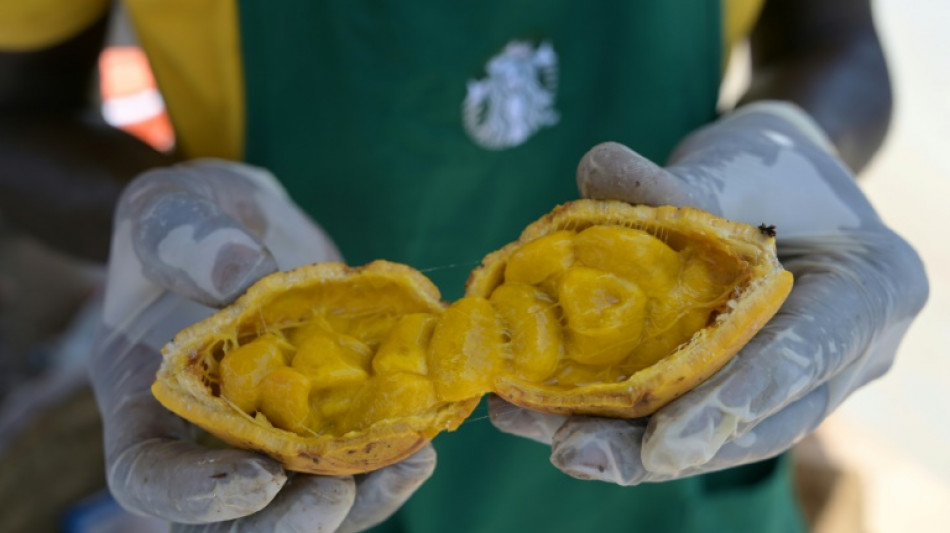
Senegalese go wild for prized 'maad' fruit / Photo: SEYLLOU - AFP

 Breytenbach confirms recommending Sibiya for Johannesburg post

 Celebrities mark Thanksgiving in turkey-themed photo gallery

 German fashion model Veruschka dies in Berlin at 87

 Thanksgiving storms disrupt thousands of US flights

 T.J. Lang criticises Aaron Rodgers over comments about Mike McCarthy

 Black Friday beauty offers span skincare, fragrance and wellness devices

 U2 pays tribute to Dolly Parton during Thanksgiving Eve NFL show

 Toyota Innova Hycross and Kia Sorento hybrids compared in top trims

 President Trump to Attend TSMC Groundbreaking in Phoenix Next Week

 Gauteng Health Department Warns of Rising Antibiotic Resistance Threat

 Bishop Museum Races to Save Rare Megamouth Shark Specimen

Outside a bustling fruit market in Senegal's Dakar region, three trucks are blocking the road while a dozen men sweat to unload the precious cargo.
Working in intense heat and racing against the clock, they are shifting 60 tonnes of maad -- a delicate tropical fruit which is massively popular in the West African state.
A yellow fruit with a pulp that has a distinctive sweet and sour savour and is rich in vitamins and fibre, maad comes from a vine called the Saba senegalensis, which grows wild and is common across the region.
The fruit's season is relatively short, running from May to August, which prompts a rush of sellers at street corners, hawking the delicacy with salt, sugar or chilli, blenderised into juice or turned into jam.
Maad has different names and spellings across West Africa, where it is eaten from Ivory Coast to Mali and Guinea -- but the lust for it is strongest in Senegal.
Countless jobs depend on the fruit, from harvesting and distribution to selling and processing.
At the Sandika market in Pikine, workers laboured to empty the trucks that had just arrived, sorting the maad according to ripeness.
- Rush to market -
"The unloading will be finished by the end of the day," said Dame Sarr, a 28-year-old wholesaler who with his uncle had invested six million CFA francs ($10,000) in the consignment.
They reckoned they could clear the equivalent of at least a thousand dollars in profit -- if the fruit was sold fast.
"If I don't shift the goods, I will have to cut the price tomorrow because with every passing day maad loses its quality," he explained, sitting under a parasol.
The good news was that several customers were already hovering around.
Sarr had separated out the finest fruit to sell for 4,200 francs for a bucket of 40 pieces. The others were on sale for half that price. A 20-kilogram (44-pound) box of maad cost between 20,000-25,000 francs.
"Maad is a very risky investment. It can't stand sunlight or rain, and transporting it is difficult," said market representative and salesman Djiby Sandika.
The fruit "best suits small-scale retailers, who make large profits," said Sarr.
- Southern delicacy -
In Senegal most maad grows in the southern Casamance region on vines that wrap themselves round trees in thickly-forested areas.
Picking the fruit is done by hand and involves using long sticks -- a labour that comes with added risk from snakes.
According to the Economy, Territory, Development and Service (ETDS) NGO, nearly 1,500 tonnes of maad are harvested annually in the Ziguinchor, Kedougou and Kolda areas.
Mariama Dieme, who heads a project to market maad production in Casamance, said that with better access, output could be trebled.
The fruit is already under threat from "over-exploitation," from fires used to burn stubble from fields and from damage caused by forest hunters, Dieme said.
The ETDS is fostering a programme for small-scale woman-led producers to make maad jam, juice or syrup and even export some of their production.
Maad jam sold in France via sellers on Instagram costs 25 euros ($27.38) for a 300 grams (10.5 ounces) jar, said Fatou Binetou Adour, a Senegalese who lives in Paris.
M.O.Allen--AT