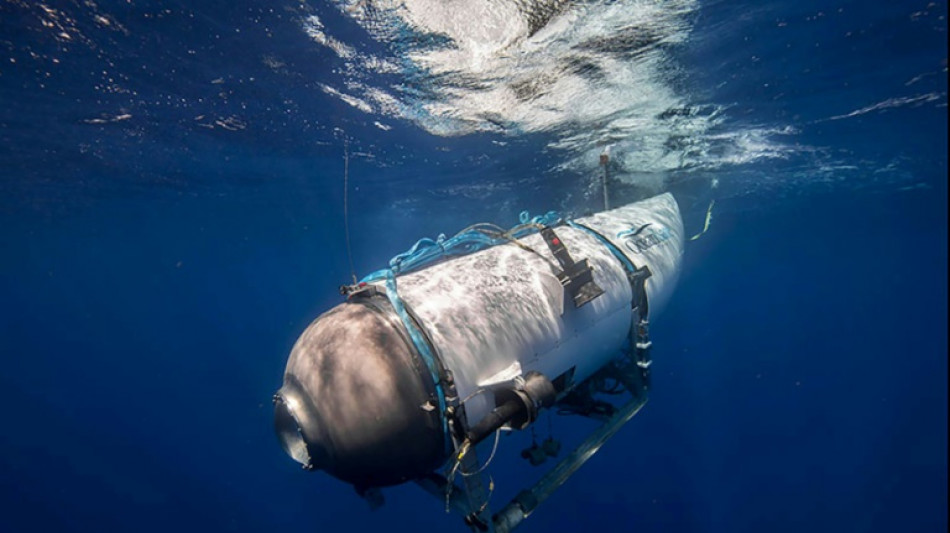
Titan sub: what is a 'catastrophic implosion'?
/ Photo: Handout - OceanGate Expeditions/AFP

 Breytenbach confirms recommending Sibiya for Johannesburg post

 Celebrities mark Thanksgiving in turkey-themed photo gallery

 German fashion model Veruschka dies in Berlin at 87

 Thanksgiving storms disrupt thousands of US flights

 T.J. Lang criticises Aaron Rodgers over comments about Mike McCarthy

 Black Friday beauty offers span skincare, fragrance and wellness devices

 U2 pays tribute to Dolly Parton during Thanksgiving Eve NFL show

 Toyota Innova Hycross and Kia Sorento hybrids compared in top trims

 President Trump to Attend TSMC Groundbreaking in Phoenix Next Week

 Gauteng Health Department Warns of Rising Antibiotic Resistance Threat

 Bishop Museum Races to Save Rare Megamouth Shark Specimen

A "catastrophic implosion," such as that believed to have destroyed the Titan submersible, would have happened with incredible force and speed given the crushing water pressure on the floor of the ocean.
The remains of the Titanic rest on the seabed in the North Atlantic at a depth of some 3,800 meters (12,400 feet).
At sea level, atmospheric pressure is 14.7 pounds per square inch (psi).
Water pressure at the depth where the ocean liner lies is equivalent to around 400 atmospheres, nearly 6,000 psi.
As a comparison, the bite of a large great white shark exerts a force of nearly 4,000 psi, according to Scientific American.
In an implosion caused by a defect in the hull or for some other reason, the submersible would collapse in on itself in milliseconds, crushed by the immense water pressure.
Death would be virtually instantaneous for the occupants of the pressurized chamber.
The Titan, built by OceanGate Inc. of Everett, Washington, was designed to sustain the extreme water pressure at the depth of the Titanic and had made previous dives to the wreck.
But safety concerns had been raised, most notably in a lawsuit involving OceanGate's former director of marine operations, David Lochridge, who was fired in 2018 after warning about the Titan's "experimental" carbon fiber hull.
Roderick Smith, an engineering professor at Imperial College, London, said the accident was likely due to a "failure of the pressure hull," but debris will need to be recovered to carry out a full investigation.
And even then it may be difficult to pinpoint the cause.
"The violence of the implosion means that it may be very difficult to determine the sequence of events," Smith said.
K.Hill--AT