Kidnappers use grisly tactics as Ecuador crime spirals / Photo: Gerardo MENOSCAL - AFP/File

 Breytenbach confirms recommending Sibiya for Johannesburg post

 Celebrities mark Thanksgiving in turkey-themed photo gallery

 German fashion model Veruschka dies in Berlin at 87

 Thanksgiving storms disrupt thousands of US flights

 T.J. Lang criticises Aaron Rodgers over comments about Mike McCarthy

 Black Friday beauty offers span skincare, fragrance and wellness devices

 U2 pays tribute to Dolly Parton during Thanksgiving Eve NFL show
 Toyota Innova Hycross and Kia Sorento hybrids compared in top trims

 President Trump to Attend TSMC Groundbreaking in Phoenix Next Week

 Gauteng Health Department Warns of Rising Antibiotic Resistance Threat

 Bishop Museum Races to Save Rare Megamouth Shark Specimen

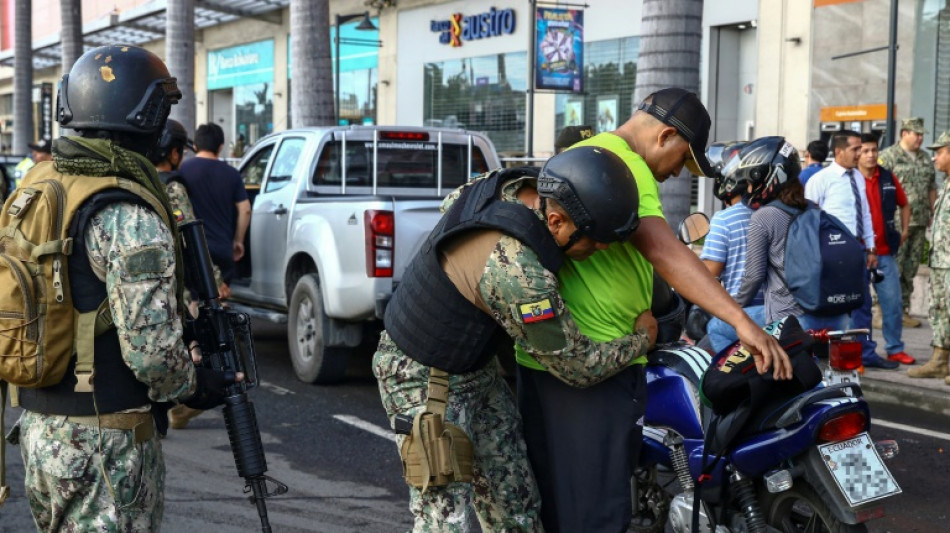
Crime has taken a sadistic turn in Ecuador, where kidnappers now regularly amputate the fingers of their victims and send images to pressure relatives to pay higher ransoms.
For decades, Ecuador was a refuge of peace wedged in a dangerous region. But these days, it increasingly resembles nearby Peru and Colombia, two huge producers of cocaine with violent criminal histories.
In March, the wife of a businessman in the port city of Guayaquil received images of someone snipping two fingers off her husband's left hand, threatening to mutilate him further unless they were paid $100,000.
At the end of 2022, police released a photograph of a member of the Chilean navy who'd had two fingers lopped off during a kidnapping while he was in the country visiting a girlfriend.
Social media lit up in April when an x-ray of a hand with no fingers made the rounds. The image was of an Ecuadoran migrant to the United States ensnared in a kidnapping during a vacation back home.
For the first five months of the year, reports of kidnappings tripled to 189 cases compared to the same period in 2022, when 60 cases were tallied.
That number is still widely believed to be underreported.
Some kidnappers seek a quick payout, demanding ransoms as low as $5,000.
Expert Luis Cordova told AFP a "frightening" campaign of attacks was putting pressure on a government mired in a public safety crisis.
The port of Guayaquil, with some three million residents, has become a hotbed of violence, with car bombs, prison massacres, mutilated bodies hanging from bridges and kidnappings.
- Not just narcos -
The bloodshed has not yet soared to the levels once reached in Colombia or Mexico at the height of narco violence but "we are traveling along a similar road," security analyst Carla Alvarez says.
The chances of someone becoming the victim of a kidnapping, extortion attempt or murder have risen five-fold, she said.
Guayaquil, where cocaine leaves are smuggled aboard ships bound for Europe or the United States, has tallied more than 1,000 murders so far in 2023.
Much of the crime wave has no ties to large drug gangs like Los Lobos and Tiguerones, linked to Mexican cartels.
Most kidnappings and extortions are the work of common criminals, bus robbers or low-profile thieves.
"Why would a powerful gang, allied to a drug cartel, risk talking to the relative of a kidnapped person when they can traffic two tons of drugs?" asked Cordova, a professor at the state-run Central University.
Thirteen major crime gangs now exist in Ecuador, and in April the government declared members of organized crime to be terrorists and empowered the military to pursue them with greater freedom.
- Phone calls from jail -
Even when tortured, the majority of kidnapping victims survive, said Oscar Salguero, regional chief of a police anti-kidnapping unit.
Those held for ransom are often kept in bathrooms, with hands bound and in constant terror, as crime gangs negotiate with their loved ones.
At the same time, extortion of entrepreneurs is on the rise. Some 2,700 such complaints have been registered this year.
Miguel, 40, who asked not to have his surname used, was threatened with kidnapping for a month because he refused to hand over $20,000 to extortionists.
The construction businessman received follow-up photos and warnings from cell phones coming from a prison, according to investigations.
Cordova said those most affected by kidnappings and extortion are the middle and upper classes, most of whom will vote for a "hard hand" against organized crime in general elections slated for August.
W.Stewart--AT