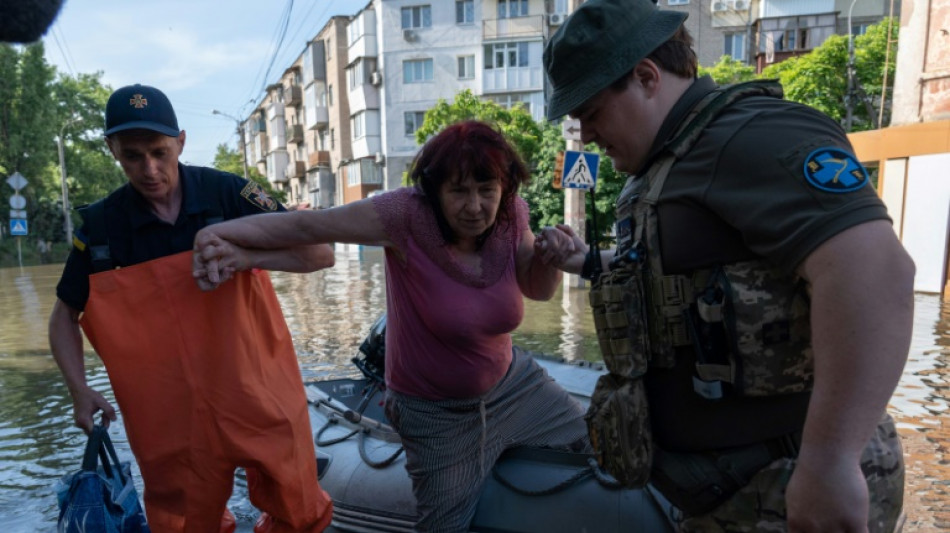
What we know about dam's destruction in Ukraine / Photo: ALEKSEY FILIPPOV - AFP

 Breytenbach confirms recommending Sibiya for Johannesburg post

 Celebrities mark Thanksgiving in turkey-themed photo gallery

 German fashion model Veruschka dies in Berlin at 87

 Thanksgiving storms disrupt thousands of US flights

 T.J. Lang criticises Aaron Rodgers over comments about Mike McCarthy

 Black Friday beauty offers span skincare, fragrance and wellness devices

 U2 pays tribute to Dolly Parton during Thanksgiving Eve NFL show

 Toyota Innova Hycross and Kia Sorento hybrids compared in top trims

 President Trump to Attend TSMC Groundbreaking in Phoenix Next Week

 Gauteng Health Department Warns of Rising Antibiotic Resistance Threat

 Bishop Museum Races to Save Rare Megamouth Shark Specimen

The Russian-held Kakhovka dam in southern Ukraine was ripped open after an explosion in the early hours of Tuesday, according to multiple accounts.
The damage has worsened due to the torrent of Dnipro River water unleashed by the breach, forcing thousands to flee, disrupting water supplies and sparking fears of an environmental as well as humanitarian disaster.
Here is what we know so far:
- What happened? -
The Kakhovka dam sits on the Dnipro River and is located on the front line about 60 kilometres (40 miles) east of the Ukrainian city of Kherson.
Russian forces have controlled territory on one bank of the river since the first days of their invasion last year and there are frequent exchanges of fire with Ukrainian forces stationed on the other side.
Ukrainian President Volodymyr Zelensky said the blast happened at 2:50 am local time on Tuesday (2350 GMT on Monday), causing its partial collapse.
Igor Syrota, the head of Ukraine's state-run hydropower generating company Ukrhydroenergo, said the station itself is destroyed and cannot be restored.
"The hydraulic structure is being washed away," he said, estimating that "half of the station is already under water".
British intelligence said that by noon on Tuesday, "the entire eastern portion of the dam and much of the hydro and utilities infrastructure was swept away.
"The dam's structure is likely to deteriorate further over the next few days, causing additional flooding," it said.
- What each side says -
Moscow and Kyiv have traded blame for the damage.
Kyiv said the destruction of the dam was an attempt by Moscow to hamper its long-awaited offensive. Zelensky said Russia had carried out "an internal explosion of the structures" of the plant.
After speaking with his top military commanders, Zelensky said: "The main conclusion is that the explosion was intentional, but the enemy acted chaotically, allowing their own equipment to be flooded."
Syrota of Ukrhydroenergo said that "we are more than convinced that there was an explosion inside the plant –- in particular, in the engine room.
"The plant broke in half," he said.
Ukrainian officials say Russian forces mined the dam shortly after its capture.
But Russia says the dam was partially destroyed by "multiple strikes" coming from Ukrainian forces. The Kremlin says the destruction is the result of "deliberate sabotage by the Ukrainian side".
Western powers say it is too soon to say conclusively what happened.
A Western official -- speaking on condition of anonymity -- said on Tuesday that the Western intelligence community, including the United States, was still assessing who was responsible but was leaning toward Russia.
The motive was also still being assessed, the official said, adding Russia possibly wanted to make it more difficult for Ukraine to conduct a river crossing, and to create a significant humanitarian challenge.
- Extent of destruction? -
Dozens of villages and towns have been flooded and thousands of people have been forced to flee the area.
Zelensky said that up to 80 settlements are under threat. Hundreds of thousands of people have been left without "normal access to drinking water," he said.
On Wednesday, more than 2,700 people have been evacuated from homes on both sides of the Dnipro, officials said.
More are believed to have left of their own accord.
In Kherson, the largest city nearby, water levels have risen by five metres (16 feet), officials say.
At least 150 tons of machine oil spilled into the waters of the Dnipro.
- What's next?
The UN warns that the destruction of the Kakhovka dam could spark an environmental disaster and have dire humanitarian consequences for hundreds of thousands of people.
The UN humanitarian agency OCHA said emergency humanitarian response efforts were underway to provide urgent assistance to more than 16,000 people, including water supplies.
Washington has warned there would be "likely many deaths".
The dam provided cooling water for the Zaporizhzhia nuclear power plant, Europe's largest.
The UN nuclear watchdog agency said the dam break was posing "no short-term risk" to the plant.
W.Moreno--AT