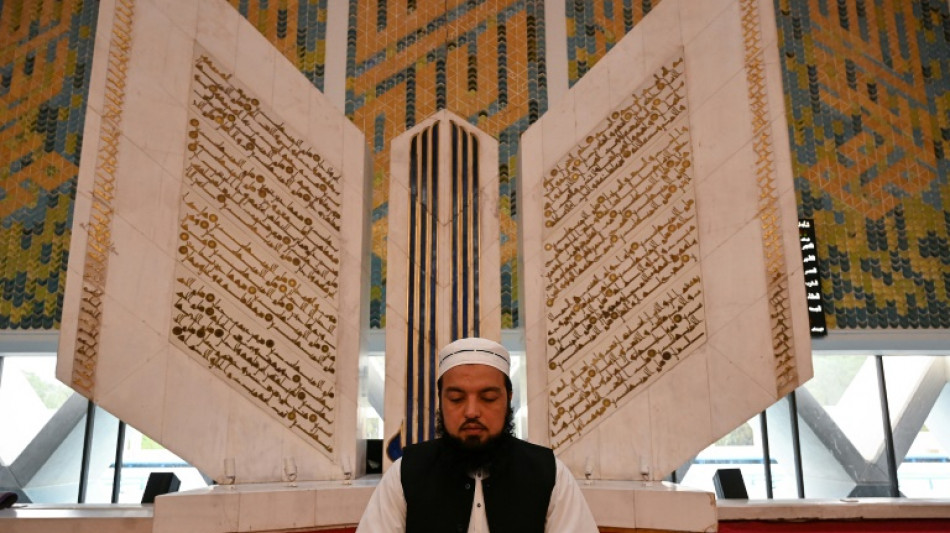
Pakistan mega-mosque muezzin summons the faithful / Photo: Aamir QURESHI - AFP

 Gauteng Health Department Warns of Rising Antibiotic Resistance Threat

 Bishop Museum Races to Save Rare Megamouth Shark Specimen

 Impauer Technologies Inc. Announces Third Quarter 2026 Financial Results and Equity Compensation Grants

 NiobiumX Mining Explains How it Will Hunt for Niobium at Shipshaw: Magnetic Lows, Thorium Highs, and Machine Learning Built for a District With One Producing Mine

 InterContinental Hotels Group PLC Announces Transaction in Own Shares - November 26

 Black Friday Discounts Cut Prices on Two Top-Rated Wiper Blades

 Luxembourg Pay Rise Delayed as Regional and World Headlines Develop

 Audience to Choose the Set List at Luxembourg's First FAMIL Jukebox Night

 Raheem Sterling Receives Suspended Sentence After Lamborghini Crash

 Luxembourg Housing Petition Passes Threshold for Parliamentary Consideration

Moments before dawn, Noor ul Islam ascends the steps of one of the world's biggest mosques, enters its cavernous hall and says a private prayer before a faintly buzzing microphone.
Then, the 32-year-old gulps down a deep breath and makes the morning's call to worship -- a forceful yet lilting chant amplified across Islamabad, Pakistan's capital, marking the start of daylight fasting during Ramadan.
"The voice is a gift from God," Islam told AFP at Faisal Mosque, a towering marble monument to the nation's devotion to faith.
"If your intentions are genuine, your voice will have the power to touch people's hearts," he said.
All across the Muslim world, men like Islam, known as muezzins, broadcast the "adhan" call to prayer, five times a day.
In the month of Ramadan, where prayers mark the start and finish of 14 hours of fasting in Pakistan, the faithful are particularly attuned.
The script and rhythm are the same everywhere.
Intoned in Arabic over minaret loudspeakers, it reminds Muslims: "God is the greatest" and they should "hasten to prayers".
But there is a quiet hierarchy among muezzins.
A particularly melodic caller can increase the standing of a mosque. House hunters might judge the neighbourhood adhan before making an offer. And at prestigious mosques, the job is highly coveted.
The three muezzin roles at Faisal Mosque -- a national emblem opened in 1986 with a fabled capacity of 300,000 worshippers -- are among the most prized outside the holy sites of Mecca and Medina.
- Holy calling -
As a teenager visiting Pakistan's capital from his hometown 105 kilometres (65 miles) away, Islam was captivated by the soulful call from Faisal Mosque's four spiked towers.
"Every Muslim yearns to say the adhan, lead prayers or give a sermon at a well-known mosque," he said. "Every pious Muslim has this dream."
His chance came in 2018, when a single slot opened and he beat 400 other candidates to the post.
When he steps up to the microphone, Islam plugs his ears with his fingers in order to block all sounds apart from his voice.
"The adhan, delivered with a beautiful and precise pronunciation, resonates with people," said 57-year-old businessman Aziz Ahmed in front of the mosque.
Some of Islam's fellow muezzins coddle their vocal cords like rock stars and theatre performers, drinking honey-laced beverages, and avoiding cold breezes and oil-drenched Pakistani cuisine.
"I am a careless person when it comes to this," chuckles Islam. "I can't resist."
Nonetheless, he treats his vocation with humble reverence.
"The fundamental purpose of the adhan is to invite people towards God. You can only accomplish this effectively when you possess a pure heart", he said.
"Any delay or lack of sincerity in performing the adhan could potentially erode our faith."
A sub-par adhan is treated as a "formality" by muezzins who create "fake voices".
A good recital can "strike me straight in the heart", Islam said.
But the position does come with a hint of celebrity.
Devotees travel for miles to hear the call at Faisal Mosque, peer through the windows to watch Islam at work and ask for selfies afterwards.
Back home in the town of Swabi, he is considered a local hero.
Now Islam aspires to secure a further promotion to muezzin at the Grand Mosque in the holy city of Mecca.
"I can't explain these feelings," he said. "Every Muslim should try to make this bond between him and God."
"There is peace in this."
W.Moreno--AT
