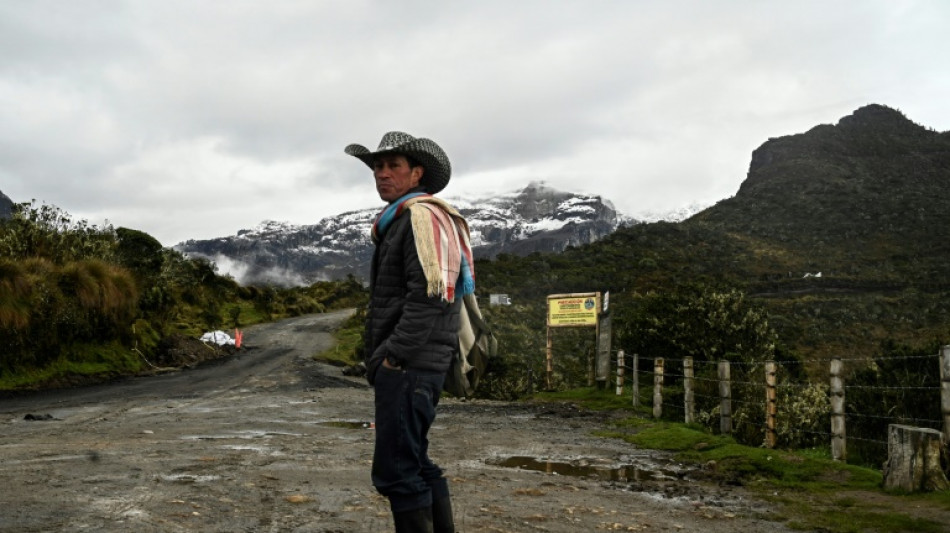
As Colombian volcano rumbles to life, villagers resist evacuation / Photo: JOAQUIN SARMIENTO - AFP

 Gauteng Health Department Warns of Rising Antibiotic Resistance Threat

 Bishop Museum Races to Save Rare Megamouth Shark Specimen

 Impauer Technologies Inc. Announces Third Quarter 2026 Financial Results and Equity Compensation Grants

 NiobiumX Mining Explains How it Will Hunt for Niobium at Shipshaw: Magnetic Lows, Thorium Highs, and Machine Learning Built for a District With One Producing Mine

 InterContinental Hotels Group PLC Announces Transaction in Own Shares - November 26

 Black Friday Discounts Cut Prices on Two Top-Rated Wiper Blades

 Luxembourg Pay Rise Delayed as Regional and World Headlines Develop

 Audience to Choose the Set List at Luxembourg's First FAMIL Jukebox Night

 Raheem Sterling Receives Suspended Sentence After Lamborghini Crash

 Luxembourg Housing Petition Passes Threshold for Parliamentary Consideration

Smoke billows from the crater of a snow-capped Andean volcano, reminding local inhabitants of the threat of another potential deadly eruption.
Yet at the foot of the Nevado del Ruiz volcano in the Colombian Andes, thousands of villagers are staying put to tend to their crops and pack animals, despite an urgent call from the government to evacuate.
Luis Canon admits he is afraid but says he sees no other option than to "resign" himself to his fate.
"If you leave things here, the crops, the animals, when you come back there is nothing," the 50-year-old, dressed in a traditional hat and poncho, told AFP.
The eruption threat has loomed since the end of March when the number of daily tremors within the volcano shot up from 50 to 12,000.
The government raised the alert level from yellow to orange and ordered the evacuation of 7,500 people living in the foothills and flanks of the volcano.
But that did not convince many of those dwelling in danger zones to leave.
"The villagers have cows, horses, sheep, goats and poultry, and that in some way prevents them from moving and taking part in the preventative evacuation ... because of the fear that they will be stolen," said presidential adviser Luis Fernando Velasco.
So the government said it was adopting "exceptional measures to move around 80,000 animals ... away from the alert zone."
More than 57,000 people live in areas that could be affected by a new eruption.
- 'Great fear' -
Authorities fear that a major Nevado del Ruiz eruption could cause the kind of devastation that rocked the area in 1985.
In a matter of hours, an eruption of lava melted part of the volcano's snowcap, creating raging torrents of mud, ash and rocks that streamed down the mountainside and buried the town of Armero, killing 25,000 people. It was the worst natural disaster in the country's modern history.
The entire world became captivated by the fate of 13-year-old Omaira Sanchez, who spent three days buried up to her neck in muddy water with her legs trapped by the debris from her destroyed home in the town of Armero.
With rescuers helpless to free her, she died in agony under the gaze of journalists and villagers alike.
A picture of her haunted expression made the front page of newspapers all over the world.
Luis Londono, 65, remembers that "very scary" November 13.
People heard a roar in the dead of night and fled for their lives "crying and shouting that it was the end of the world."
A villager in the municipality of Herveo, home to 9,000 people some 30 kilometers to the northeast of the volcano, Londono fears another such tragedy.
"There is great fear that the Nevado will explode," he said.
Like many others, though, he has not heeded the call to evacuate the mountainous area where peaks rise up to more than 5,000 meters (16,400 feet).
Nicknamed the "sleeping lion," the volcano lay dormant for decades after that 1985 eruption.
But 10 years ago there was a new eruption.
Every so often, "some ash" falls but Cecilia Gallego, a villager from Herveo, said she feels "calm."
- 'Born again' -
Few people travel along the steep trails that surround the volcano.
Occasionally a villager with a face reddened by the biting cold, comes past with a mule.
Soldiers patrol the route to a natural park that has been closed to tourists due to the eruption threat.
Earlier this week, President Gustavo Petro called on local authorities to speed up the evacuation.
The geological service publishes daily reports about seismic activity and while the readings can fluctuate, the alert remains.
"We're concerned that the tremors keep getting closer to the crater and this, according to volcanologists, is not the best sign," said Velasco.
Some have heeded warnings, though.
Cesar Ortegon, who works in the local tourism industry, survived in 1985 and did not want to tempt fate again.
"It was like being born again," he said.
He locked the door to his workplace and left in a truck.
"Not everyone will leave," he admitted, but he did.
H.Thompson--AT
