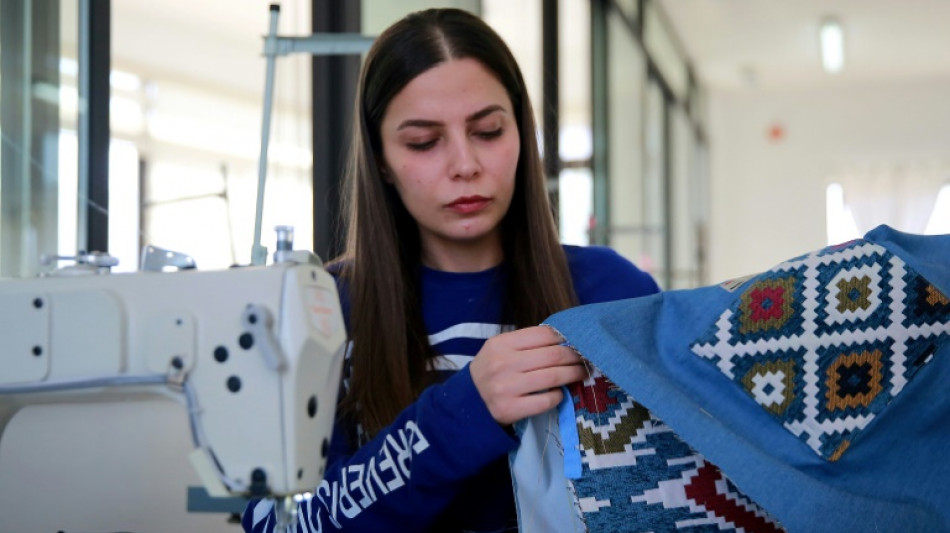
Iraqis in asylum limbo in Jordan fashion their future / Photo: Khalil MAZRAAWI - AFP

 Gauteng Health Department Warns of Rising Antibiotic Resistance Threat

 Bishop Museum Races to Save Rare Megamouth Shark Specimen

 Impauer Technologies Inc. Announces Third Quarter 2026 Financial Results and Equity Compensation Grants

 NiobiumX Mining Explains How it Will Hunt for Niobium at Shipshaw: Magnetic Lows, Thorium Highs, and Machine Learning Built for a District With One Producing Mine

 InterContinental Hotels Group PLC Announces Transaction in Own Shares - November 26

 Black Friday Discounts Cut Prices on Two Top-Rated Wiper Blades

 Luxembourg Pay Rise Delayed as Regional and World Headlines Develop

 Audience to Choose the Set List at Luxembourg's First FAMIL Jukebox Night

 Raheem Sterling Receives Suspended Sentence After Lamborghini Crash

 Luxembourg Housing Petition Passes Threshold for Parliamentary Consideration

In a Jordanian church, Sarah Nael sews a shirt for a project that has provided scores of women who fled violence in neighbouring Iraq with skills to earn a living.
Many of the women escaped the extreme violence carried out by the Islamic State group's self-declared "caliphate" that cut across swathes of Iraq and Syria, before they eventually ended up in Jordan -- where they found themselves without work.
"Life here is very, very difficult -- if we don't work, we can't live," said Nael, a 25-year-old Christian from the northern Iraqi town of Qaraqosh, who joined the "Rafedin" sewing project two years ago.
It is based at St Joseph Catholic church in the Jordanian capital Amman.
Italian priest Mario Cornioli began the project in 2016, along with Italian designers and tailors.
The products, including dresses, jackets, belts and ties, are sold in Amman and Italy to raise funds.
For refugees, barred from seeking regular work, the project provides them with a way to supplement handouts from the United Nations.
"It's a safe place," said Nael, who has been taught to create clothes from cloth and leather, while her brother helps in the church's kitchen. "We are Iraqis. We are forbidden to work anywhere."
- Asylum limbo -
Since the project started, more than 120 women have benefited.
"We try to help them with dignity," said Cornioli, who runs the Habibi Valtiberina Association, an Italian charity in Jordan.
"A lot are the only ones working in their families."
On the tables in rooms in the church building, colourful rolls of cloth lie ready for cutting.
Cornioli hopes the "Rafedin" fashion label -- meaning "two rivers", the historical term for Iraq between the Euphrates and Tigris -- will become widely recognisable.
For the priest, the aim is to make the project "self-sustaining" to provide more training to women in need.
While the IS extremists were forced out of their Iraqi territory by a US-led alliance in late 2017, many of the refugees in Jordan are still too fearful to go back to their war-ravaged home.
Many are still waiting for their painfully slow asylum applications to other countries to be processed.
"This project allowed them to do something and to survive in this period," Cornioli said. "They are just waiting to leave."
- 'Opportunity to learn' -
Nael and her family returned home after IS was defeated in 2017, but they left again after being subjected to anonymous threats, and eventually sought safety in Amman.
Their applications for asylum in Australia have been rejected.
"My father is old, and my mother has cancer," she said, but added that going back to Iraq was out of the question. "We have nothing left there to return to."
Diana Nabil, 29, worked as an accountant in Iraq before fleeing to Jordan in 2017 with her parents and aunt, in the hope of joining her sister in Australia.
During her wait, she studied how to sew fabric and leather.
"Some of our relatives help us financially, and sometimes the United Nations helps us a bit," Nabil said. "With my work here, we are managing."
Cornioli said the project offers "the opportunity to learn something", pointing to "success stories" of some of the women who have since left Jordan, and are now working in Australia, Canada, and the United States.
Wael Suleiman, head of the Catholic aid agency Caritas in Jordan, estimated the country hosts as many as 13,000 Christian Iraqi refugees.
"They hope to obtain asylum and leave to a third country, but in light of what is going on in the world now, the doors seem to be closed to them," Suleiman said.
"They are afraid of the future, and no one can blame them for that."
N.Walker--AT
