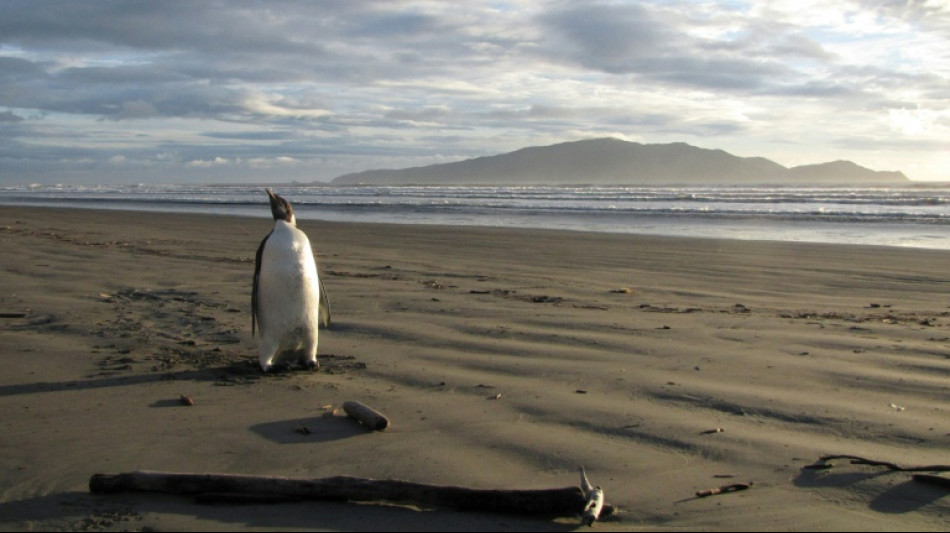
Ice melt threatens emperor penguins during annual moult: researchers / Photo: Richard Gill - DEPARTMENT OF CONSERVATION/AFP

 Stocks move lower despite oil prices dropping

 AI driving up innovation investment: UN

 UN Security Council extends Haiti mission by 6 months

 Man Utd do not deserve medals if Man City stripped of titles: Rooney

 Vana Completes Expanded Staking as Part of the Vega Upgrade, Publishes Expanded VANA Token Economics

 Spain to cap gas price hikes, extend fuel discounts

 'We just need rain': Germany's Rhine river hits new low

 Yemen health system at 'breaking point': WHO

 Ireland undecided on second Israel match: coach

 France's Le Pen defiant after top ally hit by antisemitism claims

 Tom Cruise trades stunts for satire as toxic tycoon 'Digger'

 MEXC Unveils "WE SEE YOU" Brand Visual Refresh, Putting People Behind Every Trade in Focus

 Thai capital cleans up after deadly floods

 NATO, EU allies rally to Estonia after 'sabotage' blamed on Russia

 Families demand justice for Cameroon's 'nightmare' wave of murdered women

 Tebas says Man City should face 'most severe' sanctions if guilty of rule breaches

 Pochettino calls Man City success 'a period of deception'

 Settler attack on West Bank village injures Israeli forces, drawing rare rebuke

 Mystery over UK airbase scare after reports no explosives found
 Spanish govt races to adopt housing law under protest pressure

 Estonia slams Russian 'sabotage' after arson attack on defence company

 Slovenia sees surge in '.si' sites after Trump hypes 'super intelligence'

 'Like a dream' for An as Games organisers 'sorry' for latest mix-up

 Tokyo suffers longest streak of rainy days on record

 Indonesia charges train driver over crash that killed 16 women
Emperor penguins shed all their feathers once a year, a precarious ritual that may have become deadly as climate change pushes them into shrinking patches of Antarctic sea ice, researchers said Wednesday.
The flightless birds moult during summer, relying on stored fat to survive for several weeks until their waterproof coat grows back so they can swim and hunt in icy waters again.
Researchers from the British Antarctic Survey, analysing seven years of satellite images, accidentally discovered several moulting colonies along the extremely remote coastline of an area known as Marie Byrd Land.
As sea ice melted, the penguins were forced onto smaller spaces in increasingly large and tightly packed groups, the UK polar research organisation said in a statement.
In 2025, only 25 small groups of penguins were visible in the satellite images, it said. Prior to 2022, more than 100 groups had been spotted in the same region.
"While we don't know for sure what happened to those penguins, we know they can find new suitable breeding sites after ice loss, so it's possible they have established new moulting sites elsewhere," said Peter Fretwell, lead author and mapping expert at the British Antarctic Survey.
"But also it's possible that huge numbers of penguins perished after entering the Southern Ocean before they had replaced their waterproof feathers," Fretwell said.
"If this has happened, the situation for emperors as a species is even worse than we thought."
The researchers said that if emperor penguins are forced into the ocean before their feathers are replaced, they face exhaustion from increased energy use, hypothermia and increased risk from predators.
- Ice at record low -
Emperor penguin populations have shrunk by almost a quarter as global warming transforms their icy habitat, the British Antarctic Survey said in research published last year.
During the January-March Antarctic summer, emperor penguins from the Ross Sea in West Antarctica migrate as much as 1,000 kilometres (620 miles) to Marie Byrd Land to moult on stable sea ice, the researchers said Wednesday.
It is one of the few areas that historically retains its fast ice -- sea ice attached to the coast -- throughout the year.
The moulting process takes about four to five weeks and the penguins cannot go in the freezing water during that time.
The extent of Antarctic Sea ice fell to record lows between 2022 and 2024, accompanied by a drastic decrease in fast ice, the British Antarctic Survey said.
In the region they observed, sea ice coverage fell from a 50-year average of 500,000 square kilometres -- roughly the size of Spain -- to 100,000 square kilometres in 2023. Only 2,000 square kilometres of fast ice were left near the coast.
During those years, the sea ice broke before the penguins had finished moulting, raising fears that many may not have survived, the scientists said.
The survey's previous study found that some emperor penguin colonies lost all their chicks in recent years as the ice broke, plunging hatchlings into the sea before they were old enough to cope with the freezing ocean.
At current rates of warming, there is a 45 percent chance the species will become extinct by the turn of the century, the survey said.
P.Hernandez--AT