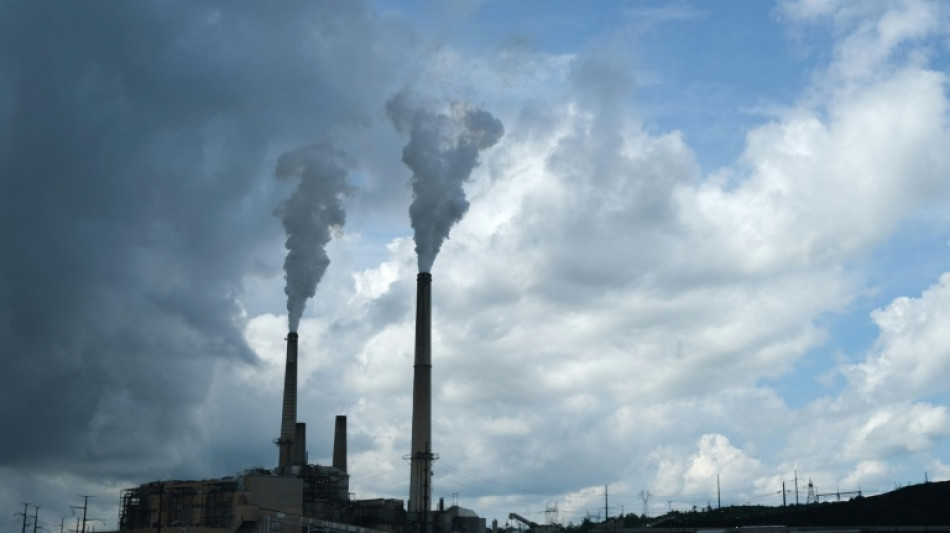
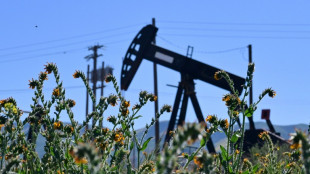
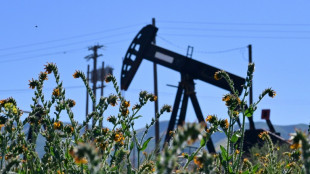
At 'Davos of energy', AI looks to gas to power its rapid expansion / Photo: Ulysse BELLIER - AFP

 Stocks move lower despite oil prices dropping

 AI driving up innovation investment: UN

 UN Security Council extends Haiti mission by 6 months

 Man Utd do not deserve medals if Man City stripped of titles: Rooney

 Vana Completes Expanded Staking as Part of the Vega Upgrade, Publishes Expanded VANA Token Economics

 Spain to cap gas price hikes, extend fuel discounts
 'We just need rain': Germany's Rhine river hits new low

 Yemen health system at 'breaking point': WHO

 Ireland undecided on second Israel match: coach

 France's Le Pen defiant after top ally hit by antisemitism claims

 Tom Cruise trades stunts for satire as toxic tycoon 'Digger'

 MEXC Unveils "WE SEE YOU" Brand Visual Refresh, Putting People Behind Every Trade in Focus

 Thai capital cleans up after deadly floods

 NATO, EU allies rally to Estonia after 'sabotage' blamed on Russia

 Families demand justice for Cameroon's 'nightmare' wave of murdered women
 Tebas says Man City should face 'most severe' sanctions if guilty of rule breaches

 Pochettino calls Man City success 'a period of deception'

 Settler attack on West Bank village injures Israeli forces, drawing rare rebuke

 Mystery over UK airbase scare after reports no explosives found

 Spanish govt races to adopt housing law under protest pressure

 Estonia slams Russian 'sabotage' after arson attack on defence company

 Slovenia sees surge in '.si' sites after Trump hypes 'super intelligence'

 'Like a dream' for An as Games organisers 'sorry' for latest mix-up

 Tokyo suffers longest streak of rainy days on record

 Indonesia charges train driver over crash that killed 16 women

Natural gas took center stage this week at the world's largest energy conference, as major market players discussed how to power the rise of artificial intelligence.
In the halls of CERAWeek, where around 10,000 experts and executives converged, attendees debated the fastest way to feed the burgeoning technology's massive energy demands, despite carbon neutrality pledges.
"Gas-fired power, for sure, is critical" to the development of artificial intelligence (AI), Laurent Ruseckas of S&P Global told AFP on the sidelines of the summit.
Dozens of sessions were held addressing how the gas sector can help satisfy AI's insatiable thirst for electricity, or how AI-driven software can, in turn, help the sector optimize its production.
The data centers on which AI -- and cloud technology more broadly -- rely consume vast amounts of electricity, which often has a large carbon footprint.
Natural gas is already the third-largest energy source used by data centers globally, covering 26 percent of demand, according to International Energy Agency figures.
Coal -- a fuel that emits the highest levels of greenhouse gases -- has the largest share, followed by renewable energy, according to the IEA.
Since 2016, the United States has ramped up its natural gas production, and its Liquefied Natural Gas (LNG) exports have increased 30-fold in that period, according to the US Energy Information Administration (EIA).
With US President Donald Trump throwing his weight behind fossil fuels -- often sidelining renewable energy -- that trend is only expected to deepen.
This "surge in gas... is coincident and driven by the need to satisfy the growth in AI," said Eric Hanselman, an energy analyst at S&P Global.
Charles Riedl, president of industry group the Center for Liquefied Natural Gas (CLNG), told AFP "the reliability and dispatch ability of gas is second to none."
CLNG represents several US industry giants, including Cheniere Energy, Chevron, and ConocoPhillips.
More than a third of US gas capacity directly powers data centers in the United States, according to a recent study by Global Energy Monitor, a think tank.
- 'Not sustainable' -
Some experts, however, remain skeptical about the long-term viability of this model.
"Will gas play a role in the AI data center future? Yes. But I'm not so sure it's to the same degree as many predict," said Mark Brownstein, senior vice president of the Environmental Defense Fund.
"My belief is that that kind of approach to project development is not sustainable," he added.
The issue, he said, is that certain projects are "expensive to run," and "the pollution from them is also considerable."
The primary component of natural gas is methane, which, when burned, releases CO2 -- the leading greenhouse gas responsible for global warming.
Gas fields, LNG tankers, pipelines, and distribution lines also give rise to massive leaks of methane -- a gas with an even greater global warming potential than CO2.
In West Virginia, a project to build a gas-fired power plant intended solely to supply a massive data center is facing opposition from many residents concerned about its health and environmental impacts.
It is far from the only one.
Tech giants had previously pledged to achieve carbon neutrality by 2030 or 2040. However, the explosive growth in demand for AI has led them to set these promises aside, according to S&P Global's Ruseckas.
"That's gone out the window," he says. "Gas is the only quick way to get power quickly, which is what the data centers need."
Another option on the table is nuclear power, which already accounts for 15 percent of global electricity consumption by data centers.
The rapid growth of AI and its surging energy demand is "making nuclear really part of the solution set now," said Ho Nieh, chairman of the US Nuclear Regulatory Commission, at CERAWeek.
Nuclear reactors take significantly longer to build than gas turbines, however.
In January, tech giant Meta announced agreements with three US nuclear energy companies, making it one of the largest corporate buyers of such energy in the United States.
The 6.6 gigawatts of power those plants would provide, however, is not expected to be fully online until 2035.
R.Lee--AT