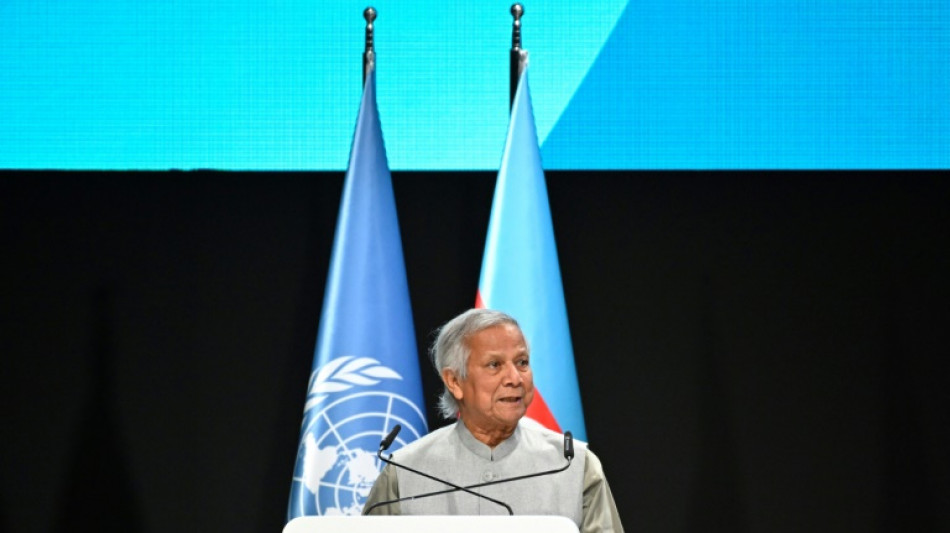
'Very humiliating': Bangladesh's Yunus seethes over climate cash fight / Photo: Alexander NEMENOV - AFP

 South Korea score late to reach Asian Games football final

 Tom Kim defies jet-lag, Kho cards ace as Asian Games golf begins

 Thai teen rocker Nene aims to tour, write music... and return to school

 Ivory Coast clamps down on harmful illegal gold rush
 Nagoya mayor says sorry for Asian Games 'inconveniences'
 G20 trade officials meet under shadow of tariffs, overcapacity

 India's fat dog vote goes viral
 Asian Games crowds in spotlight as 998 see hosts in 50,000 stadium

 The eight stadiums for the 2027 Rugby World Cup

 Thieves swipe drugs under nose of Fiji police, swap with flour
 South Korea demands North apologise for DMZ mine blasts
 In Nepal's flood zone, teachers mourn students who never returned

 US Supreme Court lifts limits on third-country deportations

 Antonelli eager to 're-establish order' as F1 returns to Malaysia

 Paw-fect candidate: Australia finds new koala rescue dog
 One third of world population exposed to harmful air pollution: monitor

 North Korea denies South's claim it was apparently behind DMZ mine blasts

 West Bank's violent settlers part of a new generation fuelled by ideology

 US-led coalition ends mission in Iraq
 Pope-backed White Sox join Braves with MLB playoff wins

 Psychology Software Tools Builds on Early Bioz Success to Expand Access to Publication-Backed Product Evidence

 Alpha Growth Management Opens Rep Office in Japan

 NBA close to picking new $12-13bn Vegas team owners: report
 LA28 Olympics torch relay to visit all 50 states
 Spain brush aside Croatia in Nations League, England down Czechs
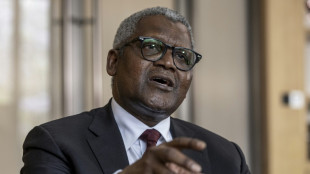
In the three months since becoming Bangladesh's interim leader following a student-led revolution, Muhammad Yunus has endured political turmoil, impatient cries for elections, and destructive flooding across the low-lying nation.
Now, the Nobel Peace Prize winner has been thrust into a brawl over money to help poorer countries deal with climate change -- and he is not pleased about it.
The 84-year-old micro-finance pioneer, who took over after the toppling of autocratic leader Sheikh Hasina in August, likened the haggling at the UN COP29 climate summit to a "fish market".
"I think that's very humiliating, for nations to come and ask for money to fix... (the) problem that others caused for them," Yunus told AFP in an interview in Azerbaijan, which is hosting the talks.
"Why should we be dragged here to negotiate? You know the problem."
Nations hope to land a deal at COP29 that boosts funding for climate action in developing nations like Bangladesh, which are least responsible for global warming, but most at its mercy.
Some want $1 trillion a year to cover the enormous cost of shifting their economies to clean energy, and adapting to ever-more erratic and extreme weather.
But rich countries -- whose rise to prosperity and associated carbon emissions have driven global warming -- are reluctant to commit such large sums and want others to chip in.
The talks have hit a wall, frustrating leaders of climate-imperilled nations who left behind populations in dire straits to travel to Baku.
Among them is Yunus, who said his riverine homeland had been smashed by six punishing floods -- "each one worse than the previous" -- in the short time since he took over.
Hundreds of thousands of people were forced into emergency shelters in the floods, which also destroyed rice crops.
- 'You figure it out' -
Bangladesh is among the world's most vulnerable nations to climate change, with large areas made up of deltas where the Ganges and the Brahmaputra rivers wind towards the sea.
The country of 170 million is particularly at risk of devastating floods and cyclones -- disasters that only stand to accelerate as the planet keeps warming.
Yunus said it was "not a secret" that rich nations would have to help poorer ones adapt and they should "figure out how much is needed -- not me".
"This is not something we are demanding out of your generosity. We're asking because you are the cause of this problem," he said bluntly.
Yunus said juggling a peaceful democratic transition and a floods response was "difficult" enough and adding a flight to Baku to feud over climate finance didn't help.
Impatience for elections in Bangladesh has gained pace since Hasina's ouster, and the silver-haired technocrat said he shared concerns for peace and security in the nation of 170 million.
A free and fair vote would come as promised, he said, but the speed of democratic reforms "will decide how quick the election will be".
He wouldn't offer a date or timeline, but said the caretaker administration was hoping to build "a quick consensus".
"We are the interim government, so our period should be as short as possible," he said.
R.Chavez--AT