Stark warning on emissions as leaders split on climate goals at COP29 / Photo: Alexander NEMENOV - AFP

 South Korea score late to reach Asian Games football final

 Tom Kim defies jet-lag, Kho cards ace as Asian Games golf begins
 Thai teen rocker Nene aims to tour, write music... and return to school

 Ivory Coast clamps down on harmful illegal gold rush
 Nagoya mayor says sorry for Asian Games 'inconveniences'

 G20 trade officials meet under shadow of tariffs, overcapacity

 India's fat dog vote goes viral
 Asian Games crowds in spotlight as 998 see hosts in 50,000 stadium

 The eight stadiums for the 2027 Rugby World Cup

 Thieves swipe drugs under nose of Fiji police, swap with flour

 South Korea demands North apologise for DMZ mine blasts

 In Nepal's flood zone, teachers mourn students who never returned

 US Supreme Court lifts limits on third-country deportations

 Antonelli eager to 're-establish order' as F1 returns to Malaysia

 Paw-fect candidate: Australia finds new koala rescue dog

 One third of world population exposed to harmful air pollution: monitor

 North Korea denies South's claim it was apparently behind DMZ mine blasts

 West Bank's violent settlers part of a new generation fuelled by ideology

 US-led coalition ends mission in Iraq

 Pope-backed White Sox join Braves with MLB playoff wins

 Psychology Software Tools Builds on Early Bioz Success to Expand Access to Publication-Backed Product Evidence

 Alpha Growth Management Opens Rep Office in Japan

 NBA close to picking new $12-13bn Vegas team owners: report

 LA28 Olympics torch relay to visit all 50 states

 Spain brush aside Croatia in Nations League, England down Czechs

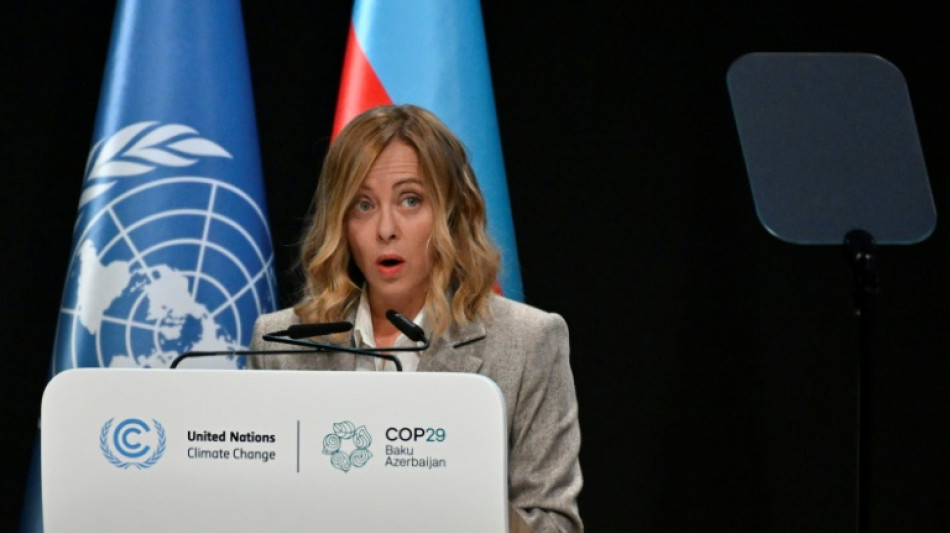
Global leaders offered competing views on how to tackle climate change at UN-led talks Wednesday as a new report warned the world must reach carbon neutrality much sooner than planned.
Planet-warming carbon dioxide emissions from oil, gas and coal rose to a new record high this year, according to preliminary research from an international network of scientists at the Global Carbon Project.
The report came as leaders gathered in Azerbaijan for COP29 climate talks aimed at reaching a deal on boosting funding to help poorer nations adapt to climate shocks and transition to cleaner energy.
The research found that to keep the Paris agreement's ambitious goal of limiting warming to 1.5 degrees Celsius in sight, the world would now need to reach net-zero CO2 emissions by the late 2030s -- instead of 2050.
The warning also follows concerns about the future of the fight against climate change following the election of Donald Trump.
Trump, who has vowed to again pull the United States out of the Paris agreement, named his head of the Environmental Protection Agency Tuesday with a mandate to slash pollution regulations.
Some leaders in Baku defended fossil fuels during two days of speeches while others from countries plagued by climate disasters warned that they were running out of time.
- 'Slower' path -
Italian Prime Minister Giorgia Meloni called for a "realistic global outlook" on Wednesday, saying that world population growth will boost energy consumption demand.
"It is equally a priority that decarbonisation takes into consideration our production and social system's sustainability," she said.
"We must protect nature, with man at its core. An approach that is too ideological and not pragmatic on this matter risks taking us off the road to success," the far-right leader said.
"Currently there is no single alternative to fossil fuel supply."
Greek Prime Minister Kyriakos Mitsotakis called for a "smart" Green Deal, the European Union's ambitious climate plan which aims to make the bloc carbon-neutral by 2050.
"We cannot drive ourselves into industrial oblivion," the conservative leader said.
"We need to ask hard questions about a path that goes very fast, at the expense of our competitiveness, and a path that goes somewhat slower, but allows our industry to adapt and to thrive," he said.
Their views contrasted with leaders from countries beset by climate catastrophes and rising sea levels.
"Tuvalu sincerely hopes that this COP's concluding decisions will deliver a clear signal that the world is promptly phasing out fossil fuel," said the Pacific island's Prime Minister Feleti Penitala Teo.
"For Tuvalu and similarly placed countries, there is simply no time to waste," he said.
- Money fight -
As leaders spoke, negotiators released a fresh draft of a deal with a raft of options to raise funding for poorer countries, while leaving unresolved sticking points that have long delayed an agreement.
Most developing countries favour an annual commitment from wealthy countries of at least $1.3 trillion, according to the latest draft of the long-sought climate finance pact.
This figure is more than 10 times the $100 billion annually that a small pool of developed countries -- among them the US, the EU and Japan -- currently pay.
Some donors are reluctant to promise large new amounts of public money from their budgets at a time when they face economic and political pressure at home.
The prime minister of the hurricane-vulnerable Bahamas, Philip Davis, said small island nations have spent 18 times more on debt repayment than they have received in climate finance.
"The world has found the ability to finance wars, the ability to mobilise against pandemics," Davis said.
"Yet when it comes to addressing the most profound crisis of our time, the very survival of nations, where is that same ability?"
F.Wilson--AT