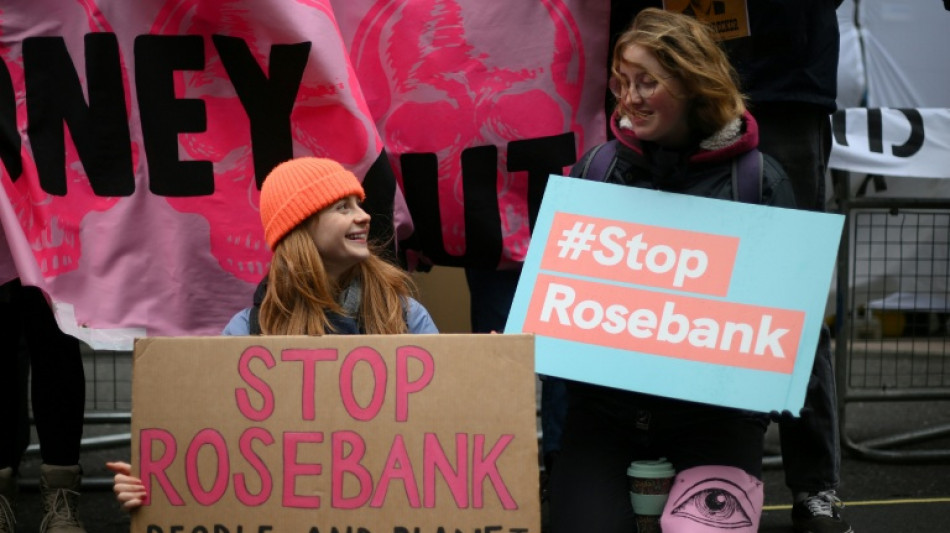
Court challenge begins against UK oil and gas field approvals / Photo: Daniel LEAL - AFP

 South Korea score late to reach Asian Games football final

 Tom Kim defies jet-lag, Kho cards ace as Asian Games golf begins

 Thai teen rocker Nene aims to tour, write music... and return to school

 Ivory Coast clamps down on harmful illegal gold rush

 Nagoya mayor says sorry for Asian Games 'inconveniences'

 G20 trade officials meet under shadow of tariffs, overcapacity

 India's fat dog vote goes viral
 Asian Games crowds in spotlight as 998 see hosts in 50,000 stadium

 The eight stadiums for the 2027 Rugby World Cup

 Thieves swipe drugs under nose of Fiji police, swap with flour

 South Korea demands North apologise for DMZ mine blasts
 In Nepal's flood zone, teachers mourn students who never returned

 US Supreme Court lifts limits on third-country deportations

 Antonelli eager to 're-establish order' as F1 returns to Malaysia

 Paw-fect candidate: Australia finds new koala rescue dog

 One third of world population exposed to harmful air pollution: monitor

 North Korea denies South's claim it was apparently behind DMZ mine blasts

 West Bank's violent settlers part of a new generation fuelled by ideology

 US-led coalition ends mission in Iraq
 Pope-backed White Sox join Braves with MLB playoff wins

 Psychology Software Tools Builds on Early Bioz Success to Expand Access to Publication-Backed Product Evidence

 Alpha Growth Management Opens Rep Office in Japan

 NBA close to picking new $12-13bn Vegas team owners: report
 LA28 Olympics torch relay to visit all 50 states
 Spain brush aside Croatia in Nations League, England down Czechs

Two environmental groups kicked off a legal challenge in Scotland on Tuesday to block the Rosebank and Jackdaw oil and gas fields in the North Sea, with activists optimistic of success.
"We're more confident than ever we can win," said environmental lawyer Tessa Khan before the case opened at the Court of Session in Edinburgh.
Her optimism was shared by hundreds of people who demonstrated outside the court, in celebratory mood given recent rulings that have put the future of the fields in doubt.
Campaign groups Uplift and Greenpeace argue that the UK government granted permissions unlawfully by failing to take into account all emissions from burning oil and gas.
A win for the campaigners would mean operators would have to resubmit environmental assessments for approval before drilling can start.
Former Scottish National Party lawmaker Tommy Sheppard called the case "the granddaddy because it is so big".
"The case will be applied to the decision-making process in general," he told AFP.
"There were 100 licences granted by the last Conservative government in its final dying months. All of them will now be under question."
Regulatory approval for drilling at the Rosebank oil field, 145 kilometres (90 miles) off the Shetland Islands in Scotland's far north, was granted last year.
It is the UK's largest untapped oil field, estimated to contain up to 300 million barrels. Drilling had been due to begin between 2026 and 2030.
The Jackdaw gas condensate field, approved in 2022, is being developed 155 miles east of the Scottish city of Aberdeen and was expected to start production next year.
Rosebank is owned by Norwegian energy giant Equinor and the UK's Ithaca Energy. Jackdaw is owned by Shell. Both say the developments are "vital" for UK energy security.
- Narrow window -
Khan, who is executive director of Uplift, said it had been a "David versus Goliath" battle at the start of the case, pitting campaigners on one side against the UK government and energy firms on the other.
But in July, the UK Supreme Court ruled that the previous Conservative government should have considered the carbon emissions of burning extracted oil and gas, not just of extracting it.
Then the incoming Labour government announced it would not contest the case, leaving the oil companies alone to fight legal challenges.
"We are on the precipice of a massive victory for the climate," said Uplift campaigner Lauren MacDonald.
Khan said there was a broader message to the oil industry: that they now have to take into account all greenhouse gas emissions, even those that occur indirectly.
"We now have a government that is really trying to re-establish the UK's climate credentials," she said. "The window for approval has really, really narrowed."
- Renewables -
Sheppard said the increased economic costs would force energy companies to look towards developing the renewables sector, provided the government gives the necessary investment and incentives.
At the same time, governments in oil-generating countries like Scotland must tread a fine line in balancing the longer term threats of rising temperatures with the shorter term risks of job losses in the sector.
Energy historian Ewan Gibbs, from the University of Glasgow, pointed to potential parallels with the breakdown of social cohesion caused by the closure of the UK's coal mines in the 1980s without a plan for those made redundant.
Prime Minister Keir Starmer, in Baku, Azerbaijan for the UN climate change summit, intends to decarbonise Britain's power grid by 2030 as part of government plans to reach net-zero greenhouse gas emissions by 2050.
Sheppard said it was important that those affected by net-zero transition plans be reskilled and retrained to enable them to benefit from new jobs being created by clean energy technologies.
A.O.Scott--AT