Cracked earth in Greece's saffron heartland as drought takes toll / Photo: Sakis MITROLIDIS - AFP

 South Korea score late to reach Asian Games football final

 Tom Kim defies jet-lag, Kho cards ace as Asian Games golf begins
 Thai teen rocker Nene aims to tour, write music... and return to school
 Ivory Coast clamps down on harmful illegal gold rush

 Nagoya mayor says sorry for Asian Games 'inconveniences'

 G20 trade officials meet under shadow of tariffs, overcapacity

 India's fat dog vote goes viral

 Asian Games crowds in spotlight as 998 see hosts in 50,000 stadium

 The eight stadiums for the 2027 Rugby World Cup

 Thieves swipe drugs under nose of Fiji police, swap with flour
 South Korea demands North apologise for DMZ mine blasts
 In Nepal's flood zone, teachers mourn students who never returned

 US Supreme Court lifts limits on third-country deportations

 Antonelli eager to 're-establish order' as F1 returns to Malaysia

 Paw-fect candidate: Australia finds new koala rescue dog
 One third of world population exposed to harmful air pollution: monitor

 North Korea denies South's claim it was apparently behind DMZ mine blasts

 West Bank's violent settlers part of a new generation fuelled by ideology

 US-led coalition ends mission in Iraq
 Pope-backed White Sox join Braves with MLB playoff wins

 Psychology Software Tools Builds on Early Bioz Success to Expand Access to Publication-Backed Product Evidence

 Alpha Growth Management Opens Rep Office in Japan

 NBA close to picking new $12-13bn Vegas team owners: report

 LA28 Olympics torch relay to visit all 50 states

 Spain brush aside Croatia in Nations League, England down Czechs

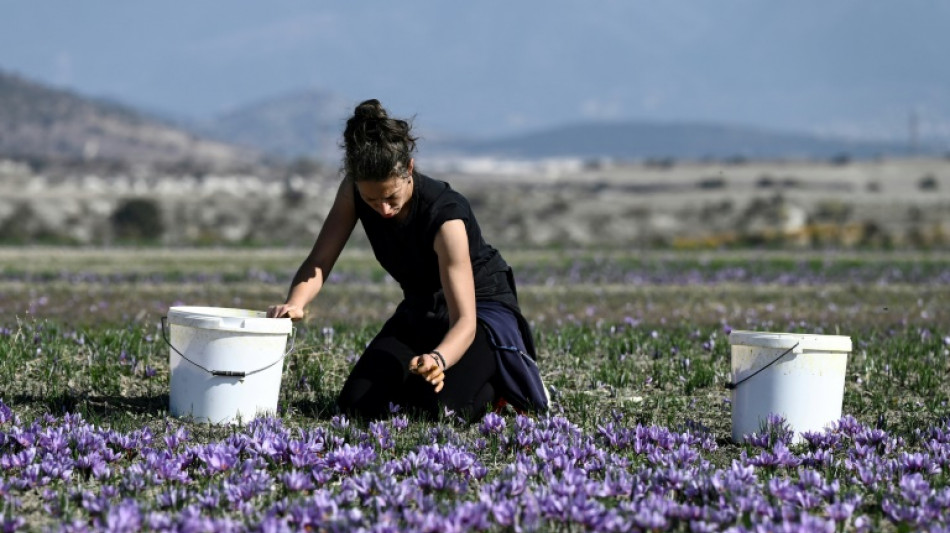
At a field outside Kozani, northern Greece, the strikingly blue-and-purple petals of saffron give off an intoxicating scent that underscores the value of one of the country's most lucrative crops.
But beneath the beautiful flowers, which can fetch five to nine euros ($5.45-9.8) for a single gramme, the earth is cracked and parched after uncommonly long periods of drought, taking a toll on the crop's yield.
"We haven't had a good dose of rain in our area since May," sighed veteran saffron farmer Grigoris Tzidimopoulos.
After the warmest winter and summer since detailed records began in 1960, Greece has now experienced its driest month of October in the last 15 years, according to the national observatory.
"This field used to give us more than a pound (454 grammes) per acre. Last year... from nine acres in all, the yield was three pounds," 68-year-old Tzidimopoulos said.
"Ten or 12 years ago when I sowed, it often snowed. Now we have neither snow nor rain," he added.
- Ancient tradition -
Harvested in Greece for at least 3,600 years -- a saffron picker is even immortalised in a Minoan-era fresco -- the spice is commonly used to flavour rice, chicken and fish but can also be found in cosmetics and pharmaceuticals.
At the local village of Krokos and in about 20 other neighbouring villages in Kozani, the inhabitants have systematically cultivated saffron since the 17th century.
Around 1,000 farmers live from the crop in the area and are intimately familiar with the microclimate that the plant requires order to perform better.
About 5,200 hectares of land (12,800 acres) cultivated here produce the largest quantity of saffron in Europe.
The local Krokos Kozani variety, also known as Greek saffron, enjoys protected designation status at European Union level.
Seventy percent of the product is exported to over 20 countries, with the largest markets being Switzerland and the United States.
And the regional cooperative, set up in 1971, has the exclusive right to collect, package and distribute the product.
Sissy Ioana, 40, has been working the fields for over 10 years and knows from experience whether the upcoming harvest will be a good one.
"Every year the crop is worse," she said, holding up a freshly cut flower to show the red or orange threads that, once dried, make saffron.
- Thinner than hair -
"The flower is not very big. Other years it's three times as big. When you dry it out it will be thinner than hair," she told AFP.
According to local growers, it takes about 50,000 of these red specks to produce 100 grammes of Greek saffron.
The cultivation is particularly labour-intensive as the harvesting to packaging process is all done by hand.
In the 1980s, according to the cooperative, total saffron production in the area was as high as 12 tonnes. Last year it was just over one tonne.
"The annual quantities produced have been decreasing every year," said the cooperative's president, Vassilis Mitsiopoulos.
In 2017, the cooperative produced of 3.8 tonnes of saffron, while last year they barely reached 1.1 tonnes with the same acreage, he said.
"The climate is getting warmer. The rains are erratic through the year and at the wrong time. Snowfall is, I would say, non-existent now."
"All this has resulted in a reduced yield of Kozani saffron," he said.
Climate conditions have changed so dramatically over the last 20 years that olive trees now flourish in Kozani, something unthinkable previously, Mitsiopoulos said.
"If the (saffron) yield continues to be so low I imagine that producers will abandon it or be forced to try to relocate to more northern areas," he said.
E.Rodriguez--AT