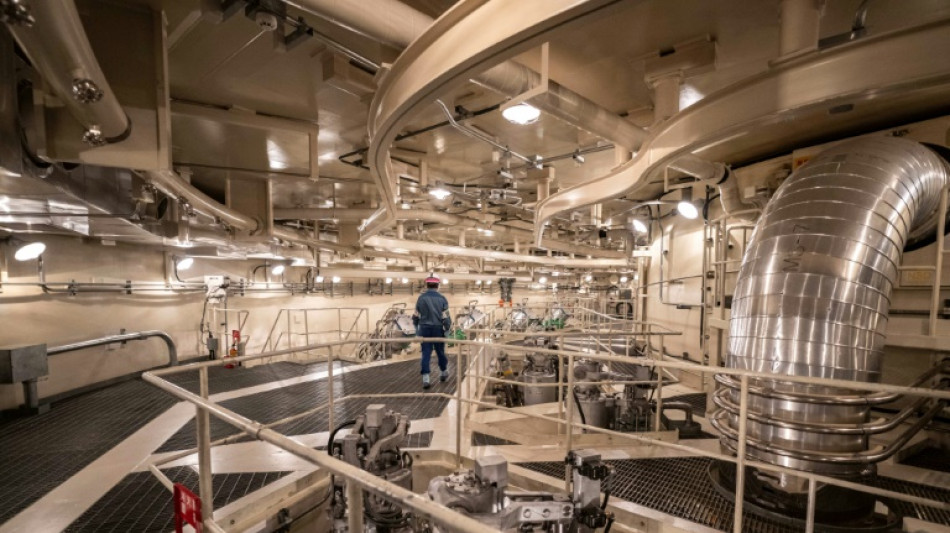
Japan shifting back to nuclear to ditch coal, power AI / Photo: Yuichi YAMAZAKI - AFP

 South Korea score late to reach Asian Games football final

 Tom Kim defies jet-lag, Kho cards ace as Asian Games golf begins
 Thai teen rocker Nene aims to tour, write music... and return to school
 Ivory Coast clamps down on harmful illegal gold rush
 Nagoya mayor says sorry for Asian Games 'inconveniences'
 G20 trade officials meet under shadow of tariffs, overcapacity

 India's fat dog vote goes viral
 Asian Games crowds in spotlight as 998 see hosts in 50,000 stadium

 The eight stadiums for the 2027 Rugby World Cup

 Thieves swipe drugs under nose of Fiji police, swap with flour

 South Korea demands North apologise for DMZ mine blasts
 In Nepal's flood zone, teachers mourn students who never returned

 US Supreme Court lifts limits on third-country deportations
 Antonelli eager to 're-establish order' as F1 returns to Malaysia

 Paw-fect candidate: Australia finds new koala rescue dog
 One third of world population exposed to harmful air pollution: monitor

 North Korea denies South's claim it was apparently behind DMZ mine blasts

 West Bank's violent settlers part of a new generation fuelled by ideology
 US-led coalition ends mission in Iraq
 Pope-backed White Sox join Braves with MLB playoff wins

 Psychology Software Tools Builds on Early Bioz Success to Expand Access to Publication-Backed Product Evidence
 Alpha Growth Management Opens Rep Office in Japan

 NBA close to picking new $12-13bn Vegas team owners: report

 LA28 Olympics torch relay to visit all 50 states

 Spain brush aside Croatia in Nations League, England down Czechs
Glinting in the sun by the world's biggest nuclear plant, the Sea of Japan is calm now. But as the huge facility gears up to restart, Kashiwazaki-Kariwa has a new tsunami wall, just in case.
Japan pulled the plug on nuclear power after the 2011 Fukushima disaster, but with the G7's dirtiest energy mix, it is seeking to cut emissions, and atomic energy is making a steady comeback, in part because of AI.
At the 400-hectare (1,000-acre) KK plant, shown to AFP in an exclusive tourthe 15-metre (50-foot) wall is just one measure to prevent another catastrophe and reassure the public and Japan's jittery neighbours.
"We believe that (a similar accident to Fukushima) could be largely avoided," Masaki Daito, KK deputy superintendent, told AFP. Japan now has "the strictest (regulatory) standards in the world".
The facility in central Japan -- like the nation as a whole -- is no stranger to earthquakes, having been shut down for two years for "upgrades" after a big jolt in 2007.
At Fukushima, a 15-metre tsunami cut power lines and flooded backup generators, disabling water pumps needed to keep nuclear fuel cool.
In this century's worst nuclear accident, three reactors went into meltdown and hydrogen explosions blew off roofs and released radioactivity into the air.
To keep the power running in the event of a quake, KK has new backup power supply vehicles on higher ground, plus "blow-out" panels and a new vent meant to filter out 99.9 percent of any radioactive particles.
In addition to the recently built sea wall, an embankment has been enlarged and reinforced. In corridors deep inside the reactor building, luminous stickers mark pipes and faucets.
"The lights all went out at Fukushima and no one could see," Daito said.
- Climate goals -
Before the 2011 quake and tsunami, which killed around 18,000 people, nuclear power generated about a third of Japan's electricity, with fossil fuels contributing most of the rest.
All of Japan's 54 reactors were shut down afterwards, including those at KK. To keep the lights on, resource-poor Japan has hiked imports of natural gas, coal and oil while increasing solar power.
But fossil fuels are expensive, with imports last year costing Japan about $510 million a day.
It is also not helping Japan achieve its climate pledges.
The E3G think-tank ranks Japan in last place -- by some distance -- among G7 nations on decarbonising their power systems.
Britain recently closed its last coal power station. Italy, France and Germany plan to follow suit. Japan and the United States, however, have no such target.
The government is striving for "carbon neutrality" by 2050 and to cut emissions by 46 percent by 2030 from 2013 levels.
It wants to increase the share of renewables to 36-38 percent from around 20 percent and cut fossil fuels to 41 percent from around two-thirds now.
Hanna Hakko, a Japan-based energy expert at E3G, thinks Japan could aim higher and have renewables generate 70-80 percent of its power by 2035.
"This would allow Japan to phase out coal, as it has committed to doing together with its G7 peers," Hakko told AFP.
- Nuclear resurgence -
Yet even under this scenario, the remainder would need to be covered by gas and nuclear energy.
Under its current plan, Japan aims for nuclear power to account for 20-22 percent of its electricity by 2030, up from well under 10 percent now.
Japan in late 2022 decided to accelerate reactor restarts and to extend operating time for nuclear reactors to 60 years from 40.
Nine of Japan's 33 still-operable reactors are currently online. At KK, unit seven is ready to join them once the local governor approves, with others set to follow.
Because of tougher safety rules since Fukushima, getting approval is a slow process. One restart was recently blocked because of earthquake risk.
Business groups remain worried about power shortages, particularly as Japan seeks to go big in energy-hungry data centres for artificial intelligence (AI).
"Japan has large untapped potential for renewable energy development," new Prime Minister Shigeru Ishiba told local media last week ahead of elections on October 27.
But he added: "Obviously, nuclear energy needs to be utilised."
- Megaquake -
The meltdown at Fukushima still looms large for people in Japan and elsewhere.
Japan is hit by hundreds of earthquakes per year -- mostly minor -- and in August, it issued a first "megaquake advisory" for its Pacific coast.
The alert was lifted after a week, but the government still sees a roughly 70 percent chance of a monster tremor within 30 years.
Making Fukushima fully safe, meanwhile, has also barely begun.
Japan last year started to release into the Pacific Ocean some of the 540 Olympic pools' worth of treated cooling water amassed since 2011. China banned Japanese seafood imports in response.
Engineers still have not worked out what to do with 800 tons of highly radioactive fuel and rubble. Humans still cannot enter the wrecked facility.
Mototsugu Oki, picnicking with his family at the beach by KK, said that like many Japanese, the Fukushima accident turned him off nuclear power for good.
"It is operated by human beings, and human beings naturally make mistakes," he told AFP.
O.Ortiz--AT