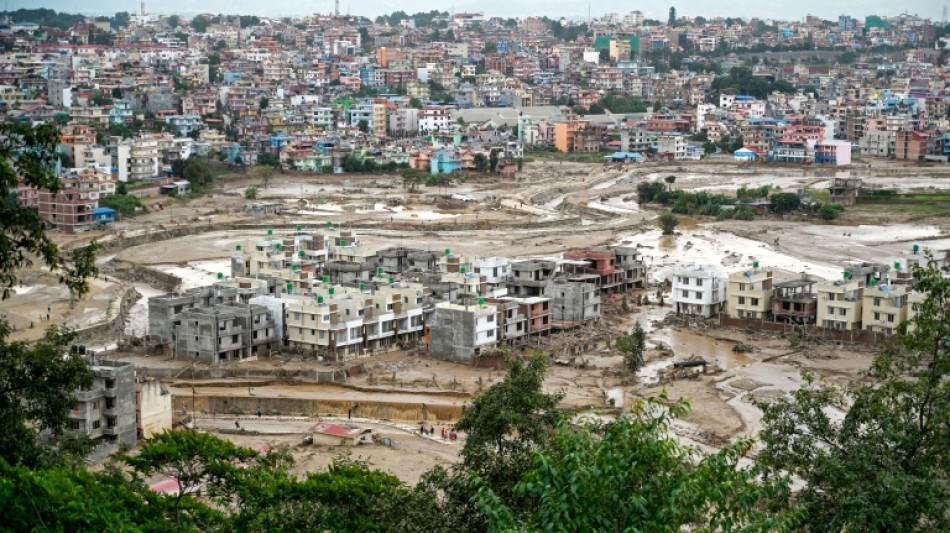
Climate change worsened deadly Nepal floods, scientists say / Photo: Prakash MATHEMA - AFP

 South Korea score late to reach Asian Games football final

 Tom Kim defies jet-lag, Kho cards ace as Asian Games golf begins
 Thai teen rocker Nene aims to tour, write music... and return to school

 Ivory Coast clamps down on harmful illegal gold rush

 Nagoya mayor says sorry for Asian Games 'inconveniences'

 G20 trade officials meet under shadow of tariffs, overcapacity

 India's fat dog vote goes viral

 Asian Games crowds in spotlight as 998 see hosts in 50,000 stadium

 The eight stadiums for the 2027 Rugby World Cup

 Thieves swipe drugs under nose of Fiji police, swap with flour

 South Korea demands North apologise for DMZ mine blasts
 In Nepal's flood zone, teachers mourn students who never returned

 US Supreme Court lifts limits on third-country deportations

 Antonelli eager to 're-establish order' as F1 returns to Malaysia

 Paw-fect candidate: Australia finds new koala rescue dog

 One third of world population exposed to harmful air pollution: monitor

 North Korea denies South's claim it was apparently behind DMZ mine blasts

 West Bank's violent settlers part of a new generation fuelled by ideology

 US-led coalition ends mission in Iraq
 Pope-backed White Sox join Braves with MLB playoff wins

 Psychology Software Tools Builds on Early Bioz Success to Expand Access to Publication-Backed Product Evidence

 Alpha Growth Management Opens Rep Office in Japan

 NBA close to picking new $12-13bn Vegas team owners: report
 LA28 Olympics torch relay to visit all 50 states

 Spain brush aside Croatia in Nations League, England down Czechs

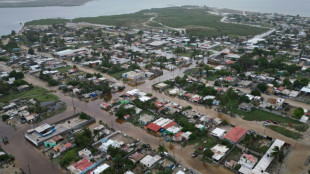
Climate change, along with rapid urbanisation and deforestation, turbocharged floods in Nepal that killed more than 240 people last month, scientists said on Thursday.
Nepal suffered its worst flooding in decades in late September after ferocious monsoon rains swelled rivers, swamping entire neighbourhoods in the capital Kathmandu and other districts.
World Weather Attribution (WWA), a network of scientists who assess the role of human-induced climate change on extreme weather events, said the link between the intense rainfall and a warming planet was clear.
"If the atmosphere wasn't overloaded with fossil fuel emissions, these floods would have been less intense, less destructive and less deadly," said researcher Mariam Zachariah, from Imperial College London.
Their analysis found the relentless rain, which fell on saturated ground in the late monsoon, was made at least 10 percent heavier and 70 percent more likely by climate change.
They warned that such "explosive" rain bursts will "become even heavier, risking more destructive floods" if the world does not stop burning fossil fuels.
Lashing rain from September 26 sparked floods and landslides that killed 246 people and left 18 missing, according to Nepal's government.
WWA, which uses modelling to compare weather patterns in our world and one without human-induced climate change, said there was a high level of uncertainty in the results because of the complex rain dynamics in the small, mountainous region affected.
However, the results were in line with growing scientific evidence on large-scale extreme rain in a warming climate, in which the atmosphere holds more water.
The role of climate change was also compounded by other man-made problems, they said, including rapid urbanisation, with a nearly four-fold increase in built-up areas in Kathmandu since 1990.
That was coupled with major deforestation that disrupted the natural flow of water, with tree cover slashed by more than a quarter since 1989.
The floods smashed hydropower plants, washed away homes and ripped away bridges. It was the latest disastrous flood to hit the Himalayan nation this year.
"Climate change is no longer a distant threat," said Roshan Jha, Researcher at the Indian Institute of Technology in Mumbai.
"With every fraction of a degree of warming, the atmosphere can potentially hold more moisture, leading to much heavier downpours, and catastrophic floods like these."
Nepal has embarked on a giant hydropower dam building spree, generating 99 percent of its power, with output increasing fourfold in the past eight years.
It has signed deals to export surplus power to neighbouring coal-dependent India.
Earlier this month, the UN's World Meteorological Organization said that increasingly intense floods and droughts are a "distress signal" of what is to come as climate change makes the planet's water cycle ever more unpredictable.
WMO chief Celeste Saulo called water the "canary in the coal mine of climate change".
E.Flores--AT