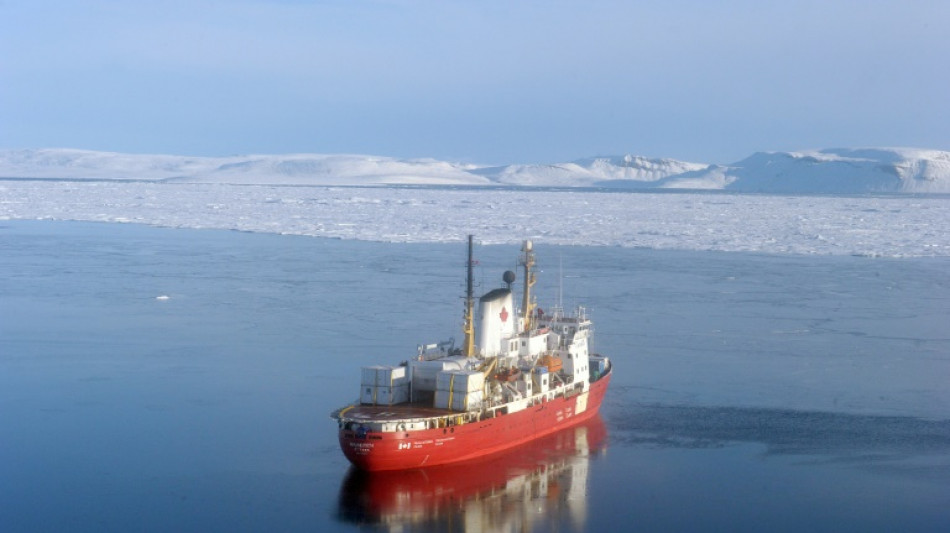
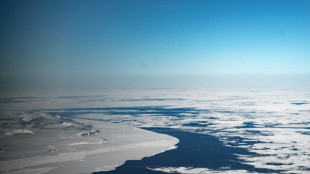
Melting ice no guarantee of smooth sailing in fabled Arctic crossing: study / Photo: Clement Sabourin - AFP

 In Manchester, people say City scandal is 'shame for football'
 Stocks lacklustre as inflation data weighs on sentiment

 Israel-bound plane rerouted, pilots wounded in reported fight

 Truth commission on Sweden's Sami people seeks redress

 Energy costs spark inflation surges in France, Italy

 South Korea break China hearts to reach Asian Games football final

 Eala storms into Asian Games semi-finals to thrill adoring fans

 Turkey freezes ex-minister's assets as fund crisis grows

 What we know about the North Korean POW dispute

 Most equities rise after oil price plunge, US data in focus

 Polar oceans transformed as warming melts ice habitats: research

 Lost shark becomes viral star in South Korea

 Dangote to launch $16bn refinery in Kenya

 North Korean leader 'extremely obese': Seoul spy agency

 Yankees and pope-backed White Sox start MLB playoffs with wins

 Malaysia's ex-PM Mahathir in hospital for observation

 'No limits': Marathon world record holder Sawe chasing history

 Countdown begins to biggest-ever Rugby World Cup
 Bangladesh women lose ground after quota reform

 Vietnam admits 'differing opinions' on Hanoi development

 Stocks temper gains as oil pares heavy losses, US data in focus

 New Zealand denies breaching climate commitments to EU

 Albert becomes youngest US scorer in 4-2 win over Chile

 Pirate island's plunging population shows Greece's demographic decline

 With elections ahead, Latvia's Russian-speakers reject Moscow's help

Melting sea ice in the fast-warming Arctic Ocean is not making it easier for sailors to navigate a legendary shortcut between Europe and Asia despite popular belief, scientists said Thursday.
To the contrary, climate change was causing thicker, more hazardous ice to choke the fabled "northwest passage" long-sought by navigators seeking a faster route from the Pacific to the Atlantic Oceans.
Considered virtually impassable a century ago, a growing number of ships have been sailing this remote seaway north of Canada as the thawing of the polar ice promised new opportunities for trade and exploration.
Cargo ships, fishing boats, racing craft and even a large, 1,000-passenger cruise liner were among the vessels to make the once-unthinkable voyage in recent years.
But a new study challenges "the increasingly common belief" that the northwest passage could become a viable alternative shipping route as warming temperatures cause an overall decline in Arctic sea ice.
"We found almost the opposite of what people were assuming," the study's lead author Alison Cook, an expert on polar shipping at the Scottish Association for Marine Science, told AFP.
Far from opening up, Cook and colleagues found that the shipping season in the northwest passage -- the number of weeks per year that a vessel can safely navigate -- actually shortened between 2007 and 2021.
This was the result of an increase in older, thicker ice from the melting polar cap drifting southward into the passage, where it reinforced choke points and impeded navigation.
This ice posed a greater risk to ships than the younger, thinner ice more common in the Canadian archipelago, said the study published in the journal Communications Earth and Environment.
- Storied route -
Explorers dreamt for centuries of discovering a northwest passage through the Arctic.
In one of the Arctic's great mysteries, British explorer Sir John Franklin led a storied expedition to chart the course in 1845 that cost two ships and the lives of all aboard.
In 1906, Roald Amundsen became the first European to sail its icy distance.
The journey saves ships approximately 7,000 kilometres (4,300 miles) of distance between Europe and Asia.
As sea ice has considerably declined in the Arctic, the prospect of reshaping global trade flows has renewed geopolitical and economic interest in the storied route.
But the lack of infrastructure, its remoteness, and maze-like shoals and straits make navigation perilous.
The study said that as sea ice has declined, the number of voyages across the entire Canadian Arctic had quadrupled since 1990.
Journeys through the northwest passage have grown too, but remain very low.
Ships entering its straits increased from 112 in 2013 to 160 in 2019, according to the Arctic Council, an intergovernmental organisation for the region.
This could change as the planet further warms.
A 2021 peer-reviewed study forecast that the northwest passage would be navigable for at least part of the year if global temperatures rose 2 degrees Celsius above pre-industrial levels.
This latest study did not offer future projections but Cook said the older, thicker ice accumulating in the passage would be there "for quite some time, many years into the future".
"It's more like giving a warning," she said of their findings, "or making people aware (to be) careful still, because it's not opening up anytime soon."
R.Chavez--AT