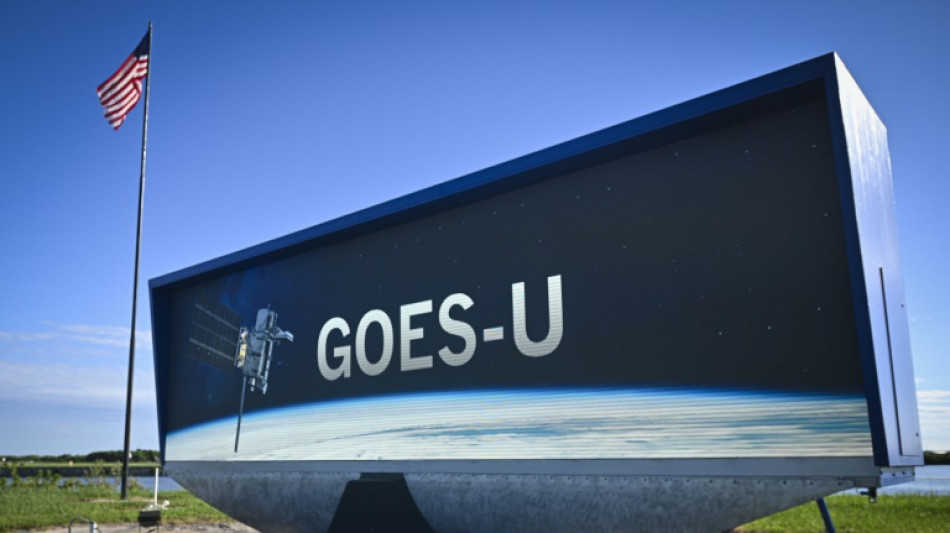
US launches satellite to better prepare for space weather / Photo: Miguel J. Rodriguez Carrillo - AFP

 In Manchester, people say City scandal is 'shame for football'

 Stocks lacklustre as inflation data weighs on sentiment

 Israel-bound plane rerouted, pilots wounded in reported fight

 Truth commission on Sweden's Sami people seeks redress

 Energy costs spark inflation surges in France, Italy

 South Korea break China hearts to reach Asian Games football final

 Eala storms into Asian Games semi-finals to thrill adoring fans

 Turkey freezes ex-minister's assets as fund crisis grows

 What we know about the North Korean POW dispute

 Most equities rise after oil price plunge, US data in focus

 Polar oceans transformed as warming melts ice habitats: research

 Lost shark becomes viral star in South Korea
 Dangote to launch $16bn refinery in Kenya

 North Korean leader 'extremely obese': Seoul spy agency

 Yankees and pope-backed White Sox start MLB playoffs with wins

 Malaysia's ex-PM Mahathir in hospital for observation

 'No limits': Marathon world record holder Sawe chasing history

 Countdown begins to biggest-ever Rugby World Cup

 Bangladesh women lose ground after quota reform

 Vietnam admits 'differing opinions' on Hanoi development

 Stocks temper gains as oil pares heavy losses, US data in focus

 New Zealand denies breaching climate commitments to EU

 Albert becomes youngest US scorer in 4-2 win over Chile

 Pirate island's plunging population shows Greece's demographic decline

 With elections ahead, Latvia's Russian-speakers reject Moscow's help

The United States on Tuesday launched a new satellite expected to significantly improve forecasts of solar flares and coronal mass ejections -- huge plasma bubbles that can crash into Earth, disrupting power grids and communications.
A SpaceX Falcon Heavy rocket carrying the satellite into orbit took off from NASA's Kennedy Space Center in Florida at 5:26 pm (2126 GMT), the US space agency announced.
The GOES-U (Geostationary Operational Environmental Satellite U) mission is a collaboration between NASA and the National Oceanic and Atmospheric Administration (NOAA).
It will be the fourth and final in a series of satellites that have tracked hurricanes and tornadoes, monitored climate and sea surface temperature, air quality and even meteor detections since 2016.
Orbiting 22,236 miles (35,785 kilometers) above the equator, the satellites match the speed of Earth's rotation in order to hold their positions over specific regions and provide continuous coverage.
They "are an indispensable tool for protecting the United States and the one billion people who live and work in the Americas," NOAA's Pam Sullivan told a press conference.
GOES-U is the first of the four to include a coronagraph, called the Compact Coronagraph-1 (CCOR-1). Coronagraphs block the Sun's disk and allow observation of its outermost layer, called the corona.
"That allows us to observe large explosions off the sun, called coronal mass ejections that can hurtle billions of tons of matter at millions of miles per hour towards Earth," said Elsayed Talaat, in charge of space weather observations at NOAA.
The ejections, known as CMEs, can disrupt Earth's magnetic field, causing satellites, energy infrastructure, and navigation systems to go down. Collecting space weather data allows authorities to issue warnings one to four days in advance.
In early May, the planet experienced its first level 5 geomagnetic storm in two decades, the highest rating on the scale, which unleashed spectacular auroras worldwide.
With the new coronagraph, the speed and direction of this event could have been better understood from the start, said Talaat.
Major disruptions weren't felt, but some farmers "reported being unable to plant their crops because the precision GPS relied upon by their equipment had malfunctioned," he said.
For the first time, the United States will have a coronagraph observing the solar corona almost continuously, with the CCOR-1 taking readings every 30 minutes.
Currently, such observations are received with a delay of up to eight hours. They are carried out by a satellite launched in 1995, which should cease operating within two years.
"Once operational CCOR-1 will mark a new chapter in space weather observations," said Talaat.
"Although the sun is no more active than in previous generations, our society has changed, and we are more sensitive than ever to the sun's changing mood."
M.King--AT