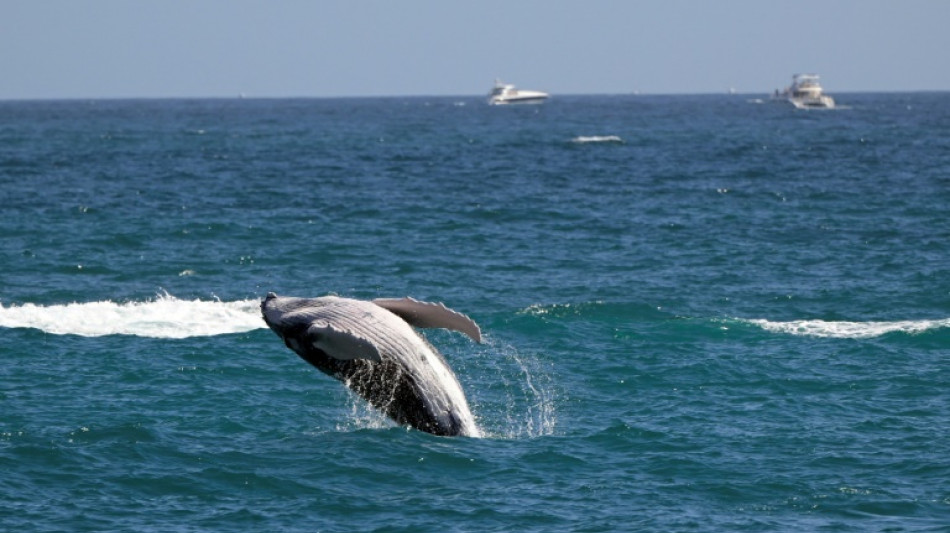
Gray whales shrinking fast as climate warms / Photo: ALFREDO ESTRELLA - AFP/File

 In Manchester, people say City scandal is 'shame for football'

 Stocks lacklustre as inflation data weighs on sentiment

 Israel-bound plane rerouted, pilots wounded in reported fight

 Truth commission on Sweden's Sami people seeks redress

 Energy costs spark inflation surges in France, Italy

 South Korea break China hearts to reach Asian Games football final

 Eala storms into Asian Games semi-finals to thrill adoring fans

 Turkey freezes ex-minister's assets as fund crisis grows

 What we know about the North Korean POW dispute

 Most equities rise after oil price plunge, US data in focus

 Polar oceans transformed as warming melts ice habitats: research

 Lost shark becomes viral star in South Korea
 Dangote to launch $16bn refinery in Kenya

 North Korean leader 'extremely obese': Seoul spy agency

 Yankees and pope-backed White Sox start MLB playoffs with wins

 Malaysia's ex-PM Mahathir in hospital for observation

 'No limits': Marathon world record holder Sawe chasing history

 Countdown begins to biggest-ever Rugby World Cup

 Bangladesh women lose ground after quota reform

 Vietnam admits 'differing opinions' on Hanoi development

 Stocks temper gains as oil pares heavy losses, US data in focus

 New Zealand denies breaching climate commitments to EU

 Albert becomes youngest US scorer in 4-2 win over Chile

 Pirate island's plunging population shows Greece's demographic decline

 With elections ahead, Latvia's Russian-speakers reject Moscow's help

Pacific coast gray whales have shrunk in length an astonishing 13 percent since 2000, adding to evidence that climate change and other human activities are making marine mammals smaller, a study says.
Their diminished size could have big impacts on survival rates and reproductive success -- and trigger ripple effects throughout their entire food webs.
For the paper, researchers focused on the Pacific Coast Feeding Group (PCFG) -- around 200 whales that are part of the wider Eastern North Pacific (ENP) population of around 14,500.
Considered "ecosystem sentinels," they stay closer to shore, feeding in shallower, warmer waters, than the wider population that inhabits colder, deeper Arctic seas. Prior research had shown they are in worse shape than their counterparts, with smaller bodies, heads and flukes.
"Now we know they have been shrinking in body size over the past 20-40 years, which may be an early warning sign that the population is at risk of declining," Kevin Bierlich, an assistant professor at Oregon State University and co-author of the paper in Global Change Biology, told AFP on Thursday.
By analyzing drone images taken from 2016-2022 of 130 individuals whose age was estimated or known, the scientists found a striking trend: a gray whale born in 2020 is likely to reach a full-grown adult length of approximately 1.65 meters (5ft 5in) less than a counterpart born in 2000.
This represents a significant 13 percent decrease in the total length of mature gray whales, which typically measure between 38-41 feet in length.
Notably, the decline was more pronounced in females, who historically exceeded males in size but are now comparable.
It would be the equivalent of seeing the average height of an American woman plummeting from 5ft 4in to 4ft 8in over two decades.
- Size matters -
"In general, size is critical for animals," said Enrico Pirotta, lead author on the study and a researcher at the University of St. Andrews in Scotland.
"It affects their behavior, their physiology, their life history, and it has cascading effects for the animals and for the community they're a part of."
Smaller whale calves may have lower survival rates when they stop weaning, while for adults, the major concern is reproductive success.
The species relies on energy reserves stored during the feeding season to support the demands of migration and reproduction during winter -- and the question arises whether they are able to put enough energy towards reproduction and keeping the population growing.
Importantly, the study found the trend was correlated with changes to the balance of "upwelling" and "relaxation" cycles of the ocean.
Upwelling transports nutrients from deeper waters to shallower areas. During relaxation periods, these nutrients remain in the shallower zones, where light enables plankton and other small species that whales feed on to grow.
Climate change is known to be an important factor affecting the dynamics of this delicate balance, through changes in wind patterns and water temperature.
A smaller stature may not only hinder whales' ability to thrive, but also increase their vulnerability to threats such as collisions with boats and entanglement in fishing gear, which can be deadly.
O.Brown--AT